Sterlite Tech: The tenants moved in. Now the landlord wants four times the rent
Pranav Yadav · · 9 min read
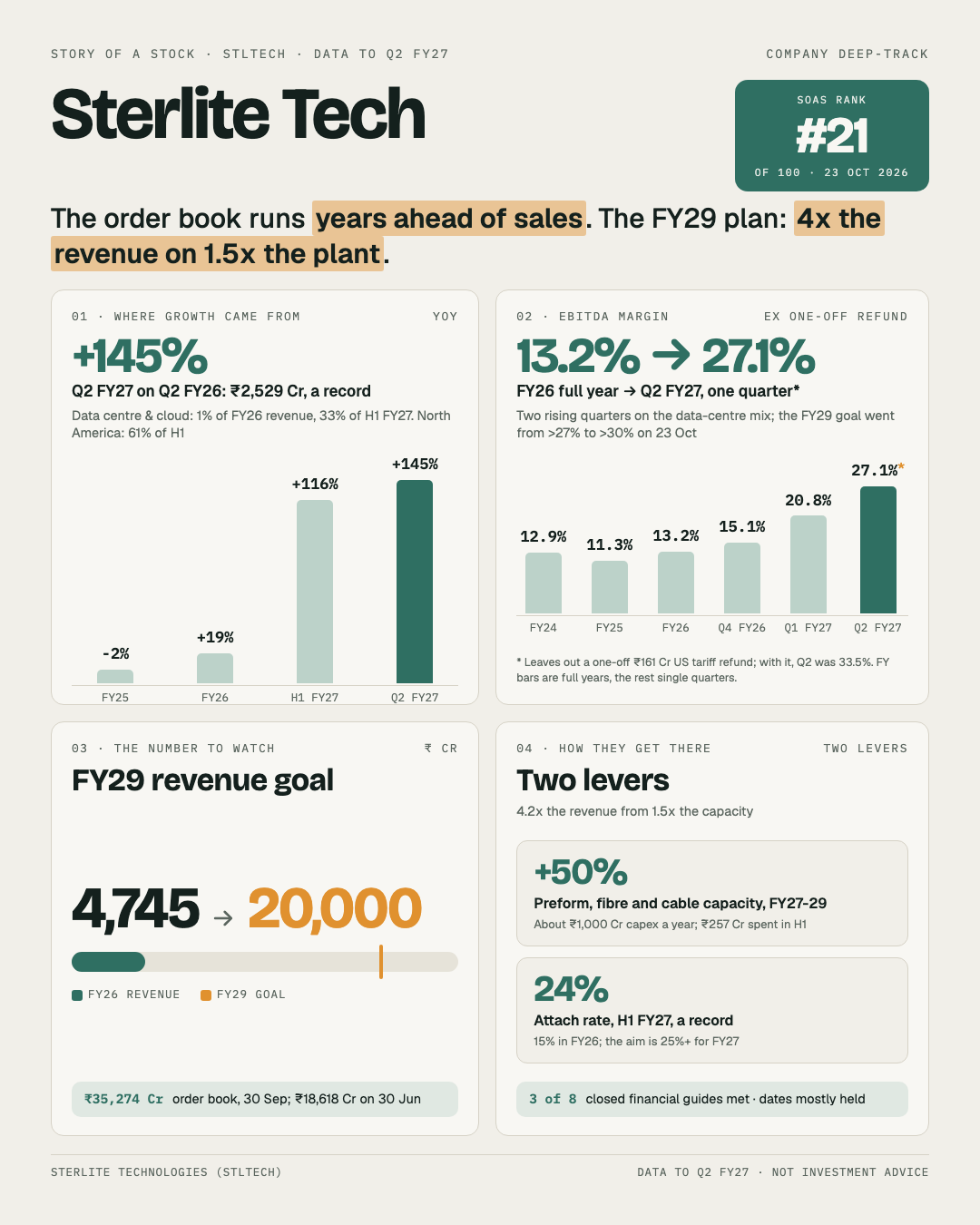
That's the Sterlite Tech story on one page. Below is the same story in words, from three years of calls and decks, the September investor meet, two annual reports and seven broker notes. The Q2 call text is a third-party transcript.
When I last wrote about Sterlite Tech, on 21 September, one tenant had signed most of the lease: a hyperscaler award had lifted the order book to ₹18,618 Cr, and the rent would start only when the tenant moved in. The comparison with HFCL a day later said the same of both companies: the demand is real, the conversion unproven.
The tenant has moved in. Q2 FY27 revenue was a record ₹2,529 Cr, and the margin, before a one-off tariff refund, reached 27.1%. A second hyperscaler has signed, and the order book has nearly doubled to ₹35,274 Cr.
So the landlord has drawn up a bigger plan: about four times FY26's rent by FY29, from a building only half again as big. That puts the weight on the rent per square foot, the one number Sterlite Tech does not post.
Where this lives on the portal: the Sterlite Tech company page.
1. What Sterlite Tech makes
Glass at one end, a plug at the other
STL makes the whole optical chain. It turns silica into glass preforms, draws them into fibre, bundles the fibre into cable, and fits it with connectors and pre-terminated assemblies that a data centre can plug straight in. It sells to telecom operators, broadband programmes, data centres and large enterprises in more than 100 countries, and holds 9% of the optical fibre cable market outside China. Optical Networking was 96% of segment revenue in H1 FY27; STL Digital, a small IT-services arm, was the rest.
The plug earns more than the cable
Cable is sold by the kilometre, mostly in competitive bids. The connectivity sold on top is the richer part. STL tracks it as an attach rate, connectivity revenue per rupee of cable revenue: 22% in FY25, 15% in FY26 and a record 24% in H1 FY27. Management says data-centre work earns better margins than telecom, but gives no figure.
2. How it got here
A US plant, a demerger and a share sale
STL opened its South Carolina cable plant in 2023. It demerged its Global Services business into STL Networks on 31 March 2025, and every figure here is for the continuing business. In July 2026 it raised ₹1,500 Cr in a QIP at ₹583.01 a share, and ₹1,103.77 Cr of it has repaid debt.
Two tenants in two quarters
With its Q1 FY27 results STL disclosed a US$1.11 bn (about ₹10,500 Cr) product award letter from a hyperscaler for FY27 to FY29. With Q2 came a US$1.2 bn (about ₹11,500 Cr) five-year agreement with a second hyperscaler, which management on the results call described as a potential value. Both are agreements to supply, not revenue earned.
3. How the numbers have moved
Years of cable, little to show for it
Revenue was ₹4,083 Cr in FY24, ₹3,996 Cr in FY25 and ₹4,745 Cr in FY26, at EBITDA margins of 12.9%, 11.3% and 13.2%. North American buyers stopped ordering while they worked through stock, and the plants ran at 40-50% at the end of FY25, the last utilisation figure STL published. The company lost money in FY24 and FY25 and earned ₹56 Cr in FY26.
Returns followed the plants, and interest took the rest
Return on capital was 8%, 11%, 3%, 3% and 8% from FY22 to FY26, at or below a broker's 9.8-11.2% estimate of the cost of capital. Plant costs are fixed, so each fall in volume went straight to returns, and in FY26 interest of ₹224 Cr took most of what was left after depreciation.
Why nothing protects those returns
Our moat call is no moat. Contracts are won in bids, the annual report says there are few barriers to capacity expansion, and STL's share outside China fell to 6% in the downturn before recovering to 9%. The Q2 deck says AI-led demand "continues to outpace fibre and preform availability". That is a tight market, not a lock.
A legal case still open
Prysmian sued STL's US subsidiary alleging that an employee breached non-compete and confidentiality agreements, and a $101.25 mn jury award is under appeal with a $41.53 mn bond posted. Counting it, contingent liabilities are 52.3% of equity. The audit opinion is unqualified.
4. The last few quarters
The tenant moved in
Q2 FY27 revenue was ₹2,529 Cr, a record, about 145% above a year earlier. H1 revenue of ₹4,439 Cr nearly matched all of FY26, and Q2 beat the ₹2,228 Cr its schedule had set by ₹301 Cr. Data-centre and cloud customers were 33% of H1 revenue, against 1% in FY26, and North America was 61%, against 39%.
A clean margin step, with one refund set aside
EBITDA margin before a one-off ₹161 Cr US tariff refund went from 15.1% in Q4 FY26 to 20.8% in Q1 and 27.1% in Q2. With the refund, reported margin was 33.5% and profit after tax ₹517 Cr. Two rising quarters, both on a growing data-centre share, make the step more credible than one.
The lease book nearly doubled
The open order book went from ₹18,618 Cr at 30 June to ₹35,274 Cr at 30 September, about 14 quarters of Q2's revenue by our arithmetic, with ₹3,021 Cr scheduled for Q3 FY27. If both hyperscaler agreements sit fully in the book, which STL has not said, they are about 62% of it. Two tenants now hold most of the lease.
5. Where growth comes from next
Four times the rent from half again the space
On 3 September, at an investor meet, STL set out Lakshya: ₹20,000 Cr of revenue in FY29, about 4.2 times FY26 or about 62% a year, at an EBITDA margin above 30%. It doubles July's capex plan to about ₹1,000 Cr a year from FY27 to FY29, adding 50% to preform, fibre and cable capacity and building a new plant for pre-terminated connectivity whose size it has not given. H1 capex was ₹257 Cr.
The rent per square foot is the undisclosed number
Four times the revenue from 1.5 times the core capacity needs roughly 2.8 times the revenue per unit of plant, by our arithmetic. That has to come from mix, price and fuller plants, and STL discloses none of the three directly. In Q1 management said it had to "pick and choose the orders basis the capacity availability". On the results call it restated its aim of 50% of FY27 revenue from data centres, now counting data centre alone rather than with enterprise; at 33% for H1, that needs about 65% in the second half.
Our cases are model work, at flat margins
STL gives no FY27 or FY28 revenue figure, so our cases are model work. The base case has revenue up 120-130% in FY27 and 30-40% in FY28. The bear case is 90-105% and 5-15% as capacity binds, the bull case 130-145% and 40-50%. We hold margins flat in our cases.
Capex runs ahead of the free cash
Working capital absorbed ₹441 Cr in H1. Net cash was ₹703 Cr at 30 September, but about ₹396 Cr of it is restricted for the Prysmian appeal, leaving about ₹307 Cr against ₹1,000 Cr of capex a year.
6. What management promised, and what it delivered
Financial delivery is poor and timing reliable. Of eight closed financial guides, STL met three: the FY25 attach-rate jump, STL Digital's break-even, three quarters late, and FY24's revenue decline, itself a cut from a 7-9% growth guide. Its dates mostly held, with 10 slips across 5 of 22 dated commitments.
The miss that mattered was FY26's margin. Set at 20% or more for FY26 on the Q4 FY25 call, it was widened to 18-20% and de-dated a quarter later, and FY26 closed at 13.2%, about 680 basis points short. Capex ran over its guide three years running, by 8% in FY24, just over the cap in FY25 and 68% in FY26, when ₹193 Cr went out against about ₹115 Cr. Small sums then; at ₹1,000 Cr a year they will not be.
What it kept is recent. The 20% margin set for the end of FY27 arrived in Q1 and was raised to 23%, and Q2 printed 27.1%. The FY29 margin goal moved from above 27% to above 30% seven weeks after it was set.
These counts differ from the 21 September post's 2 of 8 and 17 slips: the record now starts at Q2 FY24, which drops the original FY24 growth guide, and slips are counted on a stricter rule.
7. What the price already assumes
At ₹827 on 23 October, a market value of ₹42,460 Cr, the price implies about 38% a year of revenue growth over the next couple of years, with margins held flat. Our cases, restated from the last twelve months (₹7,137 Cr of revenue, 1.5 times FY26), give about 28% in the bear case, 59% in the base case and 74% in the bull case. The price sits between the bear and the base.
On 21 September the same exercise gave about 70%, measured on EBITDA against a base case of 82-95%. The price has barely moved. The yardstick has: the trailing year now carries two hyperscaler quarters and the refund, and the cases are revenue at flat margins. EV to EBITDA is 27 times against a five-year median of 13, and trailing profit includes the refund.
What would make me wrong
- The rent per square foot is real. If the margin holds near 27% through H2, mix is doing the work and capacity matters less than I make it.
- The book converts faster. Q2 beat its schedule. Two more quarters like it would make the bear case look stale.
- The record is old. The misses came from a business with half-empty plants. FY27, so far, is running ahead of its guides.
The opposite error would be to read a tight market as a moat. Contracts are won in bids, and if fibre supply loosens, price is the first thing to give.
The full read is on the Sterlite Tech company page.
The tenants are in and paying. The landlord now needs four times the rent from a building half again as big, and the rent per square foot, like the occupancy, is still not on the sign.
This is a summary of what Sterlite Tech's filings, earnings calls, annual reports and broker notes say. It is not investment advice or research.