Sterlite Technologies: It and HFCL wired India's internet and earned nothing. Now both are bidding for its AI
Pranav Yadav · · 8 min read
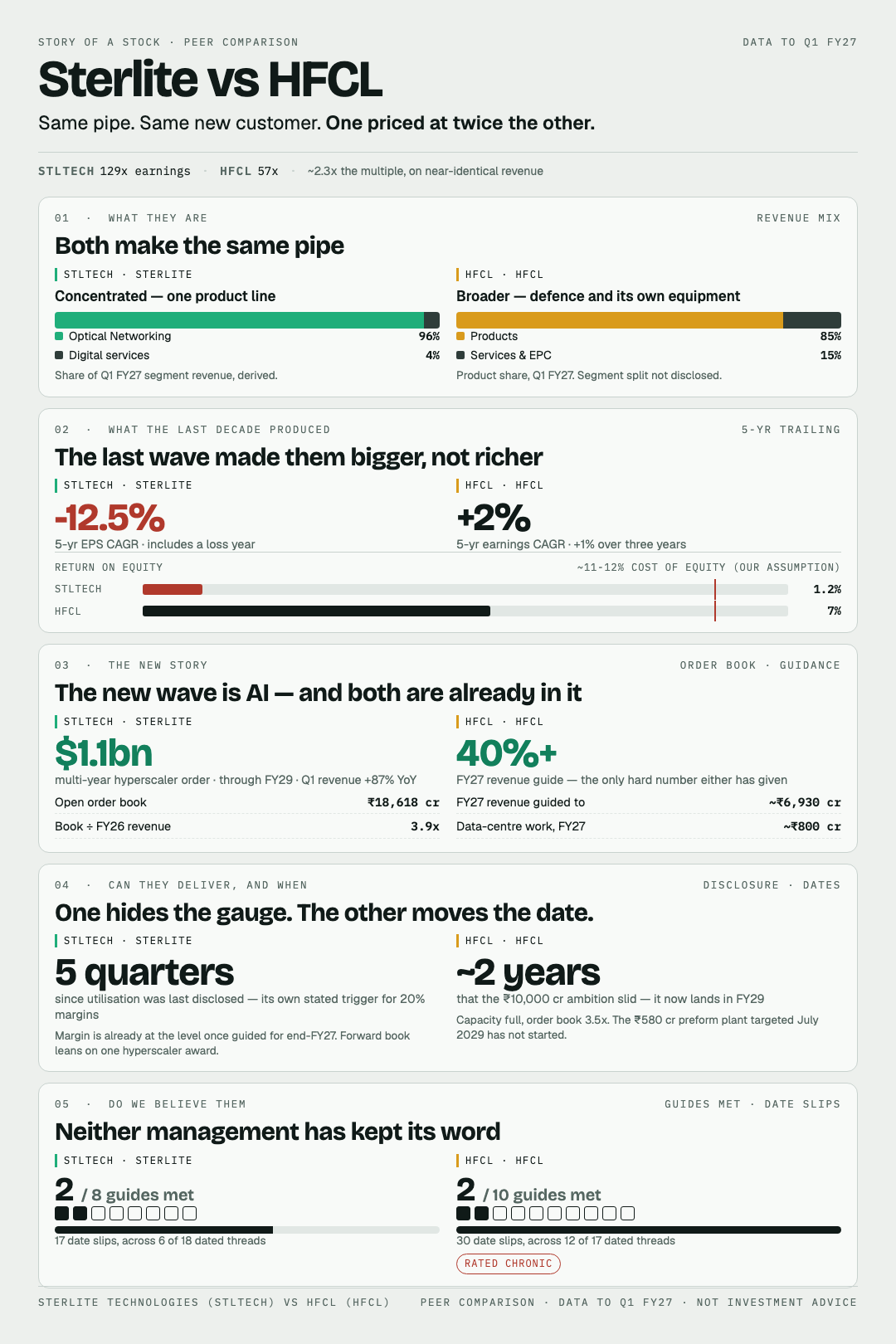
Both companies on one page. Below is the same thing in words, built from every transcript and deck each has published.
Someone had to lay the cable that carries India's internet.
Two listed companies did most of it. Sterlite Technologies and HFCL.
They spent a decade on it, and neither came out richer than it went in.
Now a second wave has arrived. The cable that AI data centres need is the same cable, in far larger quantities, for customers who pay better.
Both companies are pointed straight at it. Neither has proved it can convert it.
The central takeaway
The question is not which of these two is the better company. They make the same product, they did about the same revenue last year, and they are chasing the same customer.
The question is what you are paying for a promise neither has ever kept.
One of them is priced at more than twice the other.
At a glance
- Nearly the same size. Sterlite did ₹4,745 Cr of revenue in FY26; HFCL did ₹4,949 Cr.
- Very different price. Sterlite is worth ₹41,554 Cr on ₹236 Cr of trailing profit — 129 times. HFCL is worth ₹33,017 Cr on ₹572 Cr — 57 times.
- Neither has compounded. Earnings CAGR over five years: Sterlite 0%, HFCL 2%. Over three: −12% and 1%.
- Both prices assume that changes. Sterlite's needs about 70% a year; HFCL's about 39%.
- The new customer is real. Sterlite has a $1.1 billion multi-year hyperscaler order through FY29. HFCL guides about ₹800 Cr from data-centre connectivity in FY27.
- Both records are poor. Sterlite has met 2 of 8 closed financial guides; HFCL 2 of 10.
- Neither moat has been tested through a downturn.
1. Both companies make the same pipe
Strip away the labels and these are two optical-fibre businesses.
They draw glass fibre, they turn it into cable, and they ship it to whoever is building a network.
Sterlite calls itself India's number one end-to-end optical manufacturer, with 9% of the optical-fibre-cable market outside China. It also runs a smaller digital services arm.
HFCL makes the same fibre and cable, and adds two things Sterlite does not: telecom equipment it designs itself — Wi-Fi, routers, switches — and defence electronics, including fuzes, radars and thermal sights. It also takes on installation contracts.
So HFCL is the broader of the two and Sterlite the more concentrated. On the core product, they are the same business.
2. The last wave made them bigger, not richer
This is the part that gets skipped, and it is the part that matters most.
India spent a decade laying fibre — the telecom rollouts, the national broadband programme. Both companies grew into it.
Look at what it produced.
Sterlite's earnings are lower today than five years ago: a five-year EPS CAGR of −12.5%, including a loss year. Its return on equity last year was 1.2%.
HFCL's earnings grew about 2% a year over five, and 1% over three. Its return on equity was 7%.
Neither figure is a disaster. Both are what happens when you supply a commodity product to a customer holding all the bargaining power. Volumes came. Margins did not.
Sterlite has since separated its Global Services arm, demerged in March 2025, so its recent numbers are the continuing business only.
Ten years of work, and the earnings line barely moved at either company.
3. The new wave is AI, and both are already in it
Now the demand has changed shape.
An AI data centre needs enormous quantities of high-fibre-count cable, and it needs it faster than a telecom rollout ever did. The customers are hyperscalers, not price-squeezing telcos.
Both companies are winning this work. It is not a hope.
Sterlite has a landmark multi-year order worth $1.1 billion from a global hyperscaler, supplying optical connectivity for AI data centres through FY29, plus several separate $100 million orders. Its open order book is ₹18,618 Cr. Q1 FY27 revenue was ₹1,910 Cr, up 87% year on year, and operating margin reached 20.8% against 13.2% for the whole of FY26.
HFCL guides FY27 revenue growth above 40% — roughly ₹6,930 Cr against ₹4,949 Cr — with operating margin above 20%, already 23.25% in Q1. It expects about ₹800 Cr from data-centre connectivity this year, from capacity it is expanding fivefold, and it approved ₹820 Cr of new fibre, cable and preform capacity in September.
Both stories are the same story. The difference is what each company will commit to in public, which is Section 5.
4. One has the margin and no volume proof. The other has the volume and a date that keeps moving
This is where the two separate.
Sterlite's margin has already arrived. It is running at the level management once guided for the end of FY27. What cannot be checked is what it scales to, because utilisation — management's own stated trigger for 20% margins — has not been disclosed for five quarters. And the forward book leans heavily on that single hyperscaler award.
So the margin is real, and how much volume it survives is not something an outsider can verify.
HFCL's volume has already arrived. Capacity is full, the order book has expanded 3.5x, exports are 56% of revenue and products 85%. Capacity goes to 34 million fkm of fibre and 43 million fkm of cable by December 2026.
What keeps moving is the calendar. The ₹10,000 Cr revenue ambition now lands in FY29, about two years later than first framed. The ₹580 Cr preform plant is targeted for July 2029 and has not started. The ₹3,000 Cr defence goal leans partly on an aerospace acquisition that is announced but not closed.
One company will not tell you the size of the prize. The other tells you, then tells you it arrives later than it said.
5. Neither management has kept its word
Here is the conclusion, and it applies to both.
Sterlite has met 2 of its 8 closed financial guides — 25%. Across 18 dated commitments it has slipped 17 times, concentrated in 6 threads. Its own 20% margin goal moved from FY26 to FY27.
HFCL has met 2 of its 10 — 20%. Across 17 dated commitments it has slipped 30 times, spread across 12 of them. That is 1.76 slips per dated thread, and our read labels it chronic. It has also walked back its headline ambition once.
Both are rated low trust. Both guide in directions rather than numbers.
Set that against what the prices assume. Sterlite's price needs about 70% a year; it has delivered 0% over five years. HFCL's needs about 39%; it has delivered 2%.
Neither price is paying for a continuation of the record. Both are paying for a break from it — from managements whose stated dates have moved, repeatedly, in public.
That is the whole comparison. The new demand is real and both are winning it. What neither has yet shown is that it converts into earnings, on the schedule either one has promised.
What would make me wrong
On Sterlite:
- The $1.1 billion order is contracted work, not a hope, and it runs through FY29.
- The margin is already delivered, not guided — 20.8% in Q1 against 13.2% for FY26.
- Its earnings base is genuinely depressed, so 129 times is flattered by a low denominator rather than a rich price alone.
On HFCL:
- It commits to a number in public, which is more than its peer does, and a company that refuses to guide cannot be caught missing.
- Margin is running ahead of the guide, at 23.25% against a floor of 23%.
- The breadth is real — defence and self-designed equipment are not fibre, and they do not price like fibre.
And on both: a decade of flat earnings is exactly what you would expect before a mix shift, not proof that one cannot happen.
The one question that matters
Operating margin, held for a full year.
Both companies have now printed a quarter above 20% — Sterlite 20.8%, HFCL 23.25%. Both spent the last decade nearer 13%.
Everything in Section 3 depends on that being the new level rather than a good quarter in a strong order cycle.
Four consecutive quarters above 20% at either company would settle more than any order announcement.
What I'll be watching
- Does Sterlite disclose utilisation again, after five quarters of not doing so?
- Does HFCL's FY27 revenue track toward ₹6,930 Cr, the first hard number either has committed to?
- Does the July 2029 preform plant start, or slip like the ₹10,000 Cr date did?
Final assessment
Two companies, one product, one new customer, and two prices that differ by more than anything I can find in the businesses.
Both have laid this pipe before. Neither made money doing it.
The full reads are on the Sterlite Technologies page and the HFCL page.
The demand is finally worth having. The question is whether either company has learned to keep any of it.
This is a summary of what these companies' filings say. It is not investment advice or research.