Shree Refrigerations: Four crates went out for every one that came aboard
Pranav Yadav · · 9 min read
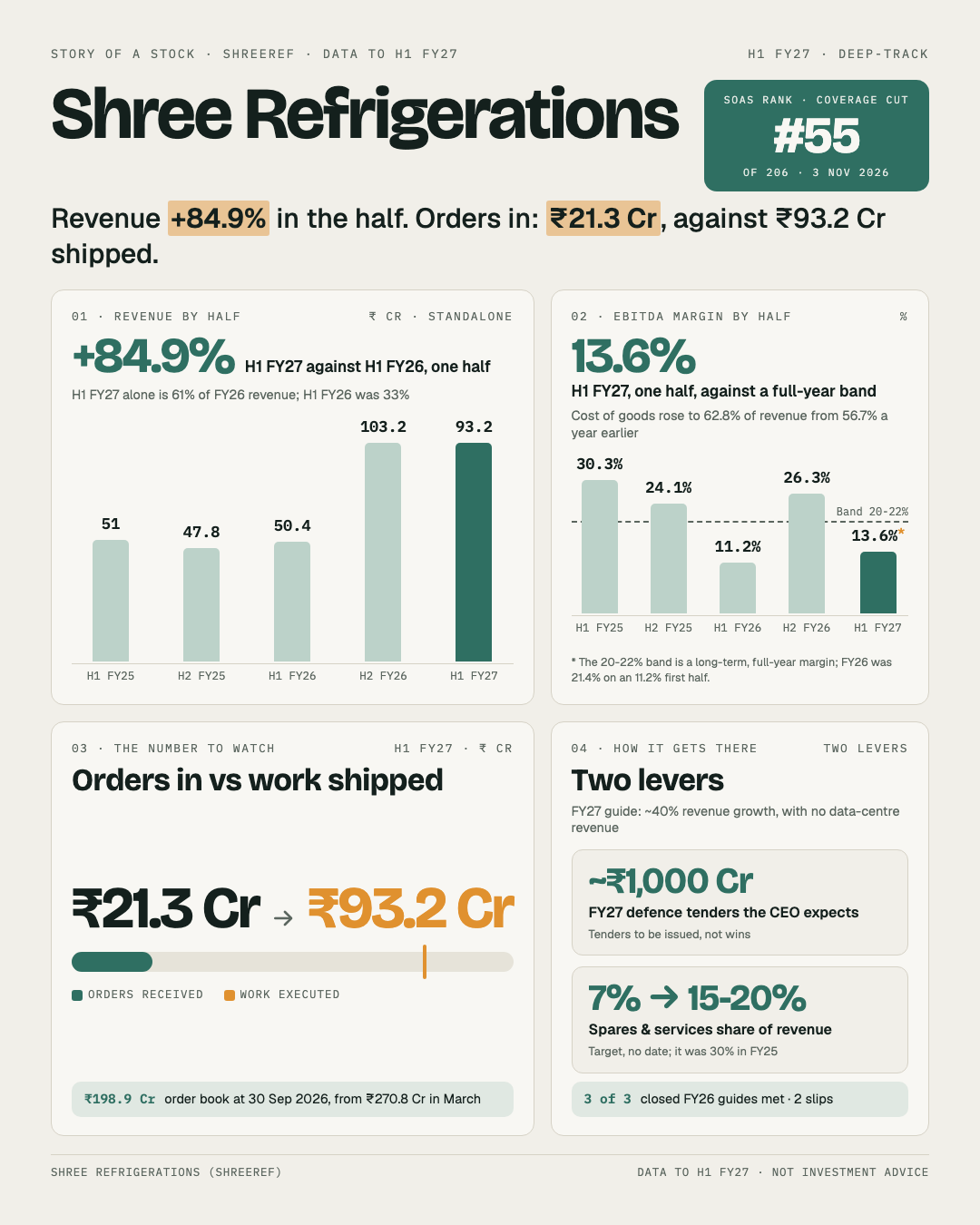
That's the H1 FY27 story on one page. Below is the same thing in words, built from the half-year results and investor deck the company filed on 28 and 30 October, both annual reports, and the earlier calls and decks.
In September I wrote that Shree Refrigerations had eaten into the stores to deliver FY26, and that the resupply hadn't docked. I ended on one question: what would the order book be at the end of September 2026? If it was at or above March's ₹270.8 Cr, new orders were landing. If it kept falling, the ship was running on stores.
It kept falling, to ₹198.9 Cr. In the six months to September the company shipped ₹93.2 Cr of work and took aboard ₹21.3 Cr of new orders. That is more than four crates out of the hold for every one that came in.
The ship also sailed faster than ever. Revenue for the half rose 84.9%. Both things are true at once, and the rest of this post is about why they cannot stay true together for long.
Where this lives on the portal: the Shree Refrigerations company page.
1. What it makes
Cooling plants for warships, sold by tender
Shree Refrigerations builds air conditioning plants, refrigeration plants, ship HVAC systems and their control panels for the Indian Navy and the shipyards that build its ships. It is the only Indian company registered with all three naval directorates that approve this equipment: marine engineering for the plants, naval architecture for HVAC, and electrical engineering for the panels.
Its customers are few and large. In CARE Ratings' rationale, filed by the company in September, about 69% of FY26 operating income came from its top 3 customers. Sales are domestic: exports were nil in FY26.
Equipment pays the bills; spares paid the margin
Equipment and turnkey projects were 93% of FY26 revenue. Spares and services were 7%, down from 30% in FY25, and management blames that shrinking share for EBITDA margin falling from 27.3% to 21.4%. Spares are the high-margin work that follows a ship through its life, and management wants them back at 15-20% of revenue.
2. How it got here
From milk chillers to naval HVAC
The company started in 1990 as a partnership in rented premises, making condensing units for milk cooling. It won its first naval orders in 2012, and management describes the climb from new entrant to market leader in naval HVAC as taking about seven years. Its first turnkey HVAC order came in 2023; HVAC is now 64% of the order book.
It listed on the BSE SME board on 1 August 2025 at ₹125 a share, in an issue oversubscribed about 187 times.
A second plant, opened in June
Unit 2, a 50,000 sq ft greenfield at Hanbarwadi in Satara district, began commercial operations on 20 June 2026 and can be expanded to about 1,00,000 sq ft. Its cost was capitalised by 30 September. The company also signed a data-centre chiller deal with Smardt in September 2025, became Danfoss Turbocor's service partner in March 2026, and set up a second subsidiary, Aquilon, in October 2026 for industrial sub-zero chillers.
3. How the numbers have moved
Revenue more than tripled in four years
Revenue went from ₹45 Cr in FY22 to ₹154 Cr in FY26. It came in spurts, the way a project business grows: FY26 alone added 55.5%.
Returns fell as two equity raises landed
ROCE was 25% in FY24, 18% in FY25 and 14% in FY26. The annual reports blame new equity: a private placement in FY25 and the IPO in FY26 grew the capital base far faster than profit. Net profit outgrew revenue in FY26 only because the tax rate more than halved, to 14% from 32%, which no FY26 document explains.
Cash has rarely kept up
Operating cash flow was negative in FY23, FY24 and FY25, by ₹25 Cr in the last of them, then positive at ₹14 Cr in FY26. In H1 FY27 it was -₹42.5 Cr. Receivables and inventory both rose by more than ₹23 Cr, and cash fell from ₹57.5 Cr to ₹6.8 Cr. In CARE's view the cycle is long because naval work passes multiple inspection stages and is invoiced only on installation.
Why we no longer see a moat
In September our moat call was narrow and weak, resting on those three registrations. On a fuller read of the company's own words it is now no moat. The registrations keep newcomers out, but every newbuild is tendered and some are lost, and the company itself took the lead from a near-duopoly of large firms in seven years. What the company did to the incumbents, a rival can do to it.
4. The last half
Revenue nearly matched the record half
H1 FY27 revenue was ₹93.2 Cr, up 84.9% on a year earlier and 9.7% below H2 FY26's record ₹103.2 Cr. The first half alone is already 61% of FY26 revenue. A year ago the first half was 33%.
The margin did not follow
EBITDA margin was 13.6%, up from 11.2% a year earlier but far below H2 FY26's 26.3%. Cost of goods rose to 62.8% of revenue from 56.7%, and the deck points to commodity inflation. Most contracts are fixed price, so a cost spike lands on the company, not the Navy.
Four crates out for every one in
The company received ₹21.3 Cr of orders in the half and executed ₹93.2 Cr. The book fell from ₹270.8 Cr in March to ₹198.9 Cr, which is 1.3 times FY26 revenue. Over the twelve months to September, ₹67.6 Cr came in against ₹196.4 Cr shipped.
After the half, on 8 October, the Navy placed a ₹7.86 Cr order for two magnetic-bearing chiller plants, for delivery by October 2027. It is a sign that wins still come; it is not yet a resupply.
5. Where growth comes from next
FY27 is mostly in the hold already
Management guides about 40% revenue growth for FY27, with no data-centre revenue in it. On FY26's ₹153.5 Cr that is about ₹215 Cr, so the second half needs about ₹122 Cr, against ₹103.2 Cr in H2 FY26. The ₹198.9 Cr book covers that on paper, but it means shipping about 61% of the book in one half.
FY28 rests on orders not yet won
Another 40% in FY28 is about ₹300 Cr of revenue. If H2 ships ₹122 Cr, about ₹77 Cr of today's book is left for FY28, so roughly ₹224 Cr has to come from orders the company does not yet hold. The CEO said in May he expects about ₹1,000 Cr of defence tenders to be floated in FY27, and management claims a 64% share of naval HVAC. Those are tenders to be issued, not orders won.
What growth will cost
Growth here costs working capital. Short-term borrowing rose from ₹33.6 Cr to ₹42.0 Cr in the half, and management has said new working capital will be funded from internal accruals and bank debt. The cheaper lever is spares: back at 15-20% of revenue, they would lift margin without a bigger hold.
The cases
Our base case has revenue growing 36-42% a year and earnings 31-44%, with EBITDA margin in the 20-22% band. The bull case is 43-50% revenue growth; the bear case is 20-29%. Data-centre revenue starts in FY28 at the earliest.
6. What management promised, and what it delivered
FY26 closed all three of its financial guides: revenue of ₹153.6 Cr against ₹140-150 Cr, EBITDA margin of 21.4% against 20-22%, and PAT margin of 13.9% against 13-14%. Three is still below the four our scorer needs, so its credibility verdict stays not assessable, not good or bad.
Timing has slipped twice across 14 dated promises. The Hanbarwadi plant was first promised for March 2026 and opened on 20 June, about three months after its first date. Data-centre revenue was first expected to trickle in during FY26 and is now FY28, two years after its first date.
This half the company restated its long-term EBITDA band at 20-22%, after the May call had widened it to 20-24%, and repeated the ~40% growth guide on the FY26 base. The FY31 ambition of ₹1,000 Cr revenue and ₹120 Cr PAT still stands beside a 40% path that reaches about ₹833 Cr, and the two have not been reconciled.
7. What the price already assumes
At ₹308 a share, a market value of about ₹1,103 Cr, the price implies about 29.7% earnings growth a year over the next couple of years. That sits between our bear case and our base case, restated from trailing earnings at about 8.9% and 34.8%. In September, at ₹384, the price implied about 41.3%, right on our base case. The price has fallen about 20% since, while trailing earnings rose.
One caveat cuts the other way. The model assumes every rupee of profit becomes cash, and this company's record has not done that.
What would make me wrong
- FY27 is covered. The ₹198.9 Cr book is larger than the ₹122 Cr H2 needs, and H2 has been the strong half: 26.3% margin in H2 FY26.
- The tender wave is large. About ₹1,000 Cr of defence tenders is five times today's book, and the October order shows wins still arrive.
- The moat call may be too harsh. It is still the only firm holding all three registrations, and management claims 64% of the segment.
- Spares could come back. A return to 15-20% of revenue would lift margin and cash at once.
If I'm wrong in the other direction, it will be because H2 needs more than half the hold in six months while nothing new has come aboard.
The full read, with every guidance thread and the sources behind it, is on the Shree Refrigerations page.
A fast voyage on a lighter hold is still a good voyage, until the hold runs out. The next resupply decides how far this ship goes.
This is a summary of what Shree Refrigerations' filings, investor presentations and earnings calls say. It is not investment advice or research.