Shree Refrigerations: It ate into the stores to deliver FY26. The resupply hasn't docked yet
Pranav Yadav · · 7 min read
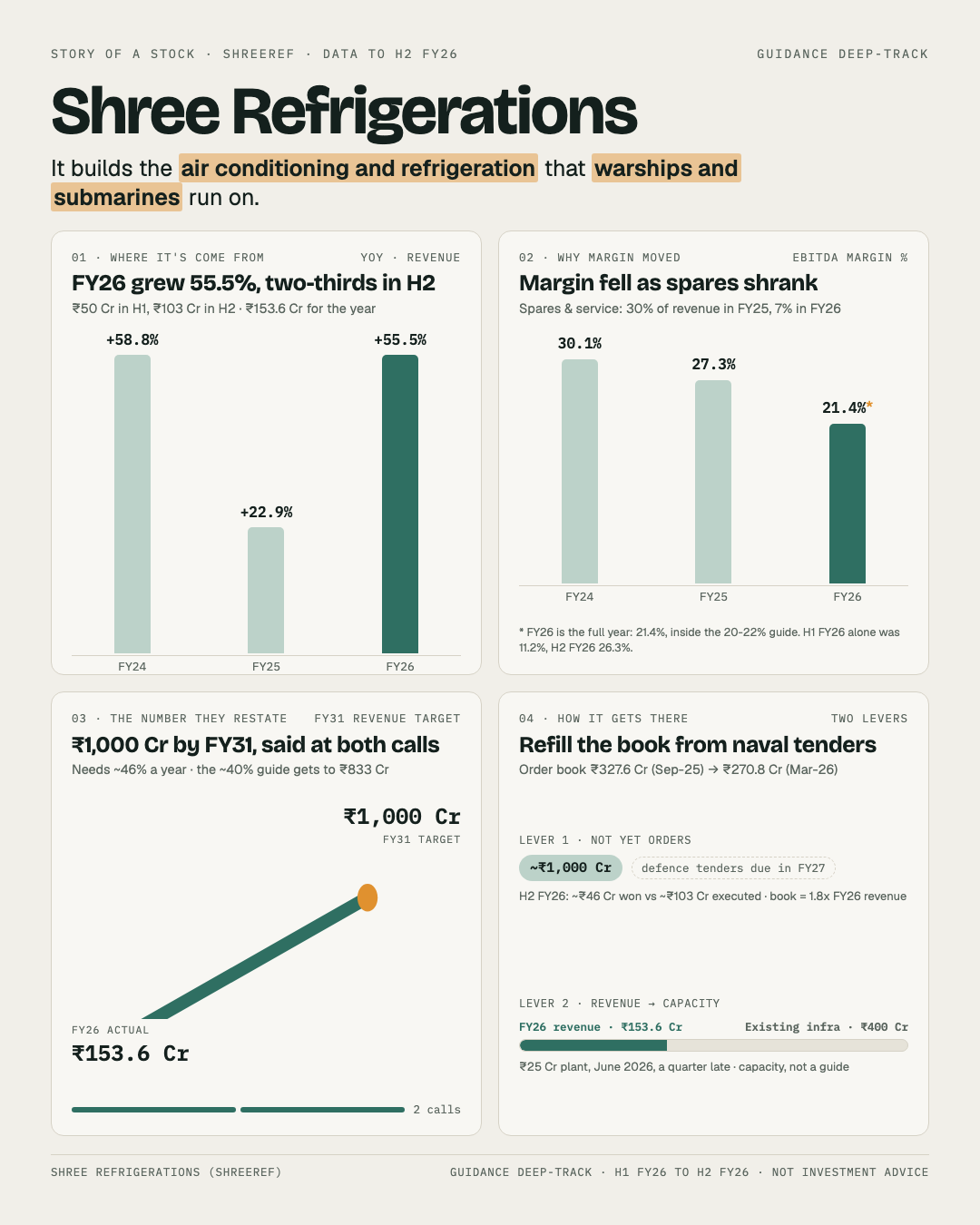
That's the Shree Refrigerations story on one page. Below is the same thing in words, built from both earnings calls and all three investor decks the company has published since it listed, H1 FY26 to H2 FY26.
A warship leaves port with its cold stores full. The voyage runs on what is in the hold, and the next resupply decides how far it can go.
Shree Refrigerations builds the air conditioning and refrigeration plants that warships and submarines run on. It is the only Indian company registered with all three naval directorates that approve this kind of equipment. Its order book is its hold: work already won, meant to be executed over two to three years.
FY26 was its largest year in the five we have numbers for. Revenue rose 55.5% to ₹153.6 Cr. It also drew down the hold faster than it restocked it.
The central takeaway
Management guided three numbers for FY26 and landed all three. The debate is no longer whether it can execute the orders it holds. It is whether new naval orders arrive fast enough to replace the ones it just used up.
The record is too short to lean on. Three closed guides, all met, is a good start, not a track record, and our scorer calls credibility not yet assessable for exactly that reason.
At a glance
- FY26 guides: revenue ₹153.6 Cr against ₹140-150 Cr, EBITDA margin 21.4% against 20-22%, PAT margin 13.9% against 13-14%. All 3 of 3 met.
- The half-year split: about ₹50 Cr of revenue in H1 at an 11.2% EBITDA margin, then ₹103 Cr in H2 at 26.3%.
- The hold: order book ₹327.6 Cr in September 2025, ₹270.8 Cr in March 2026, now 1.8x FY26 revenue.
- The guide now: about 40% revenue growth a year for three to five years on the FY26 base, cut from 40-50%. Long-term EBITDA margin 20-24%.
- The lock: a narrow moat, rated weak. Standalone ROCE went 29%, 17%, 12% across FY24-26.
- What the price assumes: about 41% earnings growth a year, on our base case.
Where this lives on the portal: the Shree Refrigerations guidance page.
1. It met all three FY26 guides, but three is too few to call a record
In November 2025, at the half-year, management guided FY26 revenue of ₹140-150 Cr with H1 at only about ₹50 Cr. That meant a second half twice the size of the first. It delivered ₹153.6 Cr, 2.4% above the top of the range. The margins landed inside their bands too.
The back-loading was flagged in advance and happened as described. Timing held too: 2 slips across 16 dated commitments, which our scorer rates reliable.
But the company listed on the BSE SME board in 2025, and this window holds two calls. Three closed financial guides is below the four our scorer needs before it will call a record in either direction. I read FY26 as a promise kept, not proof of a habit.
2. The order book fell ₹57 Cr in six months because execution ran ahead of wins
This is where the stores ran down. In H2 FY26 the company executed about ₹103 Cr of work and won about ₹46 Cr of new orders. The book fell from ₹327.6 Cr to ₹270.8 Cr.
Neither call discussed why. The arithmetic comes from the company's own order-book tables, and it points one way. At the 40% guide, FY27 needs about ₹215 Cr of revenue. The ₹270.8 Cr book covers that on paper, but it is meant to run two to three years, so FY27 orders have to land early in the year to keep the voyage going.
Growth came in spurts before this too: 58.8% in FY24, 22.9% in FY25, 55.5% in FY26. A project business that lumpy lives on its inflow, and the inflow slowed in the half that mattered most.
3. The lock is three naval registrations, and returns haven't shown it yet
The moat case is real but narrow. Getting approved took the company about five years, and it is the only vendor holding all three registrations as shipyards shift to single-vendor turnkey orders. Management says it holds 64% of naval HVAC&R, up from "upwards of 50%" in November. That share figure is management's own.
What the returns show is weaker. Standalone ROCE fell from 29% to 17% to 12% over FY24-26 as IPO money arrived, and free cash flow was negative every year from FY23 to FY26. EBITDA margin fell from 30.1% to 21.4% as spares and service, the high-margin part of the business, shrank from 30% of revenue to 7%.
So the lock keeps rivals out of the tender room. It hasn't yet shown up as pricing power, which is why we rate it weak.
4. Refilling the hold from FY27 naval tenders is the whole plan
The strategy fits in one line: win the naval tender wave to refill a thinning order book. The CEO expects about ₹1,000 Cr of defence tenders to be floated in FY27, and about 60 non-defence marine tenders. Those are tenders to be issued, not bids won, and management declined to guide FY27 order wins.
Of 30 live promises, only 3 are backed by something banked: the order book, the ₹25 Cr plant, and four FY27 project completions. Eighteen rest on management's word and nine are aspiration. Our forward read is measured ambition, thinly evidenced.
The two other levers both slipped. The 50,000 sq ft plant phase was promised for March or the start of FY27 and moved to June 2026. The FY26 annual report says it was inaugurated on 20 June, one quarter late. Data-centre cooling, via a Smardt chiller distribution deal, was meant to trickle revenue in FY26. That is now FY28, with nothing in FY27.
Management still restates ₹1,000 Cr of revenue and ₹120 Cr of PAT by FY31. That needs about 46% a year. The CEO himself said 40% compounding gets to about ₹833 Cr, and the two numbers have not been reconciled.
5. The price already assumes the base case, about 41% a year
Working backward from ₹384 a share, a market value of about ₹1,374 Cr, the price implies about 41.3% earnings growth a year over the next two years. Our base case is about 41%, inside a 31-50% range. The bull case is about 52% and the bear case about 17%.
So the price sits on the base case, which assumes revenue grows 36-42% a year and EBITDA margin holds in the 20-24% guide.
That base case needs FY27 orders. The bear case is what happens if another half brings inflow below execution.
What would make me wrong
- The hold is not empty. ₹270.8 Cr is 1.8x FY26 revenue, and the book still grew about 26% over the full year.
- The tender wave is large. About ₹1,000 Cr of defence tenders is close to four times today's book, and management claims 64% of the segment.
- FY26 showed execution. A second half twice the first, delivered as guided, is not nothing.
- Spares could return. If they climb back to the 15-20% management targets, margin rises and the ROCE story changes.
If I'm too cautious, it is because two calls is a short log for a voyage.
The one question that matters
What is the order book at the end of September 2026?
It was ₹270.8 Cr in March. If FY27 wins are landing early, it should be at or above that. If it keeps falling, the 40% guide is running on stores, not resupply.
What I'll be watching
- Does H1 FY27 inflow exceed H1 FY27 execution?
- Does spares and service move off 7% of revenue toward the 15-20% target?
- Does the Hanbarwadi plant show up in H1 FY27 revenue, and does FY27 come out less back-loaded than FY26, as guided?
Final assessment
Shree Refrigerations did what it said in FY26, on a record too short to score.
It did it partly by drawing down work it had already won.
The full read, including every guidance thread and the sources behind it, is on the Shree Refrigerations page.
A ship can have its best voyage on full stores. What matters now is whether the next resupply docks before the hold runs low.
This is a summary of what Shree Refrigerations' filings and earnings calls say. It is not investment advice or research.