Quality Power: Its smallest workshop has the best margin. The new one is up to eight times bigger
Pranav Yadav · · 9 min read
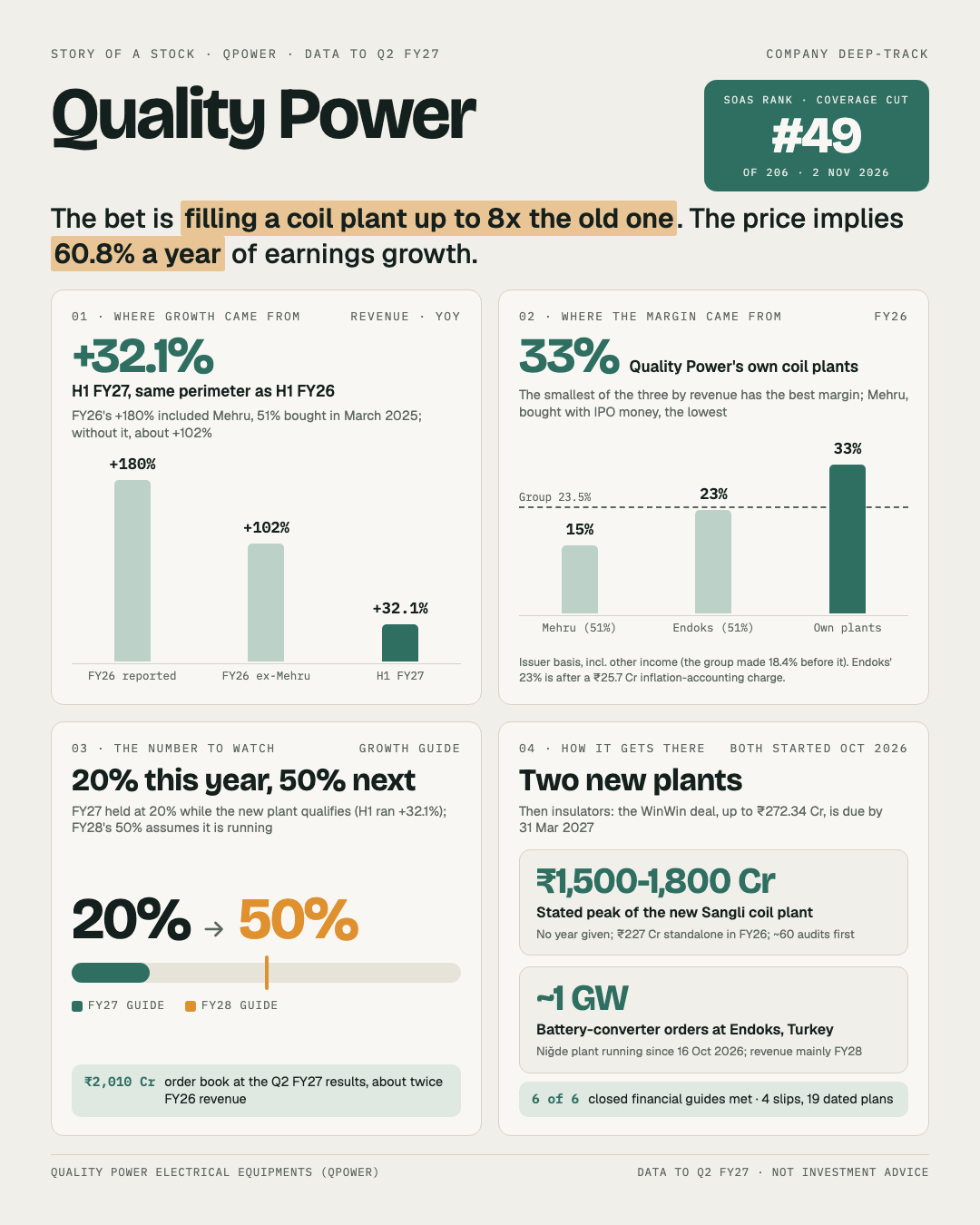
That's the Quality Power story on one page. Below is the same story in words, built from seven earnings calls, eight quarters of decks and results filings, two annual reports and nine broker notes. The Q2 FY27 call on 2 November exists only as a third-party transcript so far, so nothing here comes from it.
Picture a craftsman with three workshops. Two he shares with partners, and they make most of the sales. The third is his own: the smallest, and the one with the best margin, because almost nobody else in the country can make what it makes.
Quality Power is that craftsman. Its own plants wind the large coils that keep high-voltage grids stable, and by its own account it is India's only maker of HVDC and FACTS coils. Its partner workshops, Endoks in Turkey and Mehru in Rajasthan, are 51% owned and brought in about three-quarters of FY26 revenue. The partners keep their share: minority holders took 34.6% of FY26 profit.
On 20 October 2026 the craftsman started a new workshop at Sangli with up to eight times the old coil capacity. About ₹2,010 Cr of orders wait across the group. But in this trade a customer inspects a new workshop before ordering from it, and about 60 inspections come first.
Where this lives on the portal: the Quality Power company page.
1. What Quality Power makes
Coils that keep a grid stable
Quality Power makes air-core reactors and other coils up to 800 kV, which control current and filter disturbances in HVDC links, FACTS schemes and substations. The big grid integrators mostly source these coils rather than make them: by the company's account Hitachi Energy and Siemens make none, and Trench is the largest rival. Customers include GE Vernova T&D India, Hitachi Energy, Siemens, Hyosung and POWERGRID.
Three workshops, two of them shared
In FY26 Endoks earned ₹415.1 Cr from STATCOMs, harmonic filters and converters for battery storage, Mehru ₹316.5 Cr from instrument transformers, and Quality Power's own plants ₹221.9 Cr.
The margins do not follow the sales. On the company's basis, which counts other income, its own coil plants made a 33% EBITDA margin in FY26, Endoks 23% after a ₹25.7 Cr inflation-accounting charge in Turkey, and Mehru 15%.
2. How it got here
A Turkish stake long before the listing
The company was incorporated in 2001. In 2011 it took 51% of Endoks, an Ankara power-electronics maker, through a 98%-owned subsidiary.
The IPO paid for Mehru
Quality Power listed on 24 February 2025 after an IPO of ₹858.69 Cr at ₹425 a share, ₹225 Cr of it fresh money. Ten days later it bought 51% of Mehru for ₹120 Cr out of those proceeds. A planned majority stake in STATCON Energiaa was called off in May 2025 because it "did not fit in the investment philosophy".
Smaller deals, and one pending
In January 2026 it bought half of Sukrut Electric, a Pune maker of transformer tanks, with Yash Highvoltage holding the other half (the venture appears in the Yash Highvoltage story). In September 2026 it agreed to acquire WinWin Speciality Insulators for up to ₹272.34 Cr, ₹123.84 Cr of it in cash, due to complete by 31 March 2027. Shareholders have also approved raising up to ₹700 Cr through a QIP.
3. How the numbers have moved
Steady growth, then a near-tripling, partly bought
Revenue went from ₹183 Cr in FY22 to ₹253 Cr, ₹302 Cr and ₹338 Cr in FY25. In FY26 it rose 180% to ₹947 Cr. Mehru counted for 25 days of FY25 and all of FY26; without it, revenue grew about 102%. The organic part was still strong: Endoks grew 2.5 times and the company's own plants 46%.
Profit leaned on other income, and a third goes to partners
Profit rose from ₹42 Cr in FY22 to ₹186 Cr in FY26. From FY22 to FY25 other income, mostly interest and lira-linked currency gains, was 42-59% of pre-tax profit; in FY26 it was ₹58 Cr of ₹216 Cr. Minority holders took ₹64.2 Cr of FY26 profit, and Quality Power's own shareholders ₹121.3 Cr.
High returns that have never met a downturn
Return on capital employed ran 28-32% from FY23 to FY26. Our moat call is narrow, at the weak end, and untested. The one source that holds is scale in a small niche: the company says no other Indian firm makes HVDC or FACTS coils, and an entrant needs five to seven years to qualify. But the company listed in 2025, revenue has risen every year, and orders are won on delivery times in a shortage.
Profit ran ahead of cash
Over FY22 to FY26, operating cash came to about 57% of profit. The audit is unqualified, no promoter shares are pledged and related-party dealings are 1.24% of revenue. What stands out is contingent liabilities, mostly bank guarantees: 61% of total equity in FY26, against 28% a year earlier.
4. The last few quarters
Like for like, still growing by a third
H1 FY27 revenue from operations was ₹505.19 Cr, up 32.1%. Mehru sat in both halves, so this is the like-for-like pace. EBITDA was 27.0% of total income against 23.7% a year earlier, or 20.6% of revenue before other income, and profit for Quality Power's own shareholders rose 62.0%.
Orders passed the target early, then slowed
The order book was ₹1,406 Cr in March 2026 and ₹1,945 Cr in June, already past the ₹1,500-1,800 Cr management had set for the start of FY28. At the Q2 results it was about ₹2,010 Cr, the largest part at Endoks. By our arithmetic, new orders were about ₹772 Cr in the June quarter and ₹337 Cr in September.
Growth went into stock, not cash
Inventory rose from ₹116 Cr in March to ₹219 Cr in September, and operating cash for the half was ₹7.1 Cr. Cash and bank balances fell from ₹248 Cr to ₹151 Cr. The build sits in the subsidiaries, and the filings do not yet explain it.
5. Where growth comes from next
Filling the new workshop
The Sangli plant started on 20 October 2026. About 60 customer audits come next, which management puts at six months, with some revenue in Q3 FY27 and a turn in Q4. Its stated peak is ₹1,500-1,800 Cr of revenue, with no year, against ₹227 Cr of standalone revenue in FY26. That peak also needs an in-house winding-wire line that is about a year behind its first date, and the CFO has warned of a temporary dip in standalone margins in Q3.
Converters for battery storage
Endoks started a battery-storage converter plant at Niğde on 16 October 2026, two months early. It holds close to 1 GW of converter orders, with most of the revenue in FY28. These converters earn 10-12% at bid today, against about 25% on Endoks' older lines.
Insulators, if the deal closes
Insulators are the bottleneck management names, with deliveries of 18 to 24 months. WinWin would bring that supply in-house, with ₹250-300 Cr a year of revenue potential before new capex. Until it completes, it is in none of our cases.
Our cases, and what growth will cost
Our base case has revenue from operations up 20-30% in FY27 and 40-50% in FY28, about 30-40% a year. Earnings grow slower, 14-29% a year, because the company guides an EBITDA margin of "20% or high teens" against 23.5% in FY26. Growth will cost cash and shares: WinWin's cash, the inventory, and a QIP of up to ₹700 Cr.
6. What management promised, and what it delivered
The record is strong. Quality Power has met all 6 of its closed financial guides, and only 4 of its 19 dated plans have slipped, once each.
In May 2025, with Mehru already in the base, management guided revenue of ₹700-850 Cr, later ₹700-800 Cr; the year delivered ₹947 Cr. The margin guide rose from 17-18% to a 22% floor, and FY26 printed 23.5%. Both the raised guide and the print count other income, which the decks began including in November 2025; before it, the margin was 18.4%.
The slips are about dates. The Sangli plant was first dated to Q2 FY27, pulled in to June 2026, and started on 20 October 2026: about three weeks past its first date, and four months past the pulled-in one. The winding-wire line runs about a year late.
The live guides are 20% growth for FY27 ("We'll stick our guns to it"), against the 32.1% H1 delivered, and 50% for FY28. One undated aim is moving the other way: power electronics was meant to shrink to 20-25% of the business, and Endoks is now the largest part.
7. What the price already assumes
At ₹1,421 on 2 November, the price implies about 60.8% a year of earnings growth over the next two years. Our earnings cases give 14-29% in the base case, 29-47% in the bull case and 0-13% in the bear case, so the price sits above the top of the bull case.
Our earnings cases sit below revenue because of the margin guide, but even with no margin fall, a base case of 30-40% revenue growth stays well short of 60.8%.
The P/E is 72.7, inside the middle half of its range since listing and more than twice the industry median of 31.0. Over three years revenue grew 55% a year and profit 81%, both with Mehru inside. The reverse DCF behind the 60.8% already assumes only 57% of profit turns into cash, the measured rate.
What would make me wrong
- Management guides low. FY26 revenue beat the top of its band by about 18%, H1 FY27 ran at 32.1% against a 20% guide, and the CFO says every order in the book was priced above the margin guide.
- The new workshop may fill fast. Management says each factory sits on close to two years of orders at its old capacity, so demand is not the open question.
- The coil niche may be harder to enter than "untested" implies. The company knows of no other Indian maker, and qualification takes years.
The opposite error would be to read FY26's 180% as the company's pace. Part of it was bought; the like-for-like pace is H1 FY27's 32.1%.
The full read is on the Quality Power company page.
A workshop earns when its customers walk the floor and sign. Quality Power has about two years of orders and a building up to eight times the size, and the price is set as if the inspections were already over.
This is a summary of what Quality Power's filings, earnings calls, investor decks, annual reports and broker notes say. It is not investment advice or research.