Yash Highvoltage: A factory with two opening days
Pranav Yadav · · 8 min read
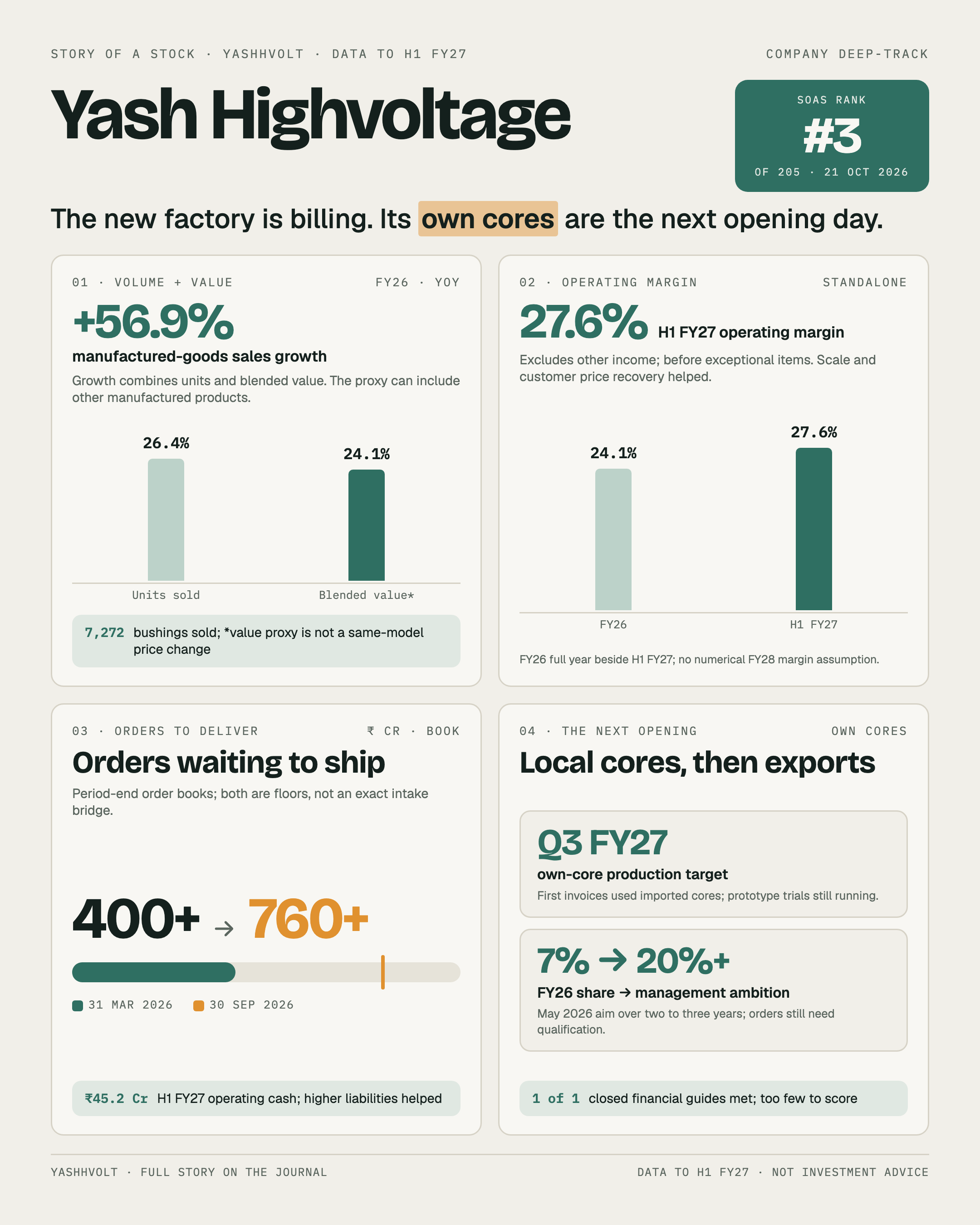
Updated 21 October 2026: Corrected the poster’s rank to #3 of 205 on the Overall Board.
That's the Yash Highvoltage story on one page. Below is the same story in words, built from its earnings calls, investor presentations and annual report.
A factory can have two opening days. On the first, people move in, machines run and a customer gets an invoice. On the second, the factory learns to make the part it previously had to bring in from outside.
Yash Highvoltage's new plant at Jarod has reached the first opening. It assembles, tests and packs transformer bushings using imported cores. The business is already growing quickly enough to need the extra space.
The second opening changes more than the address on an invoice. Making the core itself could shorten supply lines, change costs and let Yash ship its main product to markets its present arrangement keeps closed.
Where this lives on the portal: the Yash Highvoltage company page.
1. What Yash makes
The insulated passage into a transformer
A transformer needs power to pass through its metal enclosure without the current escaping into it. A bushing provides that insulated passage. Yash sells these components mainly to transformer manufacturers and power utilities, and also replaces and services ageing bushings.
Qualification matters because a failed component can interrupt the equipment around it. Tests and customer approvals take time, giving an established supplier a practical advantage when transformer demand accelerates.
Its biggest product depends on an imported core
Resin-impregnated paper, or RIP, bushings supplied 83% of FY26 revenue. Oil-impregnated paper bushings supplied 10%, high-current bushings 4%, and other products 3%.
Yash assembles RIP bushings around imported cores and currently sells them only in India under its supply arrangement. Its exports are other bushing types. Making its own core therefore matters to both manufacturing and market access.
2. How it got here
The Swiss partnership came before the new factory
Yash was incorporated in 2002, and the present management took over in 2008. A technology collaboration with Switzerland's MGC Moser Glaser brought local RIP assembly in 2016. MGC later became a shareholder, and Yash bought back its stake in 2024; the supplier relationship continued.
The company listed on BSE SME in December 2024. Its next step was to build the facilities needed to manufacture the cores as well as assemble the finished bushings.
A neighbouring business sits outside these sales
During FY26, Yash and Quality Power completed the purchase of Sukrut Electric, owning 50% each. Sukrut makes transformer components, widening Yash's exposure to the equipment around its bushings.
The numbers in this story are standalone. Sukrut's revenue is outside them, so its acquisition does not explain the growth shown here.
3. How the numbers have moved
More units and richer sales both contributed
Revenue rose from about ₹65 Cr in FY22 to ₹235.1 Cr in FY26. Comparisons across the listing period need care: FY25 onward follows Ind AS, while the earlier years use the old accounting rules.
The annual report gives a useful physical check. Bushings sold rose from 5,752 in FY25 to 7,272 in FY26, up 26.4%. Manufactured-goods sales per reported bushing sold rose from ₹2.59 lakh to ₹3.22 lakh, up 24.1%.
That second measure is a blended sales-value proxy. It reflects price and product mix, and its numerator may include FRP cylinders and other manufactured products. It cannot tell us how much the price of an identical bushing increased.
RIP's revenue share barely changed, from 82% to 83%. Simply selling more RIP cannot explain the value increase; voltage ratings, customer pricing and the mix within the product family also matter.
Better margins have arrived before local cores
Normalised operating margin was 24.1% in FY26 and 27.6% in H1 FY27, excluding other income and before exceptional items. Management credits purchasing scale and better price recovery from customers during a supply shortage. These gains arrived while the business still used imported cores.
Returns on the growing capital base tell a more measured story. Standalone return on capital employed fell from 52% in FY22 to 29% in FY26 as IPO money, inventory and a plant under construction enlarged that base. Strong operating growth has yet to establish returns through a full industry cycle.
The audit opinion is unmodified, but the report includes a ₹2.10 Cr cyber-fraud loss and discrepancies between stock statements submitted to the bank and the books. Those deserve attention alongside the growth. And approvals alone do not establish a durable moat: CG Power, Hitachi and MIM are also expanding local RIP capabilities.
4. The latest half-year
Orders have grown faster than invoicing
H1 FY27 revenue reached ₹194.5 Cr, up 95%, with profit after tax of ₹36.2 Cr. The order book rose from ₹400 Cr plus in March to ₹760 Cr plus in September.
Those books give visibility, but both are reported as floors. Subtracting one from the other and adding sales does not establish an exact order-intake figure. Delivery is the useful test now.
Cash improved, with help from liabilities
Working capital absorbed ₹5.8 Cr in H1 FY27, against ₹13.9 Cr in the comparable previous half-year. Operating cash after taxes rose from ₹4.8 Cr to ₹45.2 Cr.
Receivables still increased, while higher trade payables and other current liabilities helped offset the cash tied up in assets. It is a better cash result, but it needs to repeat as the company collects from customers and pays suppliers.
5. Where growth comes from next
Jarod's second opening is still ahead
The first Jarod invoice proves the assembly operation can help relieve an existing bottleneck. Commercial production of Yash's own RIP cores remains a separate milestone, targeted for Q3 FY27, with prototype trials still running in the latest issuer presentation.
The capacity percentages need the same distinction. FY26 utilisation was 75–80% on an existing base of roughly 9,000–10,000 bushings. In the May H2 call, management put FY27 utilisation at around 65% of an expanded base close to 15,000. A lower percentage on a larger base can support more output.
Local cores could also open RIP exports. Management's May ambition was to move exports from about 7% of FY26 revenue to 20% plus within two to three years. Customer qualification and orders still have to follow the manufacturing capability.
The second opening costs more
The latest plant budget is ₹220 Cr, against ₹153 Cr in May. The deck does not explain the increase, and the expanded scope needs watching alongside the commissioning dates.
A ₹151 Cr preferential issue provides funding, but it includes ₹60 Cr of warrants with only 25% paid initially. The issue size is therefore different from cash fully received, and further conversion adds shares. Depreciation and dilution can make profit per share grow more slowly than sales.
6. What management promised, and what it delivered
The closed financial record is encouraging but too small to grade. Yash met its one closed financial guide: FY26 revenue grew 57%, above the initial 25–30% guide and the later 35–40% framing. One result cannot establish a dependable forecasting record.
The operating dates have moved. There are three recorded slips across the tracked commitments. Trial readiness was first due by March 2026; imported-core assembly was billing by September, about six months later, meeting the restated date. Own-core commercial production remains ahead.
For FY27, management gave two unreconciled revenue formulations: growth of 40–45%, and invoicing of ₹360–400 Cr. The latter implies 53–70% growth on FY26 sales. The EBITDA-margin guide of 24–25% applies to FY27; later margin improvement is a direction without a numerical commitment.
7. What the price already assumes
At ₹1,149 on 21 October, the model implies about 37.7% annual revenue growth over the next couple of years, using flat margins. Our two-year sales cases are 32–40% in the bear case, 46–55% in the base and 58–68% in the bull. These are analytical scenarios, rather than management promises or forecasts of per-share earnings.
The cash assumption matters. The model uses 100% profit-to-cash conversion by default; the historical five-year figure is about 54%. If weak conversion persists, the same price needs stronger operating delivery. Neither future margin expansion nor full conversion should be treated as something Jarod's first invoice has already demonstrated.
What would make me wrong
- The second opening could arrive on schedule. Qualified local cores and export orders would make the manufacturing transition more tangible.
- Pricing could remain firm. Strong demand may let Yash retain better realisations even as rivals add capacity.
- The cash improvement could persist. Collections catching up would make expansion easier to fund.
The opposite error would be to count a full order book, an assembly invoice and prospective localisation savings as three completed deliveries. They sit at different stages.
The full read is on the Yash Highvoltage company page.
The first opening day gets the factory billing. The second will show how much of the business Yash can make its own.
This is a summary of what Yash Highvoltage's filings, earnings calls and annual report say. It is not investment advice or research.