Pondy Oxides: The lead press ran slow and earned more a tonne. The copper press that matters is still being built
Pranav Yadav · · 9 min read
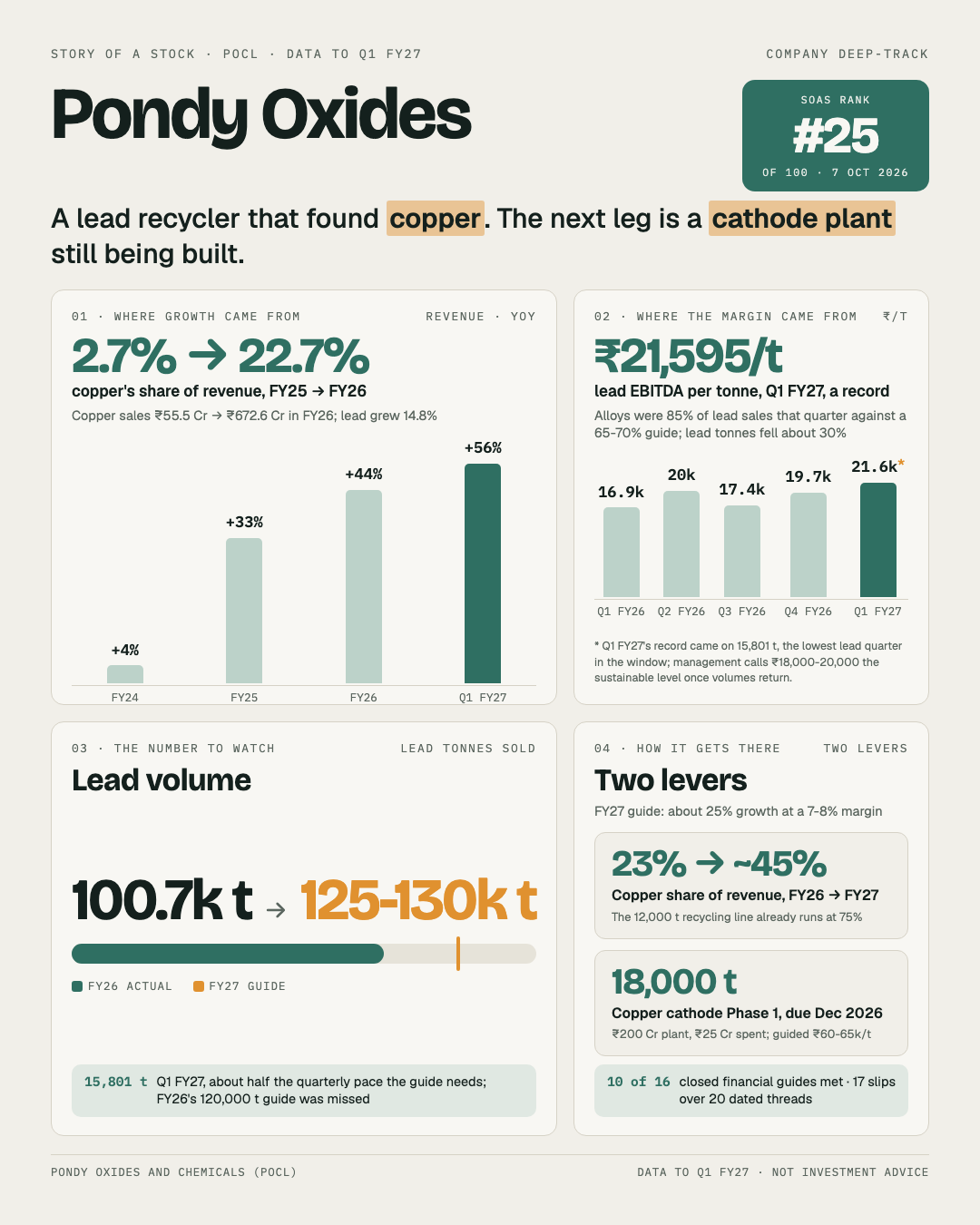
That's the Pondy Oxides story on one page. Below is the same story in words, built from 13 earnings calls (Q1 FY24 to Q1 FY27), 11 investor decks, the FY25 and FY26 annual reports and eight broker notes.
Think of a mint that takes in old metal and strikes it again. It never sets the metal's price: it buys scrap at a share of the exchange price, sells refined metal at a share of the same price, and keeps a striking fee on every tonne.
Pondy Oxides is that mint. For thirty years its press struck lead for battery makers; in FY26 it ran a second press, copper, hard enough that copper went from 2.7% to 22.7% of revenue in one year.
Then, in the first quarter of FY27, the lead press ran slow. Scrap ships were late, the company chose alloy tonnes over plain ones, and each lead tonne paid a record fee. The copper press it is betting the next two years on, a cathode plant, is a building site with a December 2026 date on it.
Where this lives on the portal: the Pondy Oxides company page.
1. What Pondy Oxides makes
Scrap in, exchange-grade metal out
Pondy Oxides buys lead and copper scrap, almost all of it imported, and refines it into pure lead, more than 100 lead alloys and recycled copper. Battery makers are the buyers of the lead; wire makers take the copper. In FY26 lead was 76.2% of ₹2,958 Cr of consolidated revenue and copper 22.7%; plastics and aluminium are the remaining 1.1%.
Paid a fee per tonne, not a bet on the metal
The company buys scrap and sells metal as a percentage of the London Metal Exchange price, so metal prices pass through; material is 88-90% of revenue and the gross margin barely moves. What it keeps is a processing spread, and management runs each metal on EBITDA per tonne: lead guided at ₹18,000-20,000, recycled copper above ₹40,000.
Imported scrap, exported metal
Scrap comes from 300+ overseas suppliers in 90+ countries; exports were 66% of FY26 revenue and three customers took 57.7% of it.
A trade being pulled into the open
Only 30-40% of India's lead recycling is organised; the rest is informal smelters that skip the cost of compliance. Battery waste rules with EPR credits, and GST on scrap paid by the buyer since October 2024, push used batteries toward registered recyclers like Pondy Oxides, Gravita and Jain Resource. Gravita's version of this trade is in an earlier post.
2. How it got here
Thirty years of lead
Incorporated in Tamil Nadu in 1995, Pondy Oxides inaugurated its first lead smelter in 2006, 18,000 tonnes a year. In 2020 it absorbed Meloy Metals and took lead capacity past 120,000 tonnes, and in 2023 it listed on the NSE.
The TKD build, a year late
The Thervoykandigai (TKD) site, acquired in January 2023, was to have an automated lead line installed by March 2024. The date moved four times, and commercial production began in April 2025, thirteen months late, at ₹85 Cr against ₹70 Cr guided. Phase 2 followed in December 2025 on time. Lead capacity is now 204,000 tonnes a year, and copper recycling doubled to 12,000 tonnes in Q4 FY26.
Paid for with new equity
A ₹175 Cr QIP in January 2025, with preferential allotments, brought ₹307.5 Cr of new equity in two years; shareholders' funds went from ₹265 Cr in FY23 to ₹788 Cr in FY26, and the promoters hold 36.39%, down from 40.61%.
3. How the numbers have moved
Volumes flat for three years, then two steps
Lead tonnes sold were about 68,000-70,000 a year from FY22 to FY24, then 90,565 in FY25 and 100,727 in FY26 as TKD came in. Revenue went ₹1,476 Cr, ₹1,541 Cr, ₹2,057 Cr, ₹2,958 Cr over FY23 to FY26; FY24 was the soft year, with profit down from ₹75 Cr to ₹32 Cr.
Margins did the work in FY26
Profit more than doubled in FY26, from ₹58 Cr to ₹132 Cr, on 44% more sales. Operating margin sat at 5% or under from FY23 to FY25 and stepped to 7.4% in FY26 on the company's basis, as the TKD lines spread fixed costs over more tonnes and alloys rose to 65% of lead sales. Lead EBITDA per tonne rose 39% to ₹18,462, and return on capital reached 23% on Screener's basis, 17% on management's own.
Profit came in, cash did not
Operating cash flow was an outflow of ₹81 Cr in FY25 and ₹44 Cr in FY26, against ₹190 Cr of profit over the two years: FY25 stocked inventory ahead of the new plant, and FY26 ended with export receivables held up by a vessel delay and collected in early April.
The checks are clean: an unqualified FY26 audit, no promoter pledge, related-party dealings at 0.24% of revenue, contingent liabilities at 1.94% of net worth.
Why those returns are not protected
Our moat call is no moat. Plain lead and copper price off the LME, and the blended margin sits at peer level: about 5% against Gravita's 10% over FY22 to FY25 on a broker's numbers, and ₹18,462 a lead tonne against Jain Resource's ₹18,382. The niche alloys are the only friction named, and those contracts renew yearly. Returns have beaten the cost of capital only since FY24, with no lead-price downturn in the record.
4. The last few quarters
FY26 was the copper year
Copper sales went from ₹55.5 Cr in FY25 to ₹672.6 Cr in FY26 as volumes rose from 700 to 6,543 tonnes. Lead grew 14.8% yet fell to 76.2% of revenue, and still earned the profit: a segment result of ₹190 Cr against copper's ₹25 Cr. Lead also missed its own volume guide, 100,727 tonnes sold against 120,000 promised.
Q1 FY27: the lead press ran slow
Revenue was ₹931 Cr, up 56%, and copper passed lead in sales for the first time: 4,001 tonnes at ₹48,488 a tonne. Lead sold 15,801 tonnes, about 30% fewer than a year earlier, because scrap shipments through Hormuz were delayed from May and the company chose alloys over plain lead. The alloy share hit 85%, against the 65-70% management calls sustainable, and lead EBITDA per tonne hit a record ₹21,595; the new TKD unit ran below 50%.
With low-margin copper near half of sales, the blended EBITDA margin was 6%, under the 7-8% guided.
5. Where growth comes from next
Copper to about 45% of revenue
Management guides copper to about 45% of FY27 revenue from 23%, on about 12,000 tonnes; the recycling line is already at 75% utilisation, so this leg is a run-rate story.
The cathode press
The next step is a 36,000-tonne LME Grade A copper cathode plant at TKD, ₹200 Cr from internal accruals, with about ₹25 Cr spent by August. Phase 1 of 18,000 tonnes is to be commissioned by December 2026 with trial runs in Q4 FY27; Phase 2 moved from mid-2027 to Q3 FY28. Cathode is guided to earn ₹60,000-65,000 a tonne "in the initial feasibility stage", against more than ₹40,000 on recycling.
Lead has to come back
The FY27 lead guide is 125,000-130,000 tonnes, 25-29% above FY26, from a year that opened at half the needed quarterly pace; management reaffirmed it in August with a caveat on shipping.
Our cases, and what growth will cost
Our base case has revenue growing 25-30% a year over two years, which with the 7-8% margin band gives earnings growth of 22-35%. The bull case is 35-40% revenue and 40-46% earnings; the bear case 15-20% and 4-17%, if the Hormuz disruption persists and the cathode trials slip. FY27 is a ₹175-180 Cr capex year after ₹49 Cr in FY26, and working capital of 46 days will be tested as copper, a dearer metal, grows.
6. What management promised, and what it delivered
Every call opens with "we don't provide any specific guidance", then gives ranges when asked. The record on those ranges is mixed: 10 of 16 closed financial guides met or beaten, and 17 slips across 10 of 20 dated threads.
The miss that mattered was FY26 lead volume: guided at over 120,000 tonnes, delivered at 100,727 sold, 13-16% short. Beside it, FY26 ROCE came in at 17% against 20% plus. On dates, TKD Phase 1 slipped four times, and the copper forward integration has slipped three times, from Q3-Q4 FY26 to December 2026.
What it kept: FY26 revenue of ₹2,939 Cr on the standalone basis the guide was set on, up 45% against 30-35%; the FY26 margin, guided at 6% and raised to 8% plus, landed at 7.4%; copper revenue of ₹673 Cr beat a ₹400 Cr guide by 68%; both lead capacity phases were commissioned inside FY26.
The live guide: about 25% revenue growth, a 7-8% margin that Q1 FY27 did not reach and management did not restate in August, 125,000-130,000 lead tonnes and 12,000 copper tonnes.
7. What the price already assumes
At ₹447 on 7 October, a market value of ₹3,411 Cr, the price implies about 16% a year of near-term earnings growth. Our cases run from 10% in the bear case to 28% in the base and 43% in the bull, so the price sits between the bear and base cases, against 36% a year of delivered profit growth over three years.
On its own history the multiples sit in the middle, EV/EBITDA of 15.4 against a median of 21.6 since listing. The caveat is the business's own: a cyclical priced on trailing earnings, with the first cathode tonne still to be struck.
What would make me wrong
- The lead tonnes may already be coming back. Management says there is no softness in demand, only a gap in supply; a quarter at Q3 FY26's 30,388 tonnes would put the guide back in reach.
- The per-tonne fee may be structural. The ₹18,000-20,000 guide sits above every full year before FY26.
- Cathode economics could hold. Two years of ₹60,000-65,000 a tonne while peers' copper stays below it is what would move the moat call.
The opposite error would be to read Q1 FY27's ₹21,595 a tonne and 56% growth as the run rate. The record fee came from striking fewer tonnes, and the growth came from copper, which earned ₹25 Cr on ₹672.6 Cr of sales last year.
The full read is on the Pondy Oxides company page.
A mint earns on what passes through its presses. Pondy Oxides ran the lead one slow and was paid more per coin; the copper press it is building is the one the next two years are priced on.
This is a summary of what Pondy Oxides's filings and earnings calls, annual reports and broker notes say. It is not investment advice or research.