Gravita India: The toll on every kilo held. The traffic kept coming in short
Pranav Yadav · · 7 min read
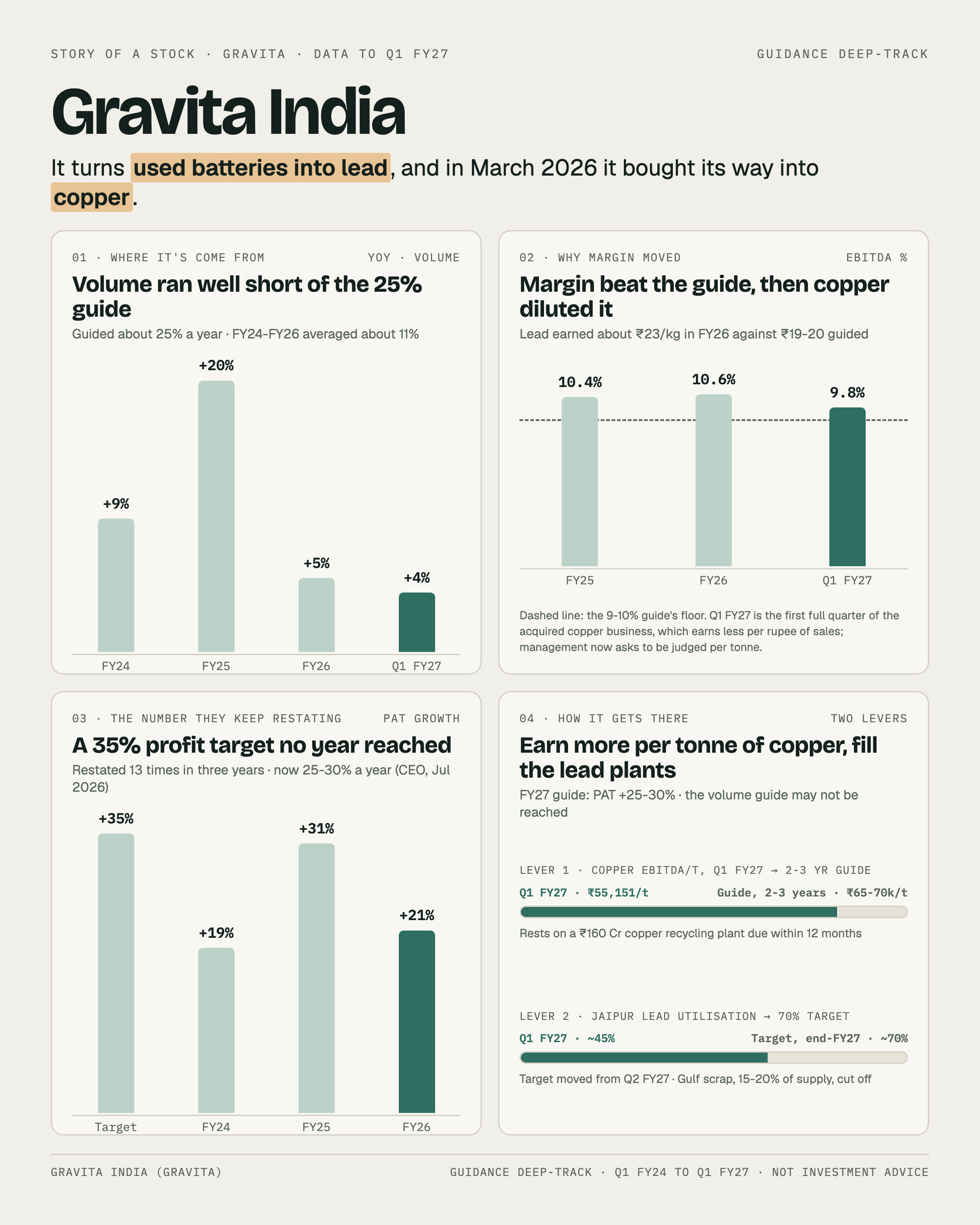
That's the Gravita India story on one page. Below is the same story in words, built from thirteen earnings calls and sixteen decks, Q1 FY24 to Q1 FY27, the FY26 annual report and broker notes.
A toll road does not care what the car is worth. It is paid a fixed amount for every car that passes, so its income is the toll times the traffic.
Gravita works the same way. It buys scrap batteries, melts them into lead and sells the metal at London Metal Exchange prices. It hedges both sides, so what it keeps is a margin per kilo: the toll. For three years the toll held and the traffic did not.
In March 2026 it bought a copper business, a second road with a higher toll and its own traffic to prove.
Gravita has appeared in this Journal once, on 10 August, in a post on what the price already assumes. The growth its price implied had fallen from 25.3% to 16.0% because profits grew. The price section explains why it now reads about 20%.
The central takeaway
The record is mixed. Management met 6 of the 13 financial guides that have closed, and five of the six were margin guides it beat. All seven misses are growth: volume and profit in each of FY24, FY25 and FY26, and EBITDA in FY26. Dates moved often, with 27 slips across 14 of 25 dated promises.
The debate is no longer whether Gravita keeps its toll. It is whether the traffic ever arrives, and whether copper can bring it.
At a glance
- FY26 delivered: revenue of ₹4,265 Cr, up 10%; adjusted EBITDA of ₹452.48 Cr, up 12%; PAT of ₹378.80 Cr, up 21%.
- The toll: lead earned about ₹23/kg in FY26 against ₹19-20 guided.
- The traffic: volume grew 9%, 20% and 5% in FY24, FY25 and FY26 against about 25% guided.
- The copper purchase: 99.44% of RMIL in March 2026; copper was ₹376 Cr of Q1 FY27's ₹1,475 Cr revenue, 25.5%.
- What the price assumes: about 20% earnings growth a year for two years.
Where this lives on the portal: the Gravita India guidance page.
1. The toll per kilo beat its guide in every year it was tested
Lead was guided at ₹18-19/kg for FY25 and earned about ₹20. The FY26 guide was lifted to ₹19-20/kg, and lead earned ₹23,043 a tonne, about ₹23/kg. Aluminium and plastic beat their FY26 guides by about ₹1/kg each. The EBITDA margin was 10.43% in FY25 and 10.6% in FY26, above a 9-10% guide.
That is the hedge doing its job. The evidence is two closed years, and some of it came from price spreads: FY25's lead beat included arbitrage gains, and management puts Q1 FY27's ₹24,181 a tonne down to disruption-driven prices.
2. The traffic came in short three years running, and the profit target was cut
From July 2023 management guided volume growth above 25% a year and profit growth of 35% or more. Volume grew 9% in FY24, 20% in FY25 and 5% in FY26, when new lead capacity came late and GST changes cut demand.
Profit followed the traffic. PAT grew 19%, 31% and 21%, about 24% a year, and no year reached 35%. In May 2026 the volume guide was cut to about 20-25% a year to 2030. In July the CEO put profit growth at 25-30% a year while the deck still printed about 30-35%.
Q1 FY27 did not turn it. Volume grew 4% including copper, lead volume fell 5% as Gulf scrap, 15-20% of supply, dried up, and the CEO said this year's volume growth may not be reached.
3. Promised dates slipped 27 times, and most projects arrived late rather than not at all
The MCX aluminium alloy contract, which would let Gravita hedge and scale its Indian aluminium plants, has been re-dated six times since November 2023. It depends on MCX, not the company.
The lithium-ion pilot slipped four times before starting in January 2026, and the Mundra and Phagi lead expansions twice each. The India rubber plant is on hold, and the Oman joint venture missed outright.
The live slip is the lead ramp. New capacity was to reach 60-70% utilisation by Q2 FY27; Jaipur ran at about 45% in Q1, and 70% now sits at the end of FY27.
4. Copper is a second road bought, not built, and its toll is still rising
In January 2025 management said it was not exploring copper. Fourteen months later it owned 99.44% of RMIL. Reported revenue rose 42% in Q1 FY27, but revenue without copper grew about 5.7%.
Copper earned ₹55,151 a tonne in Q1 FY27. Management guides ₹65,000-70,000 a tonne in two to three years, once a 29,400 MTPA recycling plant costing about ₹160 Cr feeds RMIL its own scrap within 12 months.
The second road earns less per rupee of sales, so the EBITDA margin fell to 9.80% in Q1 FY27 and returns to about 20%, against a 25% floor the CEO expects to regain in three years. Only 3 of 43 live promises are backed by orders, so our forward read is ambitious and thinly evidenced.
5. Rivals run the same kind of road, so we do not call it a moat
The company reports pre-tax returns on capital of 19-31% from FY21 to FY26. Our moat call is no moat, rated weak: brokers name rivals, Jain Resource Recycling and Pondy Oxides among them, that import scrap, hold LME lead brands and supply the same battery makers.
Gravita's edge is execution: JM Financial's peer table (March 2026) puts its margin near 10% against 4-7% for peers. Execution can be matched, and capacity costs little: Phagi added 40,500 tonnes for about ₹30 Cr.
6. What the price already assumes: about 20% earnings growth a year, between our base and bull cases
At ₹1,495 on 25 September, the reverse DCF implies about 20% earnings growth a year over the next two years. Our cases, built from the company's own volume and per-kilo guidance, put it at 7% in the bear case, 14% in the base case and 23% in the bull case. The base case grows volume at the last three years' pace, not the guide, so the implied rate sits closer to the bull case. The P/E of 28.2 is near the middle of its five-year range, against a median of 30.2.
Management's FY27 guide of 25-30% PAT growth sits above the implied rate; its profit guides have not been met.
On 10 August the implied rate was 16.0%, and most of the move is method. That reading held one rate for ten years; the section now solves for a two-year rate that fades toward 5%, graded against earnings cases. On the old method, today's price implies 13.7%.
What would make me wrong
- The plants are waiting for scrap, not customers. The lead plants run at about half. At 70%, Phagi alone would add about ₹50 Cr of revenue a month.
- The toll keeps rising. Copper is guided from ₹55,151 a tonne toward ₹65,000-70,000.
- Earnings already outran volume. Q1 FY27 EBITDA grew 29% on 4% volume growth, helped by copper's higher toll per tonne.
The opposite error would be to read the per-kilo beats as pricing power. Part came from price spreads.
The one question that matters
How much volume does Gravita ship in FY27?
The guide is 20-25% plus a little. Q1 grew 4%, so the rest of the year needs roughly 25-32%, which depends on Gulf scrap returning.
What I'll be watching
- Does Jaipur utilisation climb from about 45% toward 70%?
- Does MCX list the aluminium alloy contract within FY27, the seventh date given?
- Is the copper recycling plant running by about May 2027?
Final assessment
Gravita has shown it can protect its toll. It has not shown it can grow the traffic at the rate it promises. The price sits between what the record supports and what management guides.
The full read is on the Gravita India page.
A toll road with a reliable toll is worth the traffic it gets, not the traffic it forecasts. Gravita has forecast more cars every year for three years, and the next count is FY27's.
This is a summary of what Gravita India's filings, earnings calls and broker notes say. It is not investment advice or research.