MTAR Technologies: The trains ran on time. The new line keeps moving its opening day
Pranav Yadav · · 9 min read
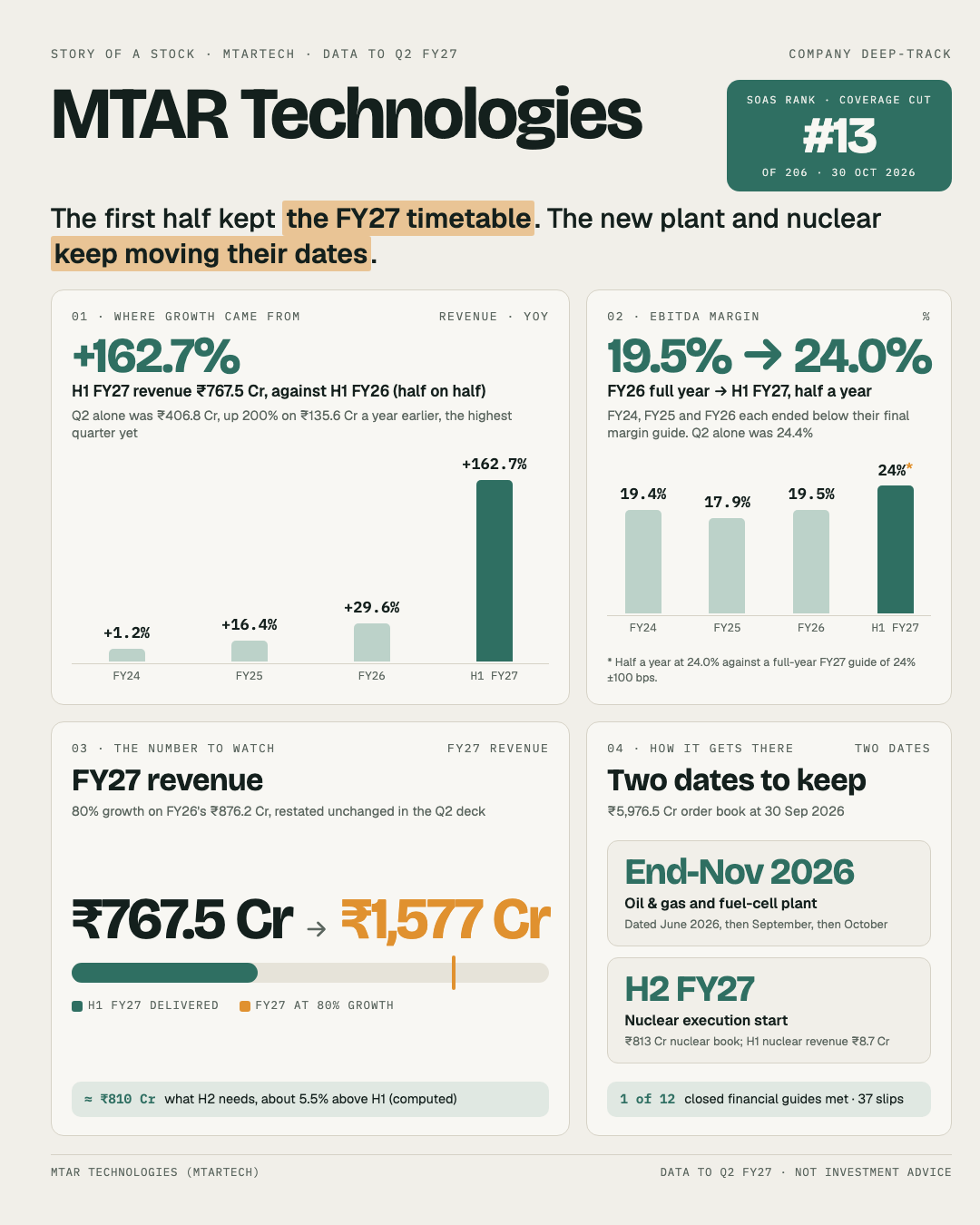
That's the MTAR story on one page. Below is the same story in words, built from 13 earnings calls, 16 investor decks and results filings, the FY26 annual report and eight broker notes. The Q2 FY27 call on 30 October exists only as a third-party transcript, so nothing here comes from it.
On 23 September I wrote that MTAR's order book has a clock in it. The book was ₹5,143 Cr at 30 June, and the question was whether the company could turn it into revenue on the dates it gives, given a delivery record nobody can skip.
An order book with a clock in it is a railway timetable. Every order is a ticket for a journey on a set date, and the fare is earned only when the train runs. MTAR has a lot of tickets out: the book reached ₹5,976.5 Cr at 30 September, close to seven times its revenue for all of FY26.
This half, the trains on the main line ran on time. Revenue for the six months was ₹767.5 Cr at a 24.0% EBITDA margin, the pace that management's 80% growth guide for FY27 asks for. But the next stretch of the network needs new lines, a greenfield plant and nuclear work, and their opening days keep moving.
Where this lives on the portal: the MTAR Technologies company page.
1. What MTAR makes
Parts that must pass a test before they ship
MTAR machines and assembles precision parts for customers who cannot accept a failure: fuel-cell systems, reactor fuel-handling assemblies, launch-vehicle engines and structures, and parts for oil-and-gas and data-centre equipment. The work is gated by qualification. A customer approves a first article, then releases volume orders, some of them under five- to ten-year contracts with orders released every quarter.
One big line and three smaller ones
In FY26 the line MTAR calls fuel cells, hydel and others was 70% of revenue, aerospace and defence 12%, products 15% and civil nuclear 3%. The fuel-cell customer the company names is Bloom Energy, and exports were 82% of FY26 revenue. The company is refiling the sector split in its Q2 deck, so I use FY26's mix here.
2. How it got here
Since 1970, making what India imported
MTAR dates its start to 1970, making parts India used to import. The customers it names today include NPCIL in nuclear, ISRO in space, Bloom Energy in fuel cells, and Weatherford and SLB in its newer lines.
Licences, plants and a long-awaited order
The defence manufacturing licence arrived in Q2 FY24. A dedicated aerospace plant in Hyderabad was commissioned in January 2025, about four months after its first date. FY26 brought a record ₹2,453.3 Cr of orders, including the ₹504 Cr Kaiga 5 and 6 nuclear order, the largest MTAR has taken.
Two subsidiaries folded in
On 28 October 2026 the tribunal (NCLT) approved merging MTAR's two wholly owned subsidiaries, Gee Pee Aerospace and Defence and Magnatar Aero Systems, into the company, with effect from 1 April 2025. MTAR no longer prepares consolidated statements and reports one segment. Past periods were restated and the company calls the effect not material, so the numbers below run as one series.
3. How the numbers have moved
A fast start, two slow years, then a recovery
On Screener's figures, revenue went from ₹322 Cr in FY22 to ₹574 Cr in FY23, then slowed: ₹581 Cr in FY24 and ₹676 Cr in FY25, before ₹876 Cr in FY26. The operating margin fell harder, from 29% in FY22 to 18% in FY25, and was 20% in FY26. Profit went from ₹103 Cr in FY23 to ₹53 Cr in FY25 and back to ₹94 Cr.
Cash caught up, and the debt more than doubled
Operating cash flow was ₹197 Cr in FY26 against ₹94 Cr of profit. In FY22 and FY23 stock and receivables had swallowed nearly all of it. Inventory still sat at 399 days and receivables at 140 days. Borrowings rose from ₹177 Cr to ₹377 Cr in FY26 to pay for new plants and the working-capital build.
Returns fell with the margin
Return on capital employed was 22% in FY23, 11% in FY24, 10% in FY25 and 15% in FY26. The FY25 audit opinion was clean, and claims not acknowledged as debt were 0.31% of equity.
Why the licence is not yet a moat
Our call is a narrow moat, at the weak end. The defence licence is a real barrier to entry, but the filings do not show that it is scarce or that it earns more. With returns this uneven and no disclosed cost of capital, whether MTAR earns above that cost is untested.
4. The last two quarters
A record half, at the margin it promised
Q2 FY27 revenue was ₹406.8 Cr, up 200% from ₹135.6 Cr a year earlier and the highest quarter MTAR has reported. The half came to ₹767.5 Cr, up 162.7%, already 87.6% of FY26's ₹876.2 Cr by my arithmetic. The company's own EBITDA margin was 24.4% in Q2 and 24.0% for the half, against 19.5% in FY26.
The book kept growing
New orders of ₹1,207.2 Cr came in during Q2, and the book reached ₹5,976.5 Cr at 30 September. Inflow was more than three times what the quarter used up at order-book value. Civil nuclear is 13.6% of the book, about ₹813 Cr.
Cash came from a working-capital swing
Net working capital fell to 50 days in Q2, from 172 days for FY26, and working capital added ₹195.0 Cr to the half's operating cash flow. Part of that is customers paying faster: receivables fell to 68 days. Part is other current liabilities, which nearly doubled in six months to ₹478.7 Cr, and the deck does not say what they are.
5. Where growth comes from next
The year needs little more than the first half
At 80% growth on FY26's ₹876.2 Cr, FY27 revenue would be about ₹1,577 Cr. That leaves about ₹810 Cr for H2, roughly 5.5% more than H1. Both are computed, not stated: 876.2 × 1.80 = 1,577.2, less 767.5 = 809.7. The press release says H2 should be stronger than H1.
Two new lines, both running late
The greenfield plant that houses Weatherford's oil-and-gas work and the second phase of fuel-cell capacity is now due by end-November 2026. A third, multifold fuel-cell phase is due at a new site by March 2027. Nuclear execution is expected from H2 FY27: more than ₹130 Cr of the ₹150 Cr of refurbishment orders expected this year has arrived, but nuclear revenue in the half was ₹8.7 Cr, 1% of sales.
Our cases put revenue growth near 50% a year
Our base case takes the 80% for FY27 and the older 25% frame for FY28, which is not a current guide: about 50% a year of revenue growth over two years. Carried through the 23-25% margin guide, that is 63-70% a year of operating-profit growth. The bear case is below 47% revenue and below 60% earnings growth, the bull case above 53% and above 73%.
What growth will cost
Capex for FY27 and FY28 was raised twice, from ₹150 Cr-plus to almost ₹500 Cr, 70% of it for clean energy. ₹273 Cr went out in H1, partly funded by ₹99 Cr of new short-term debt. Beyond FY27 the aims are bigger and thinner: products above ₹1,000 Cr from ₹134 Cr in FY26, aerospace at ₹600-700 Cr, and ₹450-500 Cr from the oil-and-gas plant, a roadmap management calls uncommitted.
6. What management promised, and what it delivered
The record is poor. MTAR has met 1 of its 12 closed financial guides, and 11 of its 15 dated plans have slipped, 37 times in all. In September I counted 48 slips across 10 of 13 plans. The recount no longer counts delay steps that carried no date; nothing new was delivered in between.
The revenue misses have narrowed. FY24 was guided at ₹830-860 Cr, cut twice, and came in at ₹580.8 Cr, 32% below the first number. FY25 started near ₹900 Cr and ended at ₹676 Cr. FY26 was guided at ₹900 Cr-plus and delivered ₹876 Cr. The EBITDA margin ended below its final guide in all three years, at 19.4%, 17.9% and 19.5%.
The dates are the weaker side. The Kaiga order landed about eight quarters after its first date. The oil-and-gas plant was first due in June 2026 and is now due five months later. What was kept: the defence licence, one quarter late, FY26 working capital at 172 days against 235 guided, and clean-energy growth of about 48% in FY26 against a 15-20% guide.
The live guide is 80% revenue growth at a 24% EBITDA margin, plus or minus 100 basis points, restated unchanged in the Q2 deck.
7. What the price already assumes
The valuation was priced on 19 October at ₹6,950, before the Q2 results, on trailing numbers that end in June. It will be re-priced once the September quarter reaches those trailing figures.
At that price, the market implies about 66.8% a year of operating-profit growth over the next two years. That sits inside our base case of 63-70%, between the bear case below 60% and the bull case above 73%. In September the price implied 68.1% against a 66.3% base case; the 19 October re-price moved it.
The P/E was 156.9 against a five-year upper quartile of 134.9 and a median of 93.2. Over five years MTAR has grown revenue 29% a year and profit 16%. The price asks for the base case to arrive in full, on a timetable this company has rarely kept.
What would make me wrong
- The timetable may now be the rule. The half ran at the guided pace and margin, the book grew again, and H2 needs only 5.5% more than H1.
- The plant could open on its new date. If it runs by end-November, oil and gas and fuel-cell Phase 2 start adding before the year ends.
- Nuclear is no longer only a promise. The refurbishment orders arrived as expected rather than slipping, and the nuclear book is about ₹813 Cr.
The opposite error would be to read a strong half as proof the network runs on time. H1 ran on lines already built; the lines that carry FY28 and beyond are still slipping.
The full read is on the MTAR Technologies company page.
A railway is judged by its timetable, not by the tickets it has issued. This half MTAR's trains ran to it; the new line still has to open on the day now printed.
This is a summary of what MTAR Technologies' filings, results documents, earnings calls, annual report and broker notes say. It is not investment advice or research.