MTAR Technologies: The order book has a clock in it
Pranav Yadav · · 7 min read
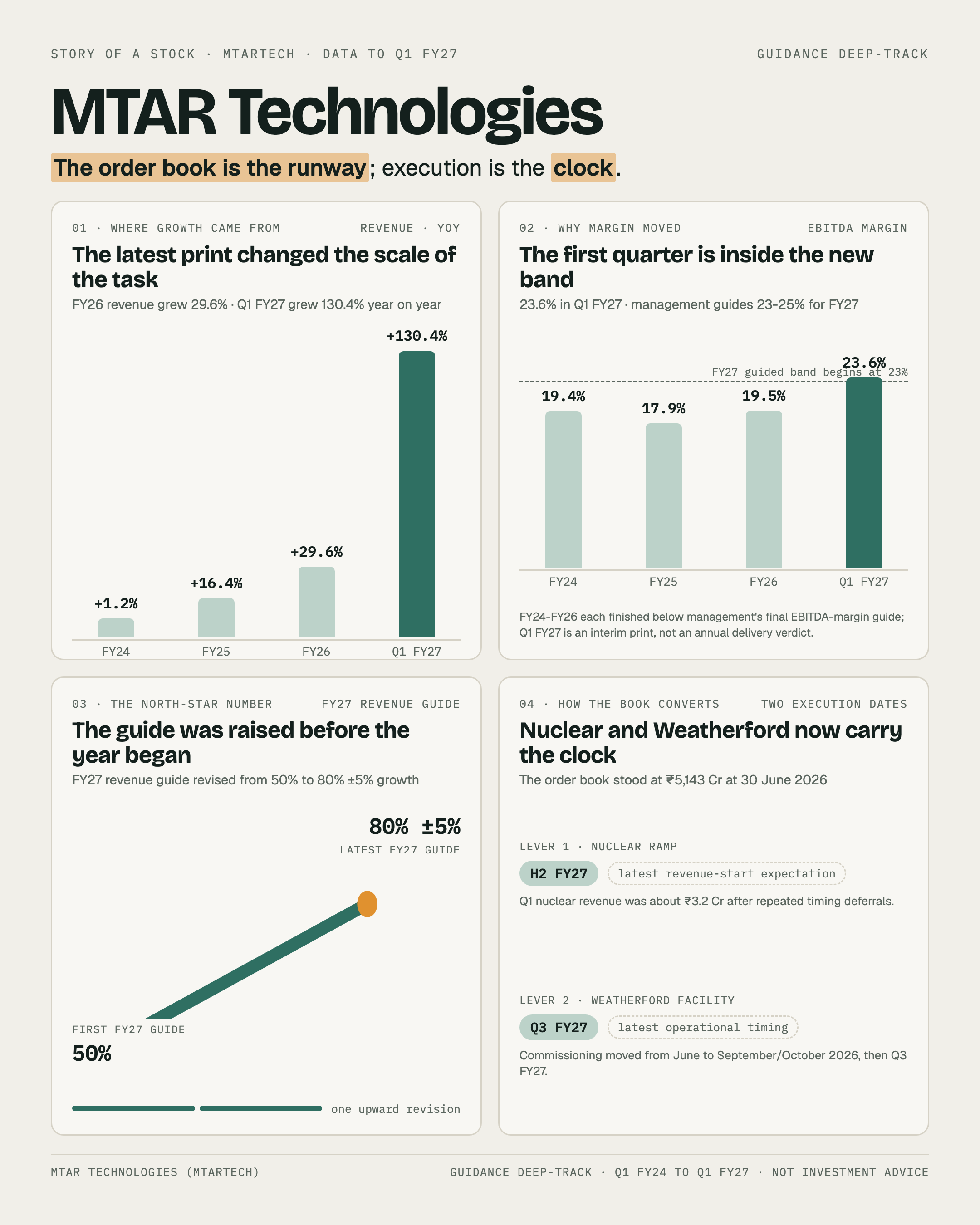
The page below is the same story in words, built from MTAR's calls, investor presentations and the guidance record they leave behind.
An order book is usually treated as a cushion. At MTAR, it is also a clock.
The company ended June with ₹5,143 Cr of orders, then spoke of another ₹800 Cr announced on the Q1 call. It has lifted its FY27 revenue guide to 80% ±5% growth and reported a Q1 revenue print of ₹361 Cr, up 130.4% year on year.
But the schedule matters as much as the runway. Nuclear revenue is now expected from H2 FY27 after repeated deferrals. The Weatherford oil-and-gas facility has moved from a June 2026 commissioning expectation to Q3 FY27. A large book is not revenue until those clocks keep time.
The central takeaway
The debate is no longer whether MTAR can win work. It is whether it can turn an unusually large book into revenue and margin on the timetable it now gives investors.
The record is not a reason to dismiss the current guide. The FY27 book is already above the ₹5,000 Cr closing-order-book goal, Q1 margin was 23.6%, and working capital was 59 days against a roughly 100-day guide. But the delivery record changes the burden of proof: only 1 of 12 closed financial guides in the deep track was met or beaten, and 48 dated milestones slipped across 10 of 13 timing threads.
At a glance
- The book: ₹5,143 Cr at 30 June 2026, before the ₹800 Cr of orders management announced on the Q1 FY27 call.
- The revenue guide: FY27 revenue growth is 80% ±5%, raised from about 50% at Q4 FY26.
- The margin guide: FY27 EBITDA margin is 23-25%; Q1 FY27 reported 23.6%, while FY24-FY26 all finished below the final annual margin guide.
- The early balance-sheet read: Q1 FY27 net working capital was 59 days against the latest roughly 100-day guide.
- The key timing risk: Nuclear revenue is expected from H2 FY27; the Weatherford facility is now expected to be operational in Q3 FY27.
- The price test: The valuation model's 68.1% implied near-term earnings growth sits close to its 66.3% base-case earnings path.
Where this lives on the portal: the MTAR Technologies guidance page.
1. The order book is already bigger than the guide needs
The visible order book is the strongest part of the case. FY26 closed at ₹2,580 Cr, below management's ₹2,800 Cr expectation. By 30 June 2026, it had reached ₹5,143 Cr. That rapid build is why the company can pair an 80% FY27 revenue guide with a much larger closing-book aspiration without it reading as a pure hope.
The composition matters, though. Fuel Cells, Hydel and Others supplied 61% of Q1 FY27 revenue. Aerospace and Defence was 10%, Products and Others 28%, and Civil Nuclear Power only 1%. The book creates visibility, but it does not make every part of the portfolio equally ready to convert.
2. The first-quarter margin is encouraging, not the annual verdict
MTAR's FY27 EBITDA-margin guide is 23-25%. The Q1 print was 23.6%, inside that range. That matters because FY24, FY25 and FY26 each ended below management's final annual margin guide: 19.4%, 17.9% and 19.5% respectively.
What is fair to say is narrower: the new band is no longer merely a slide. It has appeared in a reported quarter. The clock now runs through the rest of FY27, when the larger order book must convert without undoing that margin.
3. Nuclear and Weatherford decide whether the book becomes sales
Nuclear is the clearest example of the difference between an order and a revenue line. Kaiga 5 and 6 orders of about ₹504 Cr were ultimately received, but only after roughly eight quarters of delay. The current nuclear execution ramp has shifted from FY26 to FY27, then through Q1 and Q2 FY27, to H2 FY27. Q1 nuclear revenue was about ₹3.2 Cr.
Weatherford is the second clock. The dedicated facility was initially expected by June 2026, later September or October, and is now described as operational by Q3 FY27. Management still frames oil and gas as a future revenue pool, but the facility needs to commission and then ramp before that claim becomes a reported number.
These are not reasons to write off either programme. They are reasons to separate the book from the conversion date. The FY27 guide can work with both levers; it is just more sensitive to their timing than the headline order book implies.
4. The delivery record is the part nobody can skip
MTAR is a formal guider. It gives numerical revenue, margin, order-book and working-capital markers often enough that the record can be tested rather than inferred.
That test is uncomfortable. FY24 revenue guidance moved from 45-50% growth to ₹610 Cr before revenue delivered at ₹581 Cr. FY25 moved from roughly ₹900 Cr to ₹700 Cr-plus before delivering ₹676 Cr. FY26 was the narrowest miss: the company raised the guide to 30-35% growth and ₹900 Cr-plus, then delivered ₹876 Cr and 29.6% growth.
The same pattern appears in timing. The deep track records 48 dated slips across 10 of 13 threads. Some programmes still arrived: the dedicated aerospace facility was commissioned in FY25 and the defence licence was received. Others, including roller-screw certification and the Fluence battery-storage programme, did not reach their earlier promised destination.
The right read is not that every future commitment will fail. It is that the calendar has to be earned one operating update at a time. This is why the Q1 margin and working-capital prints are useful, but not enough on their own to settle FY27.
5. What the price already assumes
The price is not asking for a fantasy relative to the model's base case. The reverse-DCF framework implies 68.1% near-term earnings growth. The base case in the rebuilt Growth section is 66.3%, derived from the FY27 revenue guide, the older FY28 model path and the 23-25% EBITDA-margin band. The higher-growth case begins above 73%.
That proximity is the tension. The guide can support the implied path if the revenue and margin bridge holds. The valuation read becomes less forgiving because the same framework also sees the P/E, EV/EBITDA, price-to-book and sales measures above their five-year upper quartiles, while the moat assessment remains Narrow / Weak and the guidance record is low trust.
The price is therefore a demand for execution, not just growth. It leaves less room for an order that arrives on time but converts a few quarters late.
What would make me wrong
- Nuclear dispatches could begin earlier than H2 FY27 and demonstrate that the current timing is conservative rather than another postponement.
- The Weatherford facility could commission in Q3 FY27 and move quickly into commercial production.
- The Q1 EBITDA margin could persist through the year, showing that the 23-25% band is a durable operating result rather than an early mix effect.
- The order book could keep growing while working capital remains close to the new 100-day guide.
The opposite error would be to treat the old miss record as destiny and ignore a real change in order inflow, margin and working capital. The current data do show a stronger starting point. They do not yet prove a stronger clock.
The one question that matters
Can the ₹5,143 Cr order book turn into FY27 revenue without another calendar reset? The first answer is encouraging: Q1 revenue was ₹361 Cr and the margin was 23.6%. The next answer comes from nuclear dispatches and the Weatherford commissioning date.
What I'll be watching
- Whether nuclear revenue moves from about ₹3.2 Cr in Q1 FY27 into the H2 FY27 ramp management now describes.
- Whether the Weatherford facility is operational in Q3 FY27 and begins commercial conversion afterward.
- Whether margin and working-capital progress hold as the order book moves through delivery.
Final assessment
MTAR has earned the right to be judged on a larger opportunity set. It has not yet earned the right to be judged as if the order book and the delivery calendar are the same thing.
The runway is visible. The clock is still the product.
Read the full MTAR Technologies company page.
This is a summary of what MTAR Technologies' filings and our guidance deep-track say. It is not investment advice or research.