DEE Development Engineers: It laid a wider pipe. The line still has to fill before anything comes out
Pranav Yadav · · 7 min read
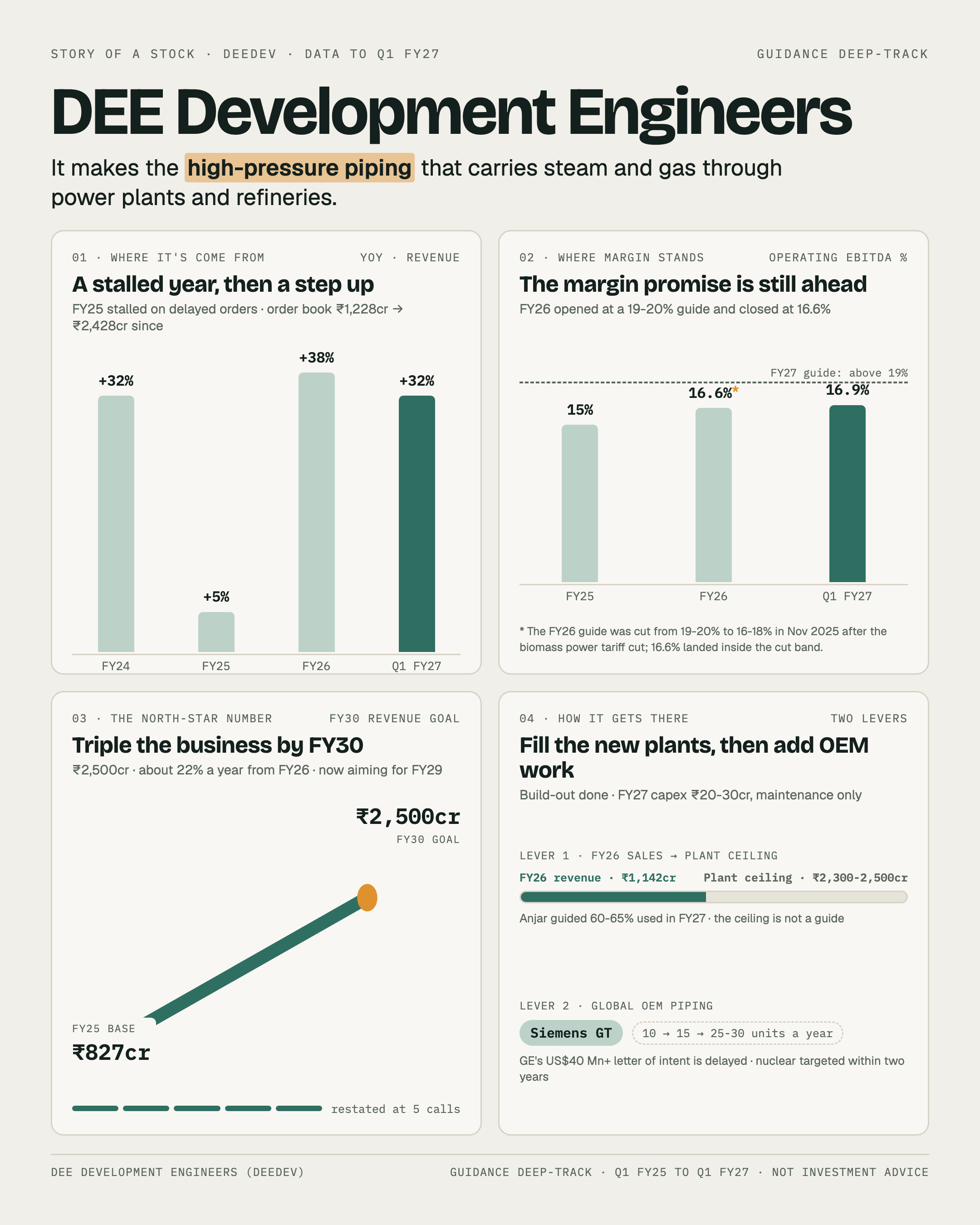
That's the DEE Development Engineers story on one page. Below is the same thing in words, built from all nine earnings calls and eleven investor decks the company has published since it listed, Q1 FY25 to Q1 FY27.
Before a new pipeline delivers a single litre, its whole length has to be filled. Pipeline operators call that line fill. It is product already paid for, and nothing comes out of the far end until the line is full.
DEE Development Engineers makes the high-pressure piping that carries steam and gas through power plants and refineries. By its own count it is India's largest process piping maker by installed capacity. Over the last two years it laid a much wider pipe: a fabrication unit at Anjar in Gujarat, now 30,000 MTPA, and a seamless pipe plant commissioned in March 2026.
The build-out is finished. What it has not done yet is fill the line. The last plant-wide utilisation the company disclosed was 39%, and its cash cycle runs to 263 days.
The central takeaway
On the arithmetic, the record is credible. Four of the five financial guides that have closed were met or beaten, and 8 slips across 26 dated promises is a modest count. The weak spot is the one full-year revenue guide: raised to about ₹1,300 Cr, cut to 40-45% growth, and still missed at 38%.
The debate is no longer whether DEE can build plants. It is whether it can fill them fast enough, and turn the fill into cash, to reach the margin above 19% it now guides.
At a glance
- FY26 delivered: revenue of ₹1,142 Cr, up 38%, at an operating EBITDA margin of 16.6%.
- The FY26 guide: ₹1,100 Cr at a 19-20% margin in February 2025, raised to about ₹1,300 Cr in May, cut to 40-45% growth at 16-18% in November.
- The FY27 guide: revenue of ₹1,500 Cr plus, called the "bare minimum", at an EBITDA margin above 19%.
- Orders: an order book of ₹2,428 Cr at 30 June 2026, up from ₹1,228 Cr in March 2025.
- The lock: no moat. Consolidated ROCE rose from 5.3% to 9.8% over FY22-FY26, below an assumed 12% cost of capital each year.
- The goal: triple revenue to ₹2,500 Cr by FY30, about 22% a year.
- What the price assumes: about 40% earnings growth a year for two years.
Where this lives on the portal: the DEE Development Engineers guidance page.
1. FY27's revenue floor is already covered by orders
Management calls ₹1,500 Cr of FY27 revenue the "bare minimum", with a plan to exceed it. That is 31% growth on FY26. The first quarter ran at 31.6%, and the order book at the end of June was ₹2,428 Cr, about 2.1 times FY26 revenue.
So the FY27 floor does not need new wins, only execution. Of the 38 live promises we track, 8 are backed by orders already won, 22 rest on management's word and 8 are aspiration. Our forward read is ambitious and partly evidenced.
The evidence reaches revenue. It stops short of the margin.
2. There is no moat yet: it wins on price, and returns sit under the cost of capital
Consolidated ROCE rose in three of the last four years, from 5.3% in FY22 to 9.8% in FY26. It never cleared the roughly 12% cost of capital we assume. Free cash flow was negative every year from FY23 to FY26 while the plants and inventory were built.
Asked about export competition on the February 2025 call, the MD said the company wins "because of our competitive prices only", on lower labour cost. In November 2024 he conceded that Chinese makers are more competitive in fittings.
NTPC approves only three piping vendors, and DEE is one of them. The other two are BHEL and L&T, which are also DEE's customers. That is a qualification, not a lock, so our moat call is no moat, rated weak.
3. Filling the plants is the whole plan, and 263 days of cash sits in the line
Capex is now maintenance only, ₹20-30 Cr for FY27, so growth has to come from use. Management guides Anjar to 60-65% utilisation this year and close to full by the end of FY28, and the seamless plant to 60-70%. The last plant-wide figure disclosed was 39%, for H1 FY26; the table then left the deck.
This is the line fill. Revenue spends about 263 days as inventory and receivables before it comes back as cash, against a guide of 180-200 days. A ₹300 Cr share issue in July 2026 put about ₹225 Cr toward debt, and net debt is guided to ₹400-425 Cr by the end of FY27.
The margin case rests here too. Seamless pipe made in-house, more power work and fixed costs spread over more tonnes are meant to lift the margin from 16.6% to above 19%. Q1 FY27 printed 16.9%.
4. The plants arrived a quarter late, and the FY26 guide was cut before it missed
Every plant DEE promised got built, but most arrived late. The 9,000 MTPA Anjar expansion was guided for 1 October 2024, re-dated to December and commissioned at the end of January 2025. The seamless plant was due in January 2026 and was commissioned in March. Only the 30,000 MTPA Anjar build came in early.
The FY26 guide was raised to about ₹1,300 Cr in May 2025, cut to 40-45% growth in November once the biomass power tariff cut stood, and closed at 38%. The margin guide fell from 19-20% to 16-18% and landed at 16.6%: met, but only against the lowered bar.
Two orders also slipped, a ₹139 Cr PDH order and a ₹51 Cr export order, and neither is reported closed. The FY25 consolidated audit also carried a qualification over the Malwa Power biomass plant.
5. What the price already assumes: about 40% earnings growth a year
At ₹658 a share, the price implies about 39.8% earnings growth a year over the next two years, with the first year near 42%. Our base case is 33-38% on an EBITDA basis, the bull case 39-49% and the bear case 19-29%. The price sits just above the top of the base case, at the bottom edge of the bull case.
The base case already assumes revenue grows 25-29% a year and the margin reaches the guide above 19%. The bull case needs the plants filled faster and new OEM work arriving on time: Siemens gas turbine piping at 10, then 15, then 25-30 units a year. GE's US$40 Mn+ letter of intent has already been pushed back.
What would make me wrong
- The orders are real. ₹2,428 Cr is 2.1 times FY26 revenue, and India plans 80 GW of new thermal capacity by FY32.
- Four of five closed guides were met. The plant slips were a quarter each, not years.
- The cash cycle is moving. Inventory days fell to 174 in Q1 FY27, and the share issue has already gone to debt.
- Global OEMs are signing up. Nooter Eriksen reserved 60% of the HRSG piping capacity, and Siemens signed a multi-year understanding.
The opposite error would be to read the order book as cash. It is not, until the line fills.
The one question that matters
What is the cash conversion cycle at the end of FY27?
It was 263 days in June 2026, and management guides 180-200. If it gets there with the plants fuller, the margin guide and the cash follow. If it stays above 250, the line is still filling.
What I'll be watching
- Does the H1 FY27 margin move toward 19% from Q1's 16.9%?
- Does the company disclose plant utilisation again, and does Anjar reach 60%?
- Does GE's letter of intent convert, and do the first Siemens units ship?
Final assessment
DEE built what it said it would, mostly a quarter late. The next test is not building. It is filling what it built and getting the cash back out.
The full read, including every guidance thread and the sources behind it, is on the DEE Development Engineers page.
A wider pipe is only worth what comes out of the far end. DEE has laid it, and the line is still filling.
This is a summary of what DEE Development Engineers' filings and earnings calls say. It is not investment advice or research.