Avalon Technologies: Both workshops have a better room. The work keeps landing in the other one
Pranav Yadav · · 9 min read
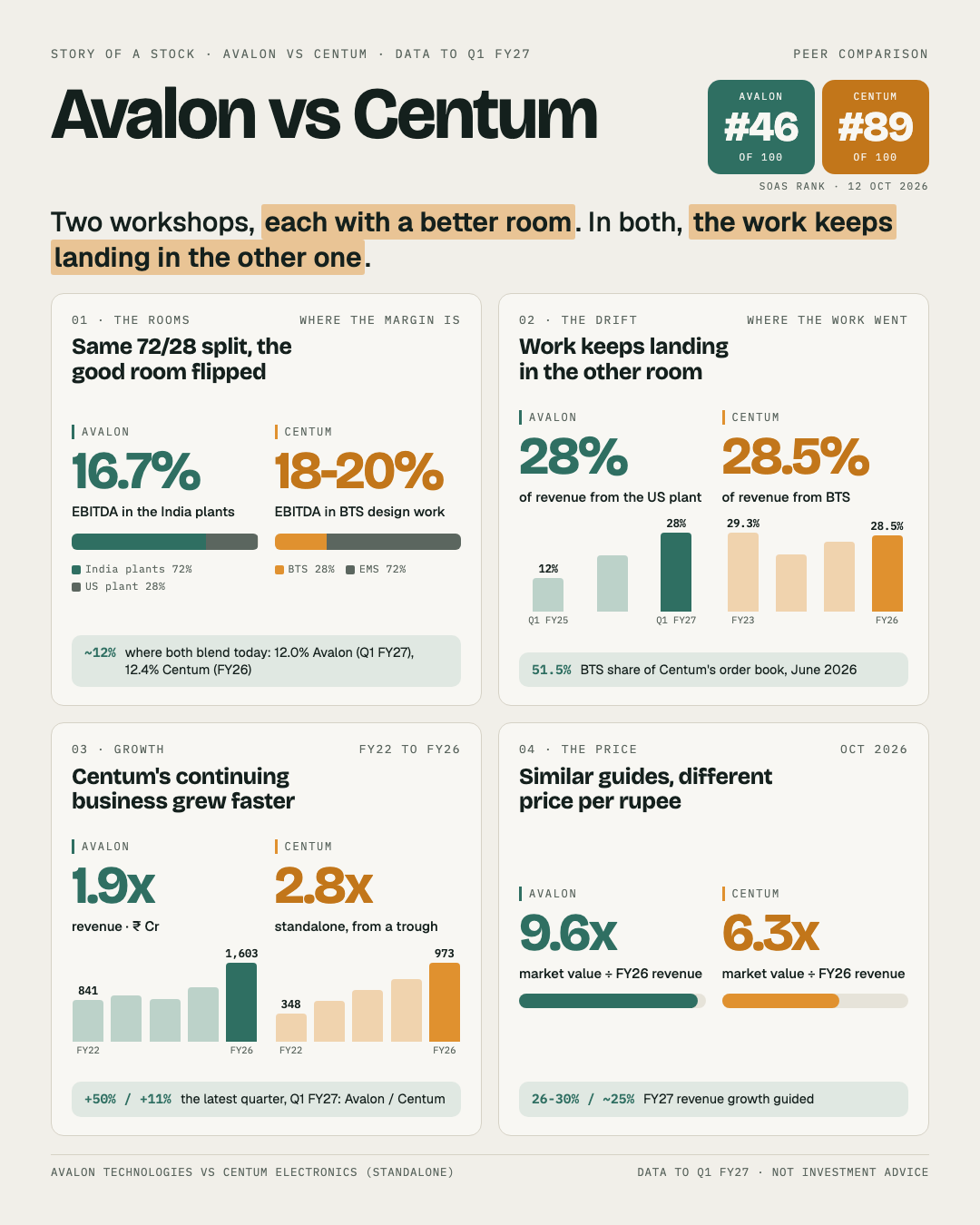
Both companies on one page. The same thing in words, built from both companies' earnings calls, investor decks and annual reports, FY22 to Q1 FY27.
Picture a workshop with two rooms. Work done in one pays well; work done in the other pays less, or loses money. The plan is obvious: move the work into the better room.
Avalon Technologies and Centum Electronics are two such workshops. Both build electronics for other companies' products, in small runs that must be qualified before they ship: rail and power systems, medical devices, radars, satellites, the machines that make chips. Both blend to an EBITDA margin of about 12%. And in both, the work has spent two years landing in the other room. Yesterday's EMS sector map put both in the specialist cohort; this is the closer look.
The central takeaway
Avalon's better room is its Indian plants, at a 16.7% EBITDA margin. Its US plant still loses money, yet went from 12% to 28% of revenue in two years. Centum's better room is its design work, build-to-specification or BTS, at 18-20%. BTS is 51.5% of the order book but 28.5% of FY26 revenue, about where it was in FY23.
What differs is how fast each grows while it waits. Avalon grew 46% in FY26; Centum's continuing business grew 25%. The market values Avalon at 9.6 times FY26 revenue and Centum at 6.3.
The question is not which workshop is better. It is which risk you would rather own: at Avalon, that the work moves to India before the price stops waiting; at Centum, that a design book more than three times a year's design revenue turns into revenue at all.
At a glance
- Size. FY26 revenue of ₹1,603 Cr and ₹973 Cr (Centum standalone, now the whole company). Market value of ₹15,385 Cr and ₹6,087 Cr.
- Order books, June 2026. ₹2,208 Cr at Avalon, 1.25 times a year's revenue. ₹1,797 Cr at Centum, half of it BTS.
- Guidance record. Avalon met 6 of 9 closed financial guides, with 15 slips across 26 dated commitments. Centum met 3 of 12, with 5 slips across 28.
- What the price assumes. About 78.5% revenue growth to start at Avalon, against our base case of 25-28%. Centum's figure is unreliable this year.
Where this lives on the portal: the Avalon Technologies company page and the Centum Electronics company page.
What you need to know first
Both work cost-plus. The customer's components pass through the bill, so revenue moves with parts prices, and the margin lives in how much of the product the maker builds or designs. Revenue arrives in programme-sized lumps, and customers rarely switch supplier mid-programme.
Centum has changed shape. In FY26 it stopped its Canadian operations, and in June 2026 a French court moved its French businesses to MBDA and SII. Its consolidated history still carries those units, so every Centum number here is standalone: the business as it stands today.
1. Same 72/28 split, with the good room on opposite sides
Avalon makes most of its products in India and ships most of them to the US, whose customers were 62% of FY26 revenue. New customers usually start in its US plant before production moves to India. In Q1 FY27 the Indian plants produced 72% of revenue at a 16.7% EBITDA margin; the US plant produced 28% and lost about ₹4 Cr after tax.
Centum splits its work by what it is asked to do. Building to a customer's design (EMS) was 72% of FY26 revenue, at about 10-11% by management's account. Designing and building radar, satellite and electronic-warfare systems to a specification (BTS) was 28%, at 18-20% or more.
The same split, with the better room on opposite sides. Avalon's job is to keep its small room from growing; Centum's is to grow its small room. Both blend to about 12%: 12.0% at Avalon in Q1 FY27, 12.42% at Centum for FY26. Neither publishes audited margins by room.
2. In both workshops, the work went to the other room
Avalon: new work starts in the US and stays there
The US plant's share of revenue was 12% in Q1 FY25, 20% a year later and 28% in Q1 FY27, above where it stood before production moved to India. New programmes ramp there first, more than planned. Losses narrowed from ₹14.2 Cr a quarter to about ₹4 Cr, and the group margin rose from 9.2% to 12.0% in a year as revenue outgrew fixed costs. But breakeven was "positive numbers" within 12 to 18 months in February 2025, and is now "the later part of FY27".
Centum: the design book grew, design revenue did not
BTS was 45.5% of the order book in September 2024 and 51.5% in June 2026. Its share of revenue was 29.3% in FY23, 21.2% in FY24 when certifications were delayed, 26.0% in FY25 and 28.5% in FY26. A BTS order takes 25 to 30 months to deliver, so a half-BTS book still turns into under a third of revenue. And by Centum's own model, BTS ties up 225-350 days of working capital against 85-110 for EMS: the better room is also the one that eats cash.
One is a plan outrun by its own demand. The other is a book that has not yet become revenue.
3. Avalon is growing faster now. Centum's continuing business grew faster over four years
Avalon's revenue went from ₹841 Cr in FY22 to ₹1,603 Cr in FY26, 1.9 times. FY24 fell 8.2% as US customers cut their stocks; FY26 rose 46% and Q1 FY27 50%. Profit has been slower to become cash: ₹323 Cr earned over FY22-26, ₹102 Cr of operating cash.
Centum's standalone revenue went from ₹348 Cr to ₹973 Cr, 2.8 times, though FY22 was a year revenue fell 18% and FY22-24 leave out an engineering unit merged in later. FY26 grew 25%, Q1 FY27 11%.
Both lean on few customers (Avalon's top 10 were 61% of FY26 revenue, Centum's top five groups over 65%), and both just added one maker of chip-making equipment: Centum's went from practically nothing to more than ₹100 Cr in FY26, and Avalon's started in Q1 FY27.
4. Avalon beats the number and misses the date. Centum keeps the date and misses the number
Avalon met six of nine closed financial guides. FY26 grew 46% against about 40%, FY25 26.6% against 22-24%; the miss was FY24, guided at 25% and down 8.2%. Its dates slip: 15 times across 11 of 26 dated commitments, the US breakeven among them.
Centum met three of twelve. FY26 grew 25% against 30%, at a 12.42% margin against 13-15%, and the 2023 frame of 20% consolidated growth was rewritten as 25-30% standalone after the exit. Its dates hold: 5 slips across 3 of 28.
Our scorer labels Avalon mixed and Centum low trust. Avalon's numbers arrive, late. Centum's dates arrive, short.
5. What the price already assumes
At ₹2,300 on 8 October, Avalon is valued at ₹15,385 Cr, 9.6 times FY26 revenue and 115 times trailing earnings. At today's margins that needs about 78.5% revenue growth in the first year, slowing over ten. Management guides 26-30% for FY27 and ₹3,200 Cr by FY29, about 26% a year; our base case is 25-28% and our bull case 29-33%. If anything 78.5% is low: the model assumes at least half of profit becomes cash, and Avalon's five-year figure is 0.30.
At ₹4,125, Centum is valued at ₹6,087 Cr, 6.3 times FY26 revenue. Its trailing P/E of 69.8 means little this year: the last four quarters carry a large write-off on the exited units and a gain when the French businesses left. Our model's 38.7% earnings growth, between our base case of about 28% and our bull case, is solved on those earnings, so I would not lean on it.
Our board ranks Avalon 46th and Centum 89th. Centum sat 152nd until today, outside the 100, because our growth score read consolidated history across the exit; on the business it kept, it scores 6.7, not 5.2. The rest of the gap is how the calls read: 8.18 against 6.75.
What would make me wrong
On Avalon:
- The Chennai plant pulls the work home. It starts in Q2 FY27; if the US share falls back toward 20%, the blend moves toward 16.7%.
- US breakeven arrives by the end of FY27, and the fastest-growing room stops costing money.
On Centum:
- The design book converts. ₹925 Cr of BTS orders deliver over 25-30 months; at a third of revenue, the 13-15% margin follows.
- Space orders arrive in size. Management sizes its space-surveillance opportunity at about ₹1,000 Cr.
The opposite error: reading Avalon's pace as proof its plan works, when the fastest growth is in the room that loses money, or Centum's misses as a weak business, when its continuing revenue grew 2.8 times in four years.
The one question that matters
What share of revenue comes out of the better room?
Both steer by it. Avalon's India plants made 72% of Q1 FY27 revenue, down from 88% two years earlier. Centum's BTS made 28.5% of FY26 revenue, against 29.3% in FY23. Whichever moves it the right way by the end of FY27 has a plan that works.
What I'll be watching
- Avalon's US plant share and loss in Q2 FY27, and the Chennai plant's first quarter.
- Whether Centum books the ₹100-150 Cr of BTS orders that slipped out of FY26 in the first half of FY27.
- Centum's second-half margin, against the more than 13% it guides for FY27.
Final assessment
Both workshops know which room pays. Avalon is growing so fast that new work lands wherever there is space, and the space is in the US. Centum has the orders for its better room and not yet the revenue.
The full reads are on the Avalon Technologies page and the Centum Electronics page.
One workshop is too busy to move into its better room. The other has booked its better room and is still waiting for the work to arrive.
This is a summary of what Avalon Technologies' and Centum Electronics' filings and earnings calls say. It is not investment advice or research.