Acutaas Chemicals: The farm raised its forecast. The price had already counted a bigger harvest
Pranav Yadav · · 8 min read
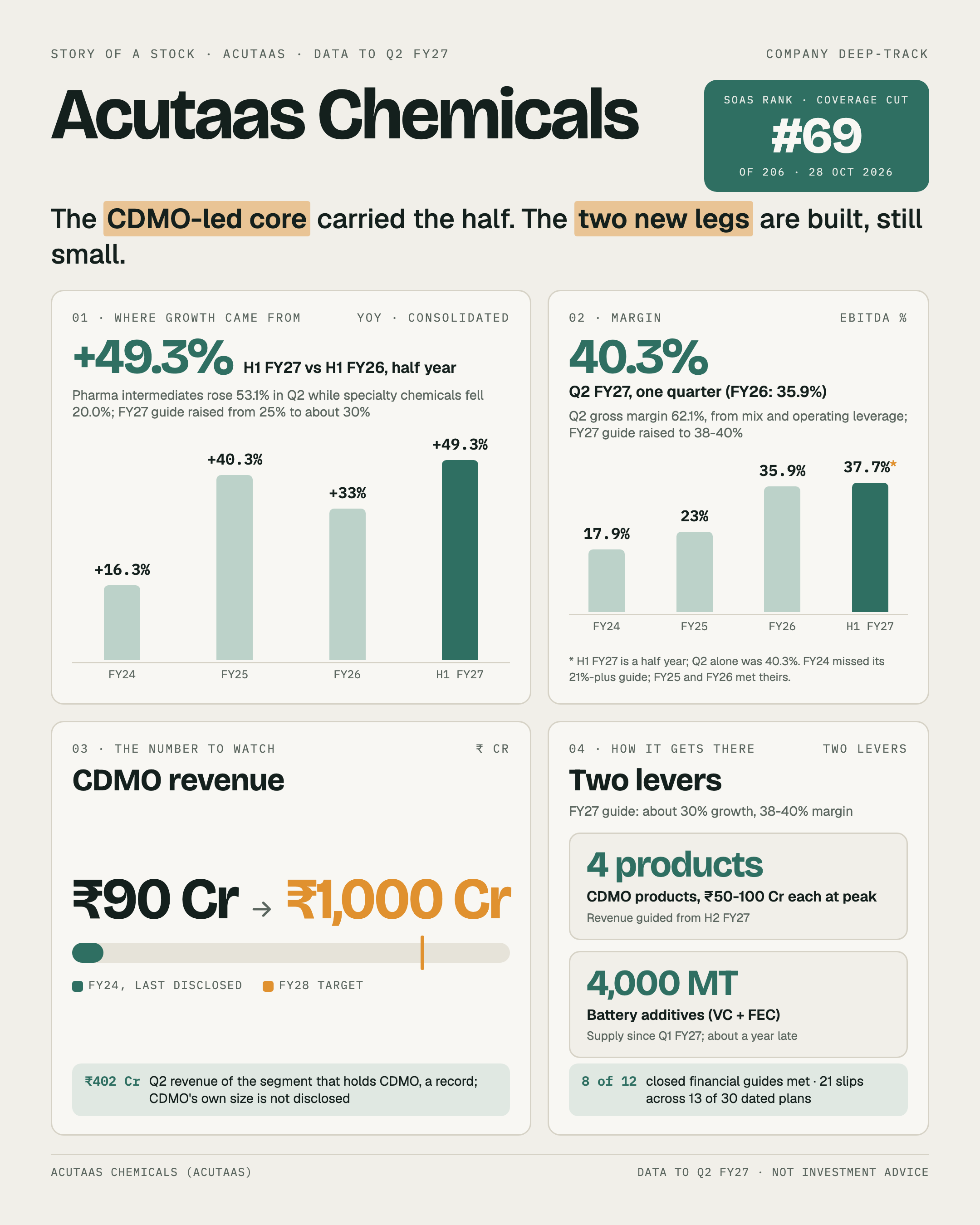
That's the Acutaas Chemicals story on one page. Below is the same story in words, built from thirteen earnings calls, eighteen decks and results filings, three annual reports and thirteen broker notes. The Q2 FY27 call transcript is not yet on the exchange, so the latest quarter rests on the results-day documents.
On 1 October I described Acutaas as a farm. One crop, grown on contract for a single kind of buyer, had doubled the margin, and the money was going into two new fields: battery additives and chip chemicals. The catch was that the farm had stopped weighing the special crop in public.
Four weeks later half the year's harvest is in, and it came in heavy. Revenue grew 49.3% in H1 FY27, the margin reached 40.3% in Q2, and one of the new fields now has a barn: the Korean chip-chemicals plant opened in August.
The farm raised its forecast for the year to about 30% growth at a 38-40% margin. That is the odd part. After a 49.3% first half, about 30% for the year asks the second half to grow only about 18%. The price had already counted a bigger harvest than that.
Where this lives on the portal: the Acutaas Chemicals company page.
1. What Acutaas makes
The steps before a medicine
Acutaas makes advanced pharmaceutical intermediates, the chemical building blocks drug makers turn into active ingredients. It sells them to generic makers and, under contract (CDMO), to drug innovators. Pharma intermediates were 87.7% of FY26 revenue of ₹1,339 Cr, and about 77% of revenue was exported.
Two ways to earn on the same plant
Some intermediates use processes Acutaas owns and sells to many buyers. CDMO work is made to order for one innovator, which shares or owns the process, and it is the richer crop. The company says CDMO drove FY26's growth, but it has not reported CDMO revenue since FY24, when it was ₹90 Cr. Buyers are concentrated too: the top 10 customers were about 57% of FY24 revenue, the last year that figure was published.
The smaller fields beside it
The rest is specialty chemicals. Commodity lines such as parabens and methyl salicylate are being phased out. Baba Fine Chemicals, 55% owned, makes photoresist chemicals for chipmakers. A plant at Jhagadia makes two battery electrolyte additives, VC and FEC, which earned no revenue in FY26.
2. How it got here
A partnership firm that listed in 2021
The business began in 2004 as a partnership firm, Ami Organics. It listed on the NSE and BSE on 14 September 2021 and was renamed Acutaas Chemicals in May 2025.
Buying, rebuilding and building
In March 2021 it bought the Ankleshwar and Jhagadia units of Gujarat Organics, then rebuilt Ankleshwar as a pharma-intermediates plant, inaugurated in December 2023 with 442 KL of capacity. From April 2023 it held 55% of Baba Fine Chemicals, its way into chip chemicals. Phase 1 of the Jhagadia battery plant, 2,000 MTPA each of VC and FEC, opened on 19 January 2026.
A barn in Korea
On 28 August 2026 Indichem, 75% held through Acutaas Advance Material, inaugurated its chip-chemicals plant at Gongju in South Korea. The company has put KRW 30 billion, about ₹200 Cr, into it, and the plant was in trial runs at the end of September.
3. How the numbers have moved
FY24: the old crop had no fence
Revenue grew from ₹520 Cr in FY22 to ₹1,339 Cr in FY26, about 27% a year, while profit went from ₹72 Cr to ₹356 Cr. FY24 was the bad year. Local rivals cut prices by 10-30%, and Acutaas kept its share by conceding price. The margin ended at 17.9% against a guide above 21%, and return on capital fell to 16%.
FY26: product mix doubled the margin
By FY26 the EBITDA margin was 35.9% and return on capital 32%. The company credits product mix, more CDMO in particular, and cost efficiencies. In my last post I wrote that those returns rested on one CDMO molecule. The company's own account is broader than that, and I have corrected our read to match it.
Still no moat
Our call remains no moat. The drug filings that name Acutaas as a supplier name others too, prices reset against a reference, and even the CDMO originator keeps two suppliers, under a patent that ends in 2033-35. That protects volume more than price, as FY24 showed.
Cash ran behind the planting, until this half
Over five years profit turned into operating cash at 0.82x, and free cash flow was negative every year as capex ran ahead. Working capital ended FY26 at 120 days against a 95-105 day guide. In H1 FY27 operating cash flow was ₹215.9 Cr, ₹92.0 Cr more than capex: for once, the farm's own cash covered its planting.
4. The last two quarters
The core crop came in heavy
Q1 FY27 revenue grew 59.1% and Q2 42.7%, to ₹436.9 Cr, which puts H1 at ₹766.6 Cr, up 49.3%. The segment that holds CDMO, advance intermediates, earned ₹402.0 Cr in Q2, up 53.1% and its highest quarter on record. The deck says CDMO and the core intermediates business both grew strongly, and gives no split.
A record margin, from the gross line
The EBITDA margin was 40.3% in Q2 and 37.7% for the half, on a Q2 gross margin of 62.1%. The company puts it down to higher gross margins and operating leverage. Profit grew more slowly than EBITDA: H1 profit rose 71% against EBITDA's 98%, as depreciation rose with the new plants and other income fell.
The small fields shrank
Specialty chemicals fell 20.0% in Q2, to ₹34.9 Cr. Commodity products are being run down on purpose, and Baba Fine Chemicals was hit when its US customer changed owners. That is the risk of a field that sells to one buyer.
5. Where growth comes from next
Four CDMO products and a battery plant
Management guides four validated CDMO products to start earning in H2 FY27, each worth ₹50-100 Cr a year at peak. The battery plant has 4,000 MT of capacity, began commercial supply in Q1 FY27 and is expected to be full within three years. It earns less than pharma, so it pulls the margin down as it grows. In August the government approved an ECMS incentive for it of up to 25% of ₹119.12 Cr of eligible investment.
Korea pays later
The Korean plant's revenue is guided "maybe" from FY28, with no committed date. Until then it is a cost.
Our cases
Our base case has revenue growing about 30% in FY27 and 25% in FY28, 27% a year over the two years. Carried through the 38-40% margin guide, that is 31-34% a year of EBITDA growth. The bear case is 17-22% revenue and 17-26% EBITDA growth, the bull case 31-40% and 35-48%.
The number that decides it
CDMO revenue: ₹90 Cr in FY24, the last figure published, against ₹1,000 Cr targeted for FY28, which management says it is confident to beat. The segment that holds it, at ₹402.0 Cr in Q2, is the nearest proxy.
6. What management promised, and what it delivered
Acutaas has met 8 of its 12 closed financial guides, and its revenue guides have run low. FY25 was raised four times to 35% and came in at 40.3%. FY26 was raised to about 30% and came in at 33%. FY27 is going the same way, from 25% to about 30%, and the first half leaves the second needing only about 18%.
Dates are the weak side: 21 slips across 13 of 30 dated plans. The battery plant opened about ten months after its first date, and its supply began about a year late. The Korean plant is the exception, inaugurated ahead of its end-Q2 date. Two dates fall due with this quarter, the battery plant's second phase and the expanded pilot plant; an exchange filing reports the pilot plant opened on 4 September, and the call should settle both.
7. What the price already assumes
At ₹3,793 on 27 October, up from ₹3,304 when I last wrote, the price implies about 50% earnings growth a year for the next two years, 49.6% to be exact. That sits above our bull case of 35-48% EBITDA growth and well above the base case of 31-34%.
The trailing P/E of 70.7 has moved just above the upper quartile of its five-year range, 70.1, and is about twice the industry median. Profit grew 46% a year over the last five years, a stretch in which the margin doubled. The price asks for a little more than that again, from a margin that is already a record.
What would make me wrong
- The guide has run low three years in a row. FY25 and FY26 were raised and still beaten, and about 30% for FY27 needs only about 18% from the second half.
- The margin may hold above the guide. Q2 ran at 40.3% on a 62.1% gross margin; if the mix holds, 38-40% could prove cautious.
- CDMO may already be far bigger than its last published figure. The segment that holds it earned ₹402.0 Cr in one quarter.
The opposite error would be to draw the second half as a straight line from the first. Management says the second half usually brings about 60% of the year, so the base it grows on is high, and FY24 showed how fast prices on the rest of the farm can reset.
The full read is on the Acutaas Chemicals company page.
The farm raised its forecast and built a barn in Korea. The price had already counted a bigger harvest, from a crop the farm still does not weigh in public.
This is a summary of what Acutaas Chemicals' filings, results documents, earnings calls, annual reports and broker notes say. It is not investment advice or research.