Acutaas Chemicals: One crop paid for two new fields. The harvest is no longer weighed in public
Pranav Yadav · · 7 min read
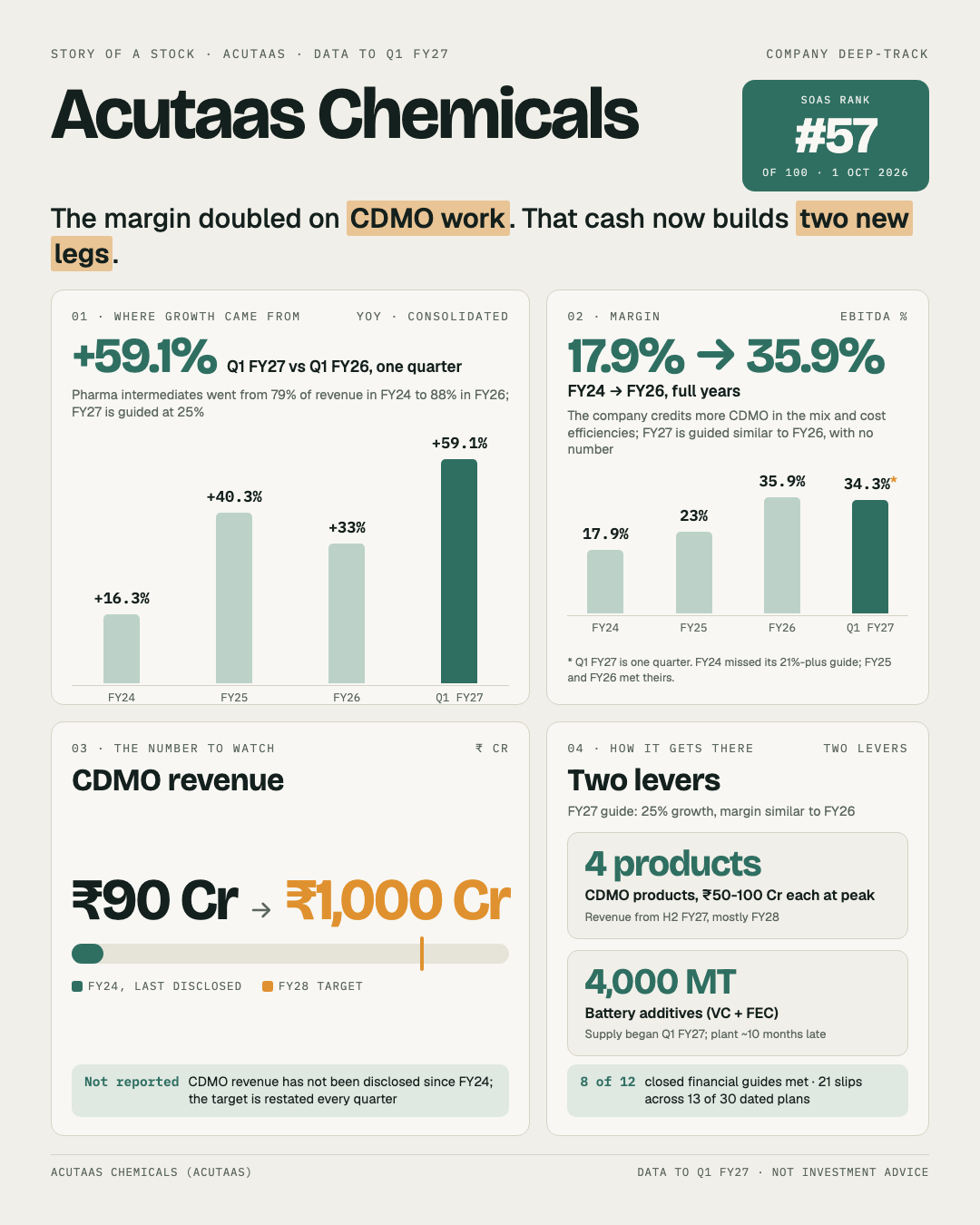
That's the Acutaas Chemicals story on one page. Below is the same story in words, built from thirteen earnings calls, fifteen investor decks, three annual reports and twelve broker notes.
In June I named Acutaas, then still Ami Organics, as one of the five steepest score climbers in the Neuland case study. This is the first full read of what sits under that climb.
Picture a farm that grows an ordinary crop for hundreds of buyers. Neighbours grow it too, and the buyers know what everyone charges. Then one buyer asks the farm to grow something to order, on contract, in a field set aside just for him. That crop pays far more than anything else on the farm.
Acutaas is that farm. It makes pharma intermediates, the chemical steps before a drug's active ingredient, for about 600 customers in about 55 countries, and exported about 77% of FY26 revenue. Its contract work for drug innovators, CDMO, is the special crop, and the money from it is going into two new fields: battery additives and chip-making chemicals.
There is one catch. Since FY24 the farm has stopped telling anyone how big the special harvest is.
The central takeaway
The record is mixed. Acutaas has met 8 of its 12 closed financial guides and beaten its revenue guides for FY25 and FY26, but 21 dates have slipped across 13 of its 30 dated plans. The money arrives; the new fields arrive late.
The debate is no longer whether one contract can lift the margin. It is whether the CDMO crop can grow from ₹90 Cr in FY24 to ₹1,000 Cr by FY28, and the new fields start paying, while the farm's cash runs behind its planting.
At a glance
- The step-up: FY26 revenue ₹1,339 Cr, 87.7% of it pharma intermediates; EBITDA margin 17.9% in FY24 and 35.9% in FY26; profit ₹356 Cr, more than double FY25's.
- Q1 FY27: revenue ₹329.7 Cr, up 59.1%; pharma intermediates up 76.5%, specialty chemicals down 10.6%.
- The new fields: battery additives had no revenue in FY26 and began supply in Q1 FY27; chip chemicals made ₹16 Cr.
- Cash: profit turned into operating cash at 0.82x over five years, and free cash flow was negative in each of them.
- The FY27 guide: 25% revenue growth at a margin similar to FY26, with no number given.
Where this lives on the portal: the Acutaas Chemicals guidance page.
1. FY24 showed the old crop has no fence
In FY24 local rivals buying Chinese raw material at lower cost cut prices by 10-30%. Acutaas kept its share by giving up price. The growth guide of 20-25% was cut twice, to 15-18%, and the year closed at 16.3%. The margin, guided above 21%, ended at 17.9%, and return on capital fell below its cost.
That is why our moat call is no moat. The drug filings that name Acutaas as a supplier also name others, and uncontracted sellers quote off export price data. Asked about lock-in, management put it plainly: "A reference price is used to negotiate. That's it."
The company claims 50-90% of the world market in its key intermediates. FY24 showed that protects volume, not price.
2. One contract crop doubled the margin, and its harvest is no longer reported
Pharma intermediates went from 79% of revenue in FY24 to 88% in FY26. The company credits more CDMO in the mix, and cost efficiencies, for an EBITDA margin that rose from 23.0% in FY25 to 35.9% in FY26.
The guides followed the crop up. FY25 was first guided at 17-22% growth, raised four times to 35%, and came in at 40.3%. FY26 was raised from 25% to about 30% and came in at 33%.
The crop is narrow: FY26's return on capital rests on one CDMO molecule, made in a block set aside for one buyer. CDMO revenue was last disclosed at ₹90 Cr, for FY24. The target is ₹1,000 Cr by FY28, which management says it is "confident to beat", restated every quarter without the number it is measured by.
Four more validated CDMO products, each worth ₹50-100 Cr a year at peak, were first dated to FY26 and now bring revenue from H2 FY27, mostly in FY28.
3. The two new fields are planted, but late and not yet paying
The battery field is 4,000 MT of VC and FEC, additives that go into lithium-ion cells. Nearly all of this supply comes from China today, and cell makers selling outside China want another source: "Demand here is unprecedented, driven by tight global supply", says management. The plant opened about ten months after its first date and began supply in Q1 FY27, with full use guided within three years. It earns less than pharma, so it will dilute the company margin as it grows.
The chip field made ₹16 Cr in FY26 through Baba Fine Chemicals, which is 55% owned and makes photoresist chemicals. The Korean plant, 75% owned, is running ahead of its capex dates, and its revenue is dated to FY28. Management says AI is pulling memory-chip demand up while supply is already tight.
Meanwhile the oldest field, commodity chemicals, is being cleared for higher-margin products from FY27.
4. So far the planting has run ahead of the farm's own cash
Profit has turned into operating cash at 0.82x over five years, and free cash flow was negative in each as capex ran ahead. Working capital was guided at 95-105 days for FY26 and came in at 120, with receivables at 99 days.
The gap was filled with equity. A ₹500 Cr QIP and preferential issue in FY25 repaid ₹250 Cr of debt and funded capex, and the company held ₹198 Cr of net cash in March 2026.
The annual report checks are clean: related-party dealings at 1.5% of revenue, no pledged promoter shares, unmodified audit opinions. The auditor does list cash losses at the battery and chip subsidiaries, still in what management calls their investment phase.
5. What the price already assumes: about 44% a year, above our bull case
At ₹3,304 on 29 September, the price implies about 44% growth a year for the next two years. Our cases put revenue growth at 15-20% in the bear case, 25% in the base case and 30-40% in the bull case, with the margin held at FY26's level.
That is above the top of our bull case. The trailing P/E of 70 sits above its 59.4 median since listing, and the only full year at such a pace was FY25, at 40.3%.
What would make me wrong
- The guide has been low two years running. FY25 and FY26 were raised during the year and still beaten, and Q1 FY27 grew 59.1% against a 25% guide.
- "Confident to beat" may be literal. If the four products ramp as dated, CDMO could pass ₹1,000 Cr unreported.
- Profit has compounded faster than revenue. Profit grew about 49% a year from FY22 to FY26, against about 27% for revenue.
The opposite error would be to read the FY26 margin as permanent. It rests on one product's ramp, and FY24 showed how fast prices on the rest of the farm can reset.
The one question that matters
CDMO revenue: ₹90 Cr in FY24, the last figure disclosed, against ₹1,000 Cr targeted for FY28. Until it is reported again, pharma intermediates revenue, ₹1,174 Cr in FY26, is the nearest proxy.
What I'll be watching
- Do the four validated products show revenue in H2 FY27, as dated?
- Does battery supply grow each quarter once the third product's capex is done?
- Does working capital come back towards 95-105 days, and does free cash flow turn positive?
Final assessment
Acutaas turned one contract crop into a doubled margin and planted two new fields with the proceeds and new equity. The money guides mostly land; the dates, the cash and the size of the crop that pays for it all are where the record is thin.
The full read is on the Acutaas Chemicals company page.
The new fields are planted. What the price is paying for is a harvest the farm has stopped weighing in public.
This is a summary of what Acutaas Chemicals' filings, earnings calls, annual reports and broker notes say. It is not investment advice or research.