Aarti Pharmalabs: The vats are filling. The till is not
Pranav Yadav · · 9 min read
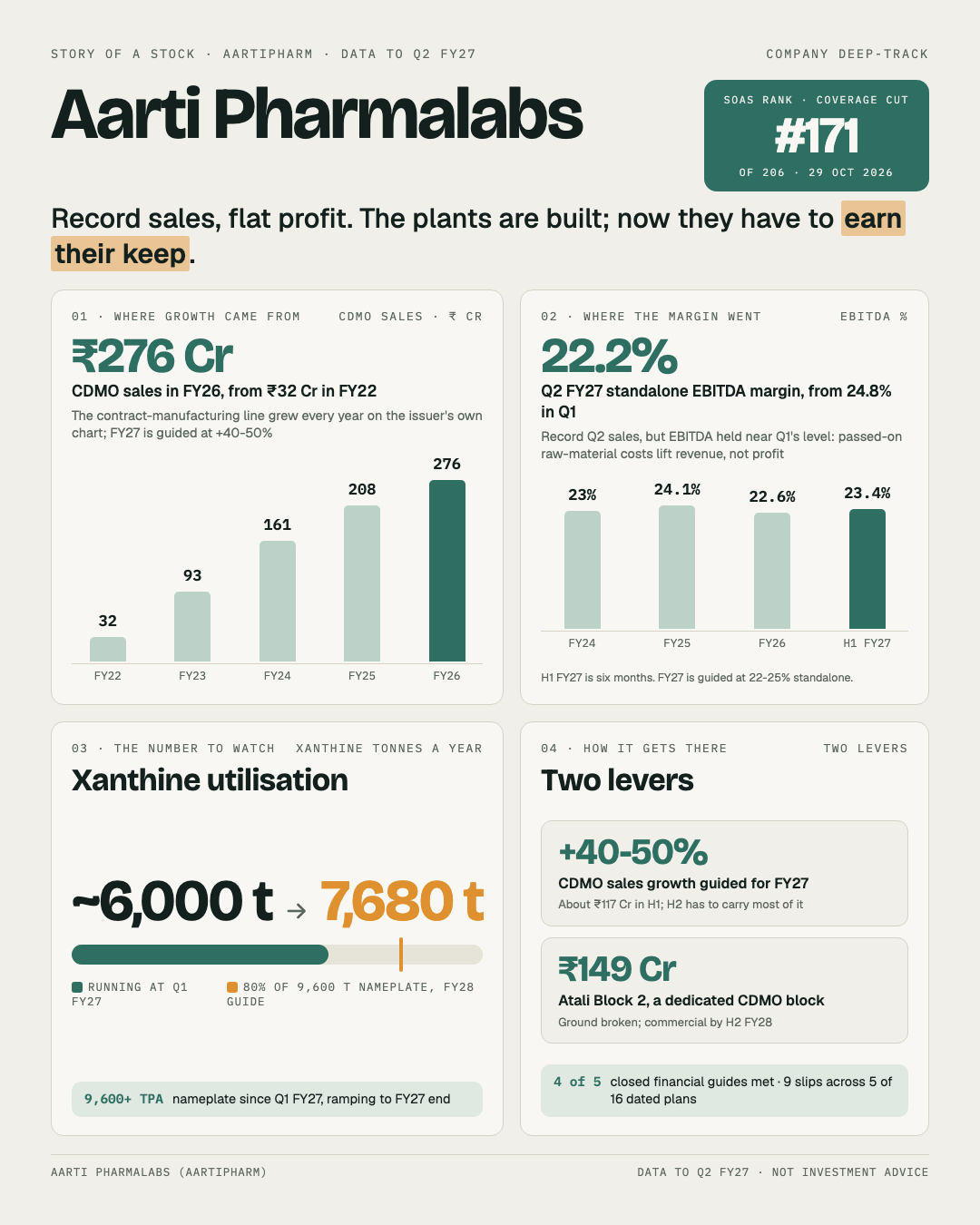
That's the Aarti Pharmalabs story on one page. Below is the same story in words, built from every call and deck since the 2023 listing, the Q2 FY27 results filing, three annual reports and two broker notes. The official Q2 FY27 call transcript is not out yet, so anything from that call is labelled as third-party.
On 23 September I wrote that Aarti Pharmalabs had spent three years building bigger vats, and now had to prove it could fill them. The Xanthine capacity had just arrived, above target, in the same year its EBITDA guide was cut twice and still missed.
Five weeks later the vats are filling. Q2 FY27 sales were a record ₹612.6 Cr, up 46.8% on a year earlier, and the plants that ran late are running.
But a chemical maker gets paid twice: when the product leaves the vat, and when the customer's money reaches the till. This half, only the first really happened. Operating cash flow for the six months was ₹29.9 Cr against ₹137.1 Cr of profit, and EBITDA has sat at about ₹134 Cr for three quarters while sales climbed.
Where this lives on the portal: the Aarti Pharmalabs company page.
1. What Aarti Pharmalabs makes
Three kinds of vat
Aarti Pharmalabs makes three things. Xanthine derivatives, caffeine above all, go into drinks and medicines, about two-thirds of the volume to beverage makers. Generic APIs and intermediates go to drug makers in regulated and other markets. Under contract (CDMO/CMO), it makes intermediates and APIs for innovators' new molecules. In FY26 the three split 47.5%, 36.0% and 16.5% of the sales the company assigns to them, with trading and other sales outside that count.
Mostly abroad, with no big customer
Customers outside India were 55.4% of FY26 standalone revenue, and no single customer reached 10%. The company holds 60 US drug master file approvals and 44 European certificates, the paperwork a plant needs to supply regulated markets.
Why the vats are not a moat
Our call is no moat. Its Chinese, Indian and European rivals hold the same kind of approvals. Xanthine prices follow cost and Chinese supply, and the recent rise came from China withdrawing an export rebate and from US tariffs, which help every producer outside China. Innovators keep several suppliers, as Aarti's own wins from other vendors show.
2. How it got here
A business that grew up inside another
The company traces itself to Aarti Organic, set up in 1984, a first API unit at Dombivli in 2001 and caffeine at Tarapur Unit 5 in 2016. For most of that time the pharma business sat inside Aarti Industries. It was demerged into Aarti Pharmalabs with effect from 17 October 2022, and the shares began trading in early 2023.
A joint operation that became a joint venture
Aarti Pharmalabs holds half of Ganesh Polychem, counted line by line as a joint operation until 31 March 2025 and as a joint venture, a profit share only, since. That is why consolidated sales fell in FY26 while the core grew, and why I quote standalone figures.
Building with borrowed money
It has raised no equity since listing. Atali, a greenfield site in Gujarat, commissioned its first 450-plus kL of reactors in 2025, and Tarapur Unit 5 took Xanthine capacity to 9,600 tonnes a year in 2026, from the 6,000 it ran in FY26. Standalone borrowings rose from ₹207 Cr in FY23 to ₹686 Cr in FY26 to pay for it.
3. How the numbers have moved
Profit outgrew sales, then the new plants cost money
Standalone revenue went from ₹1,502 Cr in FY24 to ₹1,771 Cr in FY25 and ₹1,798 Cr in FY26, with the EBITDA margin at 23.0%, 24.1% and 22.6%. In FY24 Xanthine prices fell about 20-25%, yet profit rose because raw materials fell faster. FY25 consolidated EBITDA grew 20%.
Then in FY26 standalone EBITDA fell 4.8%, to ₹406 Cr, and profit 31.5%, to ₹176.2 Cr, as Atali started slowly, API sales weakened, depreciation and interest rose, and a ₹33 Cr forex loss landed.
Returns cleared the bar, until FY26
Standalone return on capital was 15.4%, 15.6% and 16.2% from FY23 to FY25, and 10.5% in FY26, against the 12% cost of capital we assume. Capex ran ahead of operating cash in FY25 and FY26, and inventory days reached 280: large CDMO orders take several quarters to make, and customers pay no advance.
CDMO grew from small
CDMO sales went from ₹32 Cr in FY22 to ₹276 Cr in FY26, 32% up in the last year, mostly as a second, third or fourth supplier on a molecule: growth, not lock-in.
What the forensic checks say
The FY26 audit opinion is clean, with an emphasis of matter on that forward contract. Related-party dealings, mostly trade with Aarti group companies, are about 14% of revenue, and a stamp-duty order on the 2022 demerger adds ₹57 Cr of contingent liability under challenge.
4. The last two quarters
Record sales, flat EBITDA
Q2 FY27 standalone revenue was ₹612.6 Cr, 14.6% above Q1 and 46.8% above a Q2 FY26 restated down for a forward-contract loss. EBITDA was ₹135.8 Cr, against ₹132.7 Cr in Q1 and ₹134.1 Cr in Q4 FY26, and the margin fell to 22.17% from 24.82%. Profit was ₹65.8 Cr.
On the 29 October call (third-party transcript; the official one is due), management put the margin slip down to raw-material costs passed on at cost. That lifts sales without lifting gross profit.
The cash went into stock and receivables
Between 31 March and 30 September, inventories rose from ₹636.2 Cr to ₹788.2 Cr and receivables from ₹586.6 Cr to ₹695.1 Cr. Working capital absorbed ₹215.0 Cr in the half, against ₹48.8 Cr a year earlier, and current borrowings went from ₹499.8 Cr to ₹676.6 Cr. On the call the MD gave a 165-167 day working-capital cycle and said the company will have to live with higher inventory; he did not explain the receivables.
Things the call did not discuss
The board meeting that approved the results also noted the CFO's resignation, effective 30 October, and named a successor from 31 October. On the third-party transcript, nobody raised it. Separately, the promoter group had pledged 11.98% of its shares by 30 September, against almost none at the end of 2025, and its stake fell from 42.86% to 39.66% during the quarter. No reason is given in the filings we hold.
5. Where growth comes from next
Filling 9,600 tonnes
The plan is to fill what is built: the Xanthine ramp runs to the end of FY27, with 80%-plus use guided by FY28. Xanthine sales were about ₹305 Cr in Q1 and ₹306 Cr in Q2, worked out from the deck's mix, against a Q1 guide of ₹900-1,100 Cr for the year. On the call the MD said ₹1,400-1,500 Cr is possible at full capacity if prices stay high, and that spot prices will soften.
A second half for CDMO
CDMO's FY27 guide is 40-50% growth on ₹276 Cr, or ₹386-414 Cr. The first half came to about ₹117 Cr, worked out the same way, so the second half needs about ₹270-300 Cr. The pipeline is 23 customers and 59 projects, 39 of them commercial. Atali Block 2, ₹149 Cr and about 405 kL for specific CDMO projects, has broken ground and should start commercial supply by H2 FY28.
Our cases
On standalone figures, our base case has revenue growing 17-25% in FY27, because the first half is already in, and 15-18% in FY28, the company's own frame: 16-21% a year over the two years. Carried through the 22-25% margin guide, that is 14-27% a year of EBITDA growth. The bear case is 5-11% revenue and 4-10% EBITDA growth, the bull case 21-26% and 25-33%. FY27 capex is guided at about ₹400 Cr, and ₹123.2 Cr was spent in the first half, so about ₹277 Cr is still to go.
6. What management promised, and what it delivered
Aarti Pharmalabs has met 4 of its 5 closed financial guides. FY25's 10-12% EBITDA growth guide came in at 20%. The miss is FY26, and it was not small: a 12-15% EBITDA growth guide was cut to 8-12%, then to "marginal growth", and EBITDA fell 4.8%.
Dates are the weaker side: 9 re-dates across 5 of 16 dated plans. The Xanthine expansion was first due by the end of FY25 and arrived in Q1 FY27, more than a year late but above its 9,000-tonne target. Atali Block 1's ramp, due in Q4 FY26, finished in Q2 FY27, two quarters late. In September I counted 19 dated plans; the count now leaves out three with no deadline, a change of method rather than a new slip.
The live guides are the 22-25% FY27 margin, given by the CFO who has now left, CDMO's 40-50%, and a 15-18% revenue and EBITDA growth frame over three to four years, kept on the 29 October call.
7. What the price already assumes
At ₹928 on 29 October the price implies about 22.7% earnings growth a year for the next two years. That sits inside our base case of 14-27%, a little above its midpoint of 20.9%, and below the bull case of 25-33%.
In September the price implied about 27% a year against base and bull cases of 16% and 18%. Since then the half-year added profit to the trailing year, and our cases now carry a first half that grew 44.7%. The P/E of 32.3 sits above the upper quartile of its range since listing, 29.2, at 0.94 times its industry median. The price asks for the plan to work, with little room for the second half to disappoint.
What would make me wrong
- The cash may come back in the second half. CDMO stock is paid for on delivery, so if CDMO lands ₹270-300 Cr in H2, much of the inventory turns into cash.
- The margin may recover. H1 still ran at 23.40%, inside the 22-25% guide, and on the call management said the CDMO mix can lift the second half.
- Xanthine may beat its guide. H1 already brought about ₹611 Cr of a ₹900-1,100 Cr range.
The opposite error would be to read record sales as a stronger business. EBITDA has not moved for three quarters, the cash went into stock and receivables, and the CFO who gave the margin guide has left.
The full read is on the Aarti Pharmalabs company page.
The vats are filling faster than at any time since listing. Until the till fills with them, the growth is being paid for with borrowed money.
This is a summary of what Aarti Pharmalabs' filings, results documents, earnings calls, annual reports and broker notes say. It is not investment advice or research.