Aarti Pharmalabs: It built bigger vats for three years. Now it has to prove it can fill them
Pranav Yadav · · 6 min read
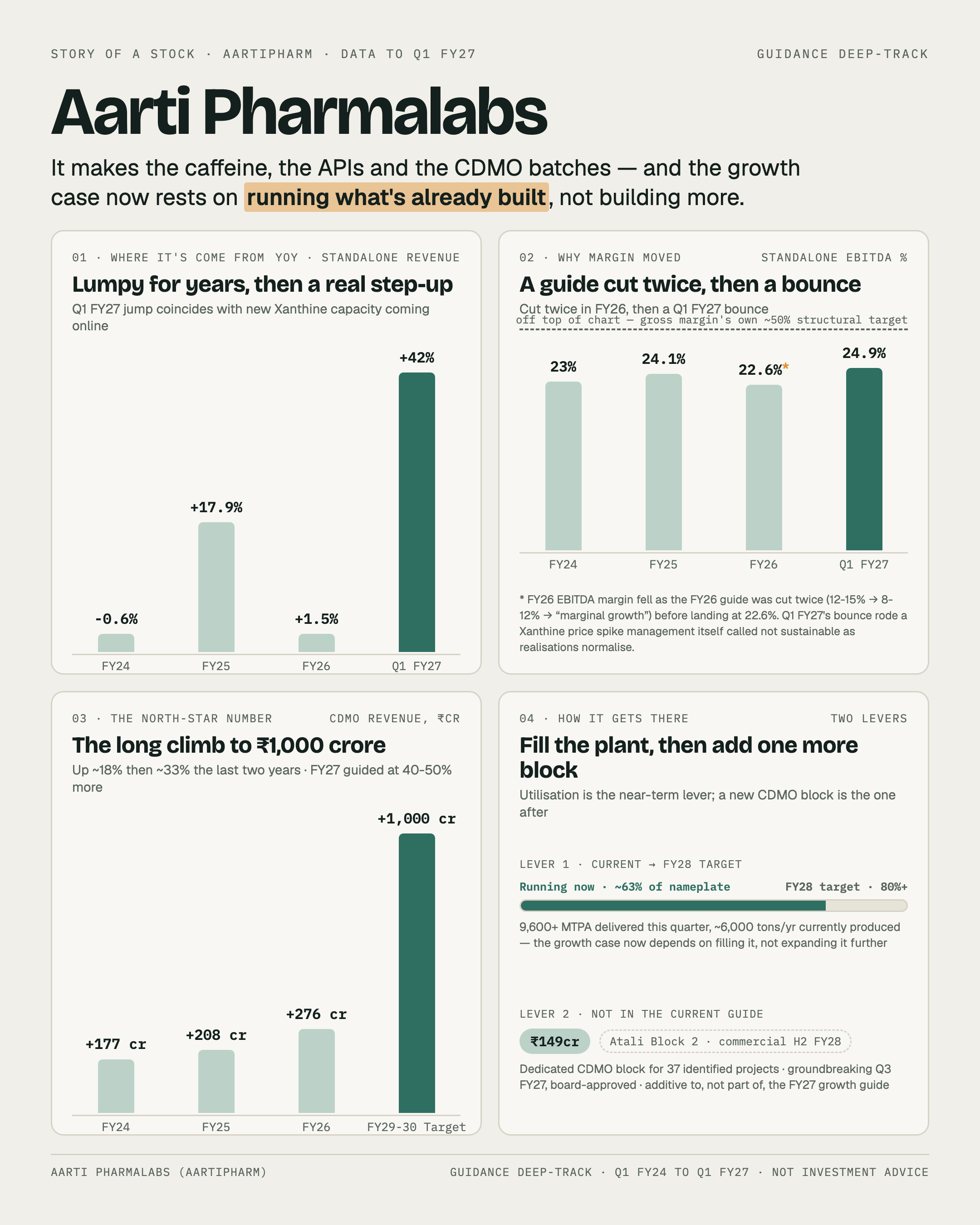
That's the whole Aarti Pharmalabs story on one page. Below is the same thing in words, built from every concall transcript and investor deck the company has published since its 2023 listing, plus two broker notes that actually cover it.
A vat only earns its keep once it's full.
Aarti Pharmalabs makes caffeine and other Xanthine derivatives, generic APIs, and small-molecule batches for other drugmakers under contract.
For three years, its story was the vat itself: bigger reactors, more capacity, a bigger footprint.
This quarter, the capacity arrived. Xanthine output capacity nearly doubled, to more than the company had even promised.
The story now has to change, from building vats to filling them, and the first year of that new story already has a real miss in it.
The central takeaway
The debate is no longer whether Aarti Pharmalabs can build capacity. It has just done that, ahead of its own original target.
It is whether the company can fill what it built, and hold a margin while doing it, fast enough to justify what the market is already paying for the answer.
At a glance
- Xanthine capacity: delivered at 9,600-plus tonnes a year, above the original 9,000-tonne target, one quarter later than first promised.
- FY26 standalone EBITDA: fell about 5% year-on-year, after the growth guide was cut twice, from 12-15% to 8-12% to "marginal growth."
- Q1 FY27 bounce: standalone revenue up 42%, EBITDA up 40%, largely on a Xanthine price spike management itself called not sustainable.
- Track record: four of five closed annual guides met. Nine timing slips across nineteen dated capacity and milestone commitments.
- The long-term CDMO number: about Rs1,000 crore (or $100 million), restated for four straight quarters, now dated to FY29-30.
- What the price assumes: about 27% growth a year, against the company's own base case of 16% and bull case of 18%.
1. The base case has a real record, with one exception
Aarti Pharmalabs guided FY24 EBITDA growth of 8-10%, after cutting it from an original 10-15%. It delivered about 13%.
It guided FY25 EBITDA growth of 10-12%, later raised to "meet and exceed." It delivered 20%.
It guided Xanthine capacity to 9,000 tonnes. It delivered 9,600-plus.
Then FY26 broke the pattern. EBITDA growth, guided at 12-15%, was cut twice and still landed negative.
Four of the five closed financial guides in this company's short history were met or beaten. The fifth is the one sitting in the most recent full year.
2. The lock is real, but still unproven at scale
Getting a Xanthine or API plant approved for the regulated US and European markets takes years of filings. Aarti Pharmalabs holds 60 US drug master files and 44 European filings, more than most peers its size, and it is the largest Indian producer of Xanthine derivatives.
That is a genuine, slow-to-replicate lock. A customer who has spent years qualifying a supplier's plant does not switch it for a small discount.
But the company's own return on capital has been tracked for only three years since its 2023 demerger, not long enough to call the pattern proven, and the one name it names as a real competitive threat is Chinese bulk caffeine producers, who can in principle build the same scale with enough capital and time. Management itself declines to name specific API or CDMO rivals on record.
3. The lever is utilisation, not more capacity
The company is running its new Xanthine capacity at about 63% today. Its own target is 80%-plus by FY28.
That gap, not a new plant, is the arithmetic behind the growth case now. A second lever, a new dedicated CDMO block at Rs149 crore, is board-approved and breaks ground next quarter, but management itself frames it as additive capacity for identified projects, not yet part of the current growth guide.
Both levers point the same way: run what exists harder before building the next thing.
4. The record slipped exactly where the ask got bigger
The Xanthine capacity build slipped three times, from an original end-FY25 target to Q1 FY27, before it was delivered.
The plant behind part of that capacity, Atali, has been operational since last year, but its ramp to full utilisation has itself slipped twice and is still guided out to the coming quarter.
And a long-standing target of about 15% annual EBITDA growth over three years, reaffirmed for five straight quarters, was disowned by management this year when an analyst restated it as a wider 15-20% band: "that is the number that we have not stated."
That target has since been replaced by a new one, a 15-18% combined revenue and EBITDA growth frame through FY30, which has not yet been tested against a single full year of delivery.
5. What the price already assumes
Working backward from today's price, Aarti Pharmalabs needs to grow at about 27% a year to justify itself.
The company's own base case is 16%. Its own bull case, the top of its own range, is 18%.
The price is not asking for the guide. It is asking for something well above the best number management has put forward.
What would make me wrong
- The closed-guide record is genuinely strong. Four of five annual financial guides met or beaten is not a company that talks big and delivers small.
- The one capacity promise that mattered most was beaten, not just met. 9,600-plus tonnes against a 9,000-tonne target is a real overshoot, not a narrow save.
- The CDMO long-term number has been restated, not walked back. Unlike the disowned EBITDA frame, the Rs1,000 crore CDMO target has held steady across a year of calls and just gained an explicit date.
- The regulatory filing moat is real and slow to build. Sixty US filings and forty-four European ones took years to file one by one and cannot be shortcut.
If I am too harsh here, it is because a company with this good a hit rate on its own numbers deserves more patience on the one year it missed.
The one question that matters
What does Xanthine utilisation actually reach by FY28, and does pricing hold as it climbs from 63% toward 80%?
Every version of the growth case, this year's and the new multi-year one, resolves to that single number. A capacity that sits unused earns nothing on the capital it consumed.
What I'll be watching
- Does Atali's ramp-up finally close out next quarter, or does it slip a third time?
- Does the new 15-18% CAGR frame survive its first full year of results, or repeat the pattern of the number it replaced?
- Does the Rs1,000 crore CDMO target keep the FY29-30 date it was just given, or start moving again?
Final assessment
Aarti Pharmalabs has proved it can build what it says it will build, and mostly deliver what it guides.
It has not yet proved it can run the thing it just built at the rate the price already assumes.
The full read, including every guidance thread and the sources behind it, is on the Aarti Pharmalabs page.
A vat only earns its keep once it's full. This one was finished this quarter. Whether it fills fast enough is the whole story from here.
This is a summary of what Aarti Pharmalabs' filings and two broker notes say. It is not investment advice or research.