Welspun Corp: The stitching promise holds. The new workshops keep slipping
Pranav Yadav · · 7 min read
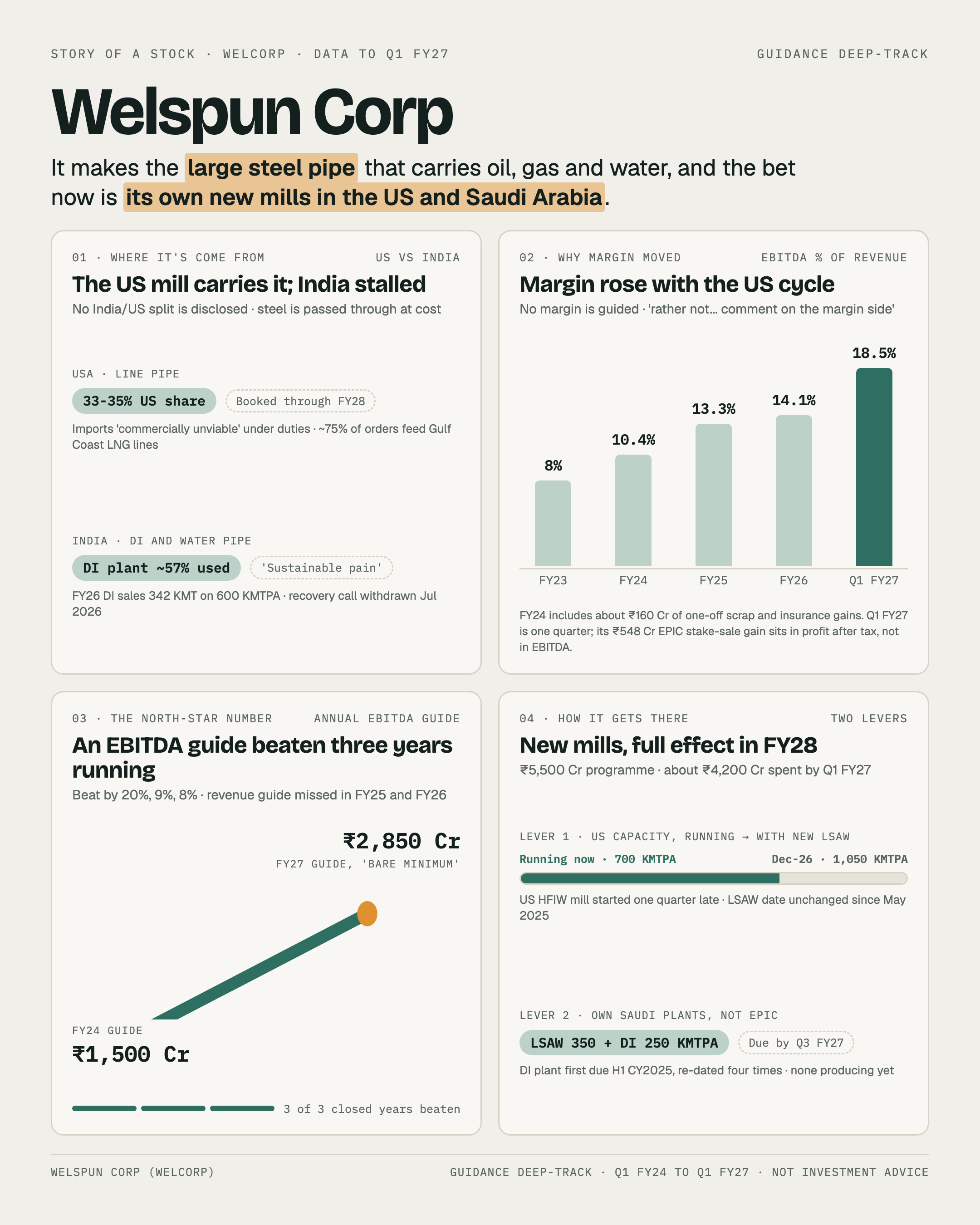
That's the Welspun Corp story on one page. Below is the same story in words, built from twelve earnings calls, nineteen investor decks and eighteen broker notes, Q1 FY24 to Q1 FY27.
A tailor who buys the cloth for you bills you for two things: the cloth, at whatever the mill charged, and the stitching. If cloth gets cheaper, the bill shrinks. The stitching fee is the part the tailor keeps.
Welspun Corp works the same way. It makes large steel pipe for oil, gas and water lines in India and the US, order by order. Steel is priced in and hedged, so management says revenue "is a function of input steel price, which are a pass through". What it guides is the stitching: EBITDA, and a return on capital above 20%.
For three years the stitching promise held and the bill did not. Now the tailor is building new workshops in the US and Saudi Arabia, and they decide the next two years.
The central takeaway
The record is mixed. Management met 5 of the 7 financial guides that have closed: every annual EBITDA guide, plus FY24's revenue and earnings-per-share guides. Both misses are revenue, in FY25 and FY26. Dates slipped 15 times across 8 of 27 dated promises, most of them plant dates.
The debate is no longer whether Welspun hits its revenue number. It is whether the new mills start on the dates their orders are booked against.
At a glance
- FY26 delivered: revenue of ₹16,770 Cr, up 20%, against a ₹17,500 Cr guide; EBITDA of ₹2,371 Cr, up 28%, against ₹2,200 Cr.
- The FY27 guide: ₹20,000 Cr of revenue and ₹2,850 Cr of EBITDA, "the bare minimum", not raised after a record Q1 EBITDA of ₹756 Cr.
- Orders: a record USD 4.7 bn, about ₹45,000 Cr, on 25 September 2026.
- Margin: EBITDA margin of 8.0% in FY23, about 14% in FY26. No margin is guided.
- What the price assumes: about 50% growth a year for two years.
Where this lives on the portal: the Welspun Corp guidance page.
1. EBITDA beat every annual guide, and the revenue misses are mostly the cloth
The EBITDA guides were ₹1,500 Cr for FY24, ₹1,700 Cr for FY25 and ₹2,200 Cr for FY26. Delivery was ₹1,804 Cr, ₹1,858 Cr and ₹2,371 Cr, beats of 20%, 9% and 8%. About ₹160 Cr of FY24's number was one-off scrap and insurance income, so the first beat is smaller than it looks.
Revenue is different. FY25 was guided at ₹17,000 Cr of total income and delivered ₹14,167 Cr, about 17% short. FY26 was guided at about ₹17,500 Cr and delivered ₹16,770 Cr, 4.2% short. In February 2025 the MD said the top line "has no relevance for us".
Most of that is the cloth: with the steel hedged ("my price is fixed"), a cheaper steel year shrinks the invoice without touching the fee. Not all of it, though. Line-pipe tonnes fell from 980 KMT in FY24 to 851 KMT in FY25. The EBITDA record is well evidenced, but the beat has narrowed every year.
2. The margin rose from 8% to 14% with the US pipeline cycle, and none of it is guided
EBITDA margin went from 8.0% in FY23 to about 14% in FY26, and ROCE from 7.9% to 22.3%. The step came in FY24 and FY25 as the US mill filled; FY24 also carried about ₹160 Cr of one-offs. The company gives no India/US split.
Q1 FY27 printed 18.5%. The only fee Welspun guides is about $300 of US EBITDA a tonne, which the MD says current orders run well above. On margins he would "rather not" comment. That fits the mechanism: when the cloth price moves, the stitching's share of the bill moves too.
3. The US position is real, but every mill behind the tariff wall shares it
Welspun is the largest US line-pipe maker, with a share management put at "more than 33% or 35%" in May 2026. Duties make imports "commercially unviable", and about 75% of the US book feeds Gulf Coast gas export lines.
Our moat call is no moat, rated weak. The duty wall protects every mill inside it: a US LSAW mill costs about ₹1,075 Cr, and management says one West Coast rival already makes LSAW pipe there; Welspun's own LSAW mill makes it two in December 2026. In FY23, the one downturn in the window, ROCE fell to 7.9%, below an assumed 11-12% cost of capital. A broker, IIFL, puts US EBITDA at ₹4,279, ₹19,276, ₹9,904 and ₹27,339 a tonne across FY23 to FY26.
So the stitching fee is not fixed. It is set by how busy every tailor in town is, and right now the town is busy.
4. FY28 rests on new mills, and the Saudi workshops keep slipping
About ₹4,200 Cr of a ₹5,500 Cr capex plan was spent by Q1 FY27, with net cash still in hand. In the US, a new 350 KMTPA HFIW mill came on one quarter late, by July 2026. A 350 KMTPA LSAW mill has been dated December 2026 since May 2025.
Saudi Arabia is where the dates move. Welspun's own DI pipe plant, separate from EPIC (the Saudi associate it holds more than 22% of), was first due in H1 CY2025. It has been re-dated four times and is now 250 KMTPA "by quarter 3" of FY27. Its 350 KMTPA LSAW sister plant has slipped twice to the same date.
The US orders are there: about USD 1.8 bn (₹17,200 Cr) and USD 412.5 mn (₹4,000 Cr), won in August and September, both running over FY28-FY29. The MD puts the full earnings effect of the new plants in FY28. India's DI demand is now "a sustainable pain".
5. What the price already assumes: about 50% a year, far above the bull case
At ₹2,754 on 28 September, the price implies about 50% revenue growth a year over the next two years, at a flat margin. Our cases put it at 1-10% in the bear case, 12-16% in the base case and 17-21% in the bull case. The base case sits below the FY27 guide's 19% because revenue missed its guide in two of the last three years.
That 50% is priced off the five-year median earnings, because trailing earnings per share of ₹87.55 sit far above the median of ₹30.93. Priced off trailing earnings, the implied rate is about 23%, still above the bull case.
In words: the market is paying for FY28 to arrive on time and for today's fee per tonne to be the new normal.
What would make me wrong
- The orders are dated and large. A ₹45,000 Cr book is not a forecast. If the new mills start on time, FY28 could beat our bull case.
- The guide is a floor, and Q1 already did 27% of it. Q1 EBITDA was ₹756 Cr against ₹2,850 Cr for the year.
- The 50% overstates the gap. On trailing earnings the implied rate is about 23%, just above the bull case.
The opposite error would be to read three EBITDA beats as proof the fee is permanent. IIFL's US figures show it halving in FY25 before nearly tripling.
The one question that matters
How much of the 950 KMTPA of new capacity is producing by December 2026? Today none of it is: the US LSAW mill (350 KMTPA) and the two Saudi plants (600 KMTPA) are still being built. Management's plan is all of it by the end of calendar 2026.
What I'll be watching
- Do the Saudi plants move a fifth time on the Q2 FY27 call?
- Is the US LSAW mill commissioned in December?
- Does first-half EBITDA keep pace with ₹2,850 Cr?
Final assessment
Welspun has kept its EBITDA promise three years running, and its revenue misses are mostly steel. It has not kept its dates for new capacity, and FY28 depends on them. The price asks for more growth than the guide itself.
The full read is on the Welspun Corp company page.
The stitching promise has held three years running. The workshops FY28 is meant to be sewn in are still being built, and one of them has been re-dated four times.
This is a summary of what Welspun Corp's filings, earnings calls and broker notes say. It is not investment advice or research.