The ghost kitchen of instant coffee is full. Its second kitchen is running late
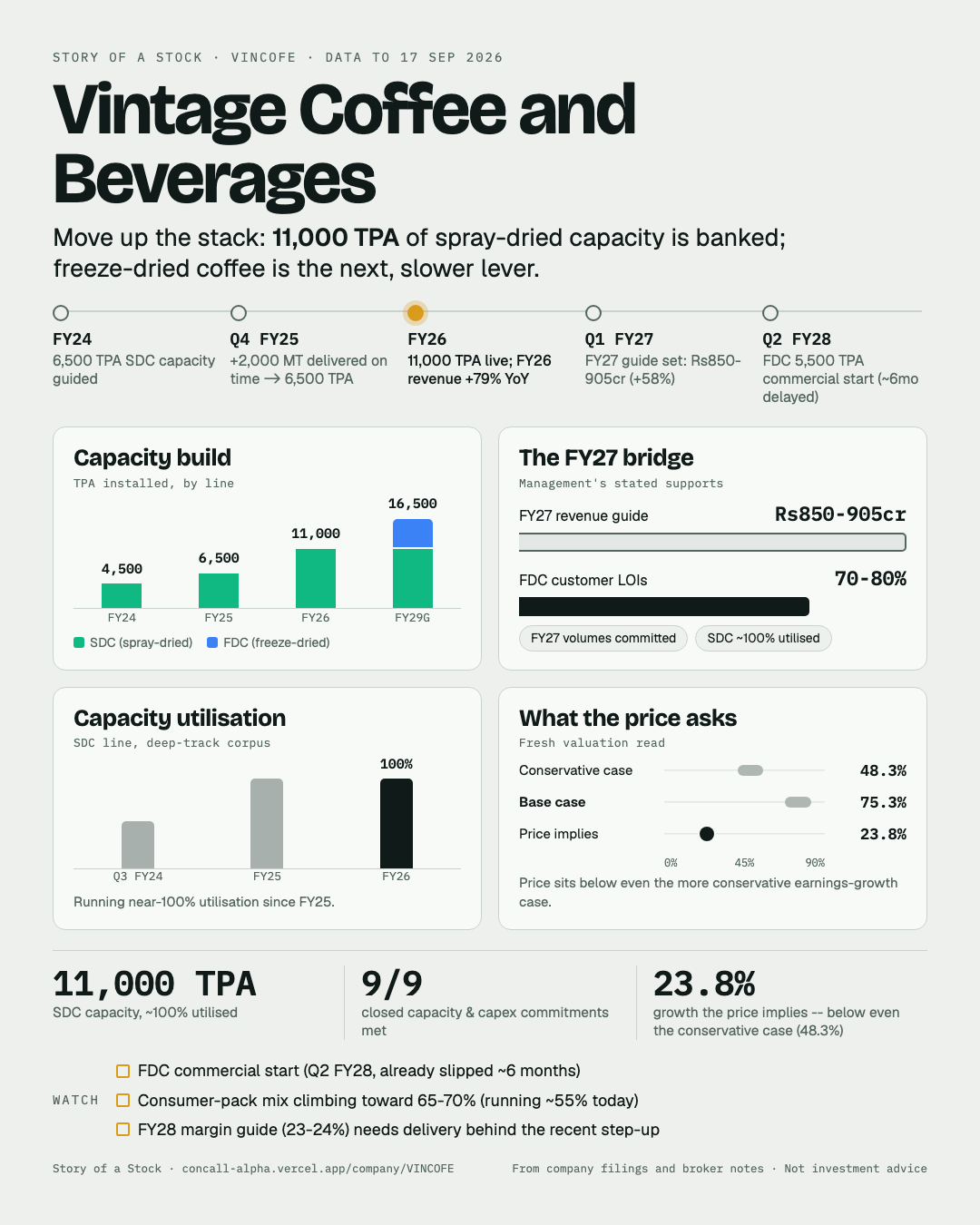
That's the whole Vintage Coffee story on one page. Below is the same thing in words, built from every concall transcript and investor deck the company has published, plus the one broker note that covers it.
You have probably never seen this company's name on a jar.
That is the business.
Vintage Coffee and Beverages makes instant coffee in Hyderabad and ships it to Africa, Russia, Southeast Asia, Europe and the Americas, where it goes on the shelf under someone else's brand.
Think of a ghost kitchen. No signboard, no dining room, no marketing. Just a kitchen that cooks each customer's recipe, to order, at scale.
The central takeaway
The kitchen is full, and that part of the story is as close to banked as small-company guidance gets.
The debate is no longer whether Vintage can fill its plant. It is whether the second, fancier kitchen opens on time.
Everything the company has promised about building things, it has done. Everything it has promised about margins is still a promise.
At a glance
- FY26 revenue: ₹553 Cr, up 79%. The year before grew about 86%.
- FY27 revenue guide: ₹850-905 Cr, roughly 58% growth.
- Capacity: 4,500 tonnes a year, then 6,500, now 11,000. The line ran at about 100% in the latest quarter.
- Operating margin: about 19% guided for FY27, 23-24% guided for FY28-29.
- Next plant: 5,500 tonnes of freeze-dried coffee, ₹550 Cr, commercial start in Q2 FY28.
- The record: nine commitments closed, nine met. One slip across fourteen dated promises.
1. The kitchen is full, and the orders are already in
Vintage took its spray-dried line from 4,500 to 11,000 tonnes in two years.
It did not build ahead of demand. The 11,000-tonne line is running near 100%, and management says customers have already committed volumes for all of FY27.
So a 58% growth guide sounds loud, but it is quieter than what the company just delivered twice.
This is the base case. It needs no new plant and no new customer.
2. The recipe is the lock
Private label sounds like a business with no loyalty. Whoever quotes lowest wins.
Vintage's answer is the blend. Its own team develops a blend for each customer, makes it only for that customer, and does not share it.
Management says a customer who leaves cannot get "the same, exact blend" elsewhere, and that it has kept about 98% of its customers for years.
I take that seriously, but not at face value. On the same call an analyst pointed out that competitors also say they can match any specification. And the 98% is the company's own number.
It is a real lock. It is not yet a tested one.
3. A lean kitchen, not a big one
The obvious peer is CCL Products, roughly seven times Vintage's size.
You would expect the bigger player to earn more per kilo. One broker's numbers say the opposite: Vintage earned ₹114 of operating profit per kilo against CCL's ₹106 in FY24, and ₹129 against ₹107 in FY25.
That is an edge from running lean. No brand to fund, no marketing, a brownfield expansion that added 4,500 tonnes for ₹45 Cr.
But lean is a choice anyone can copy. Two years of data is not a cycle.
4. The second kitchen is where the margin story lives
Spray-dried coffee is the everyday menu. Freeze-dried is the premium one, and it earns more per kilo.
That is the whole logic of the margin guide. Moving from about 19% to 23-24% depends on the freeze-dried plant and on selling more consumer packs instead of bulk.
Customers seem to want it. Letters of intent already cover 70-80% of the new plant's capacity, from five existing customers and two new ones, before it is built.
Here is the catch.
The plant was first meant to start in FY27. It is now Q2 FY28, about six months late.
It was first meant to cost ₹450 Cr. It is now ₹550 Cr.
And the FY28 margin guide was raised from 20-21% to 23-24% in a single quarter, with nothing new delivered in between.
The one place the record has slipped is the one place the next leg depends on.
5. What the price already assumes
As of 17 September, today's price works out to about 24% a year of earnings growth being baked in.
The company's own guidance, taken at its word, points to something closer to 68-83% a year over the next two years. Even the conservative case is 41-55%.
So the market is not paying for the guide. It is paying for a fraction of it.
The multiples tell a split story. At 32.5 times earnings the stock sits below the bottom quarter of its own five-year range. Against the wider industry, the same number is about 1.9 times the median.
Below its own history, above its peers, and priced for far less growth than management promises. That gap is either the market being slow, or the market reading the margin guide the way section 4 does.
What would make me wrong
If I am too relaxed about this story, it will be for one of these reasons.
- No financial guide has ever been closed. Nine out of nine is a record on plants and capex. There is no record yet on revenue or margin, because every one of those numbers is still in the future.
- Prices reset every quarter. Contracts are cost-plus with annual volumes. A full plant protects volume, not what each kilo earns.
- A few customers matter a lot. Management has said its top five or six customers bring in 45-50% of revenue.
- CCL already runs freeze-dried capacity. Vintage is arriving second, and late, in the premium product.
- Most of the book is words. Of twenty open commitments, four are backed by orders or committed assets, thirteen are management's say-so, and three are long-range ambition.
If I am too harsh, it is because a company that has met every building deadline but one has earned some benefit of the doubt on the next one.
The one question that matters
What share of volume goes out in consumer packs?
Management wants 65-70%. It is at about 55% today, and it has already moved this year's interim aim down to about 60%.
Revenue will look after itself while the plant is full. This number tells you whether margins will.
What I'll be watching
- Does the freeze-dried plant start in Q2 FY28, or slip again?
- Does the consumer-pack share close the gap to 60% this year?
- Does any quarter bring delivery behind the 23-24% margin guide, or does it stay a statement?
Final assessment
Vintage has proved it can build a kitchen and fill it.
It has not yet proved it can change the menu.
The full read, including every guidance thread and the sources behind it, is on the Vintage Coffee page.
A ghost kitchen wins by being invisible. Its margins are the one thing it cannot hide.
This is a summary of what Vintage Coffee's filings and one broker note say. It is not investment advice or research.