Unimech Aerospace: It built a hangar for twice its fleet. The first planes in it were bought
Pranav Yadav · · 8 min read
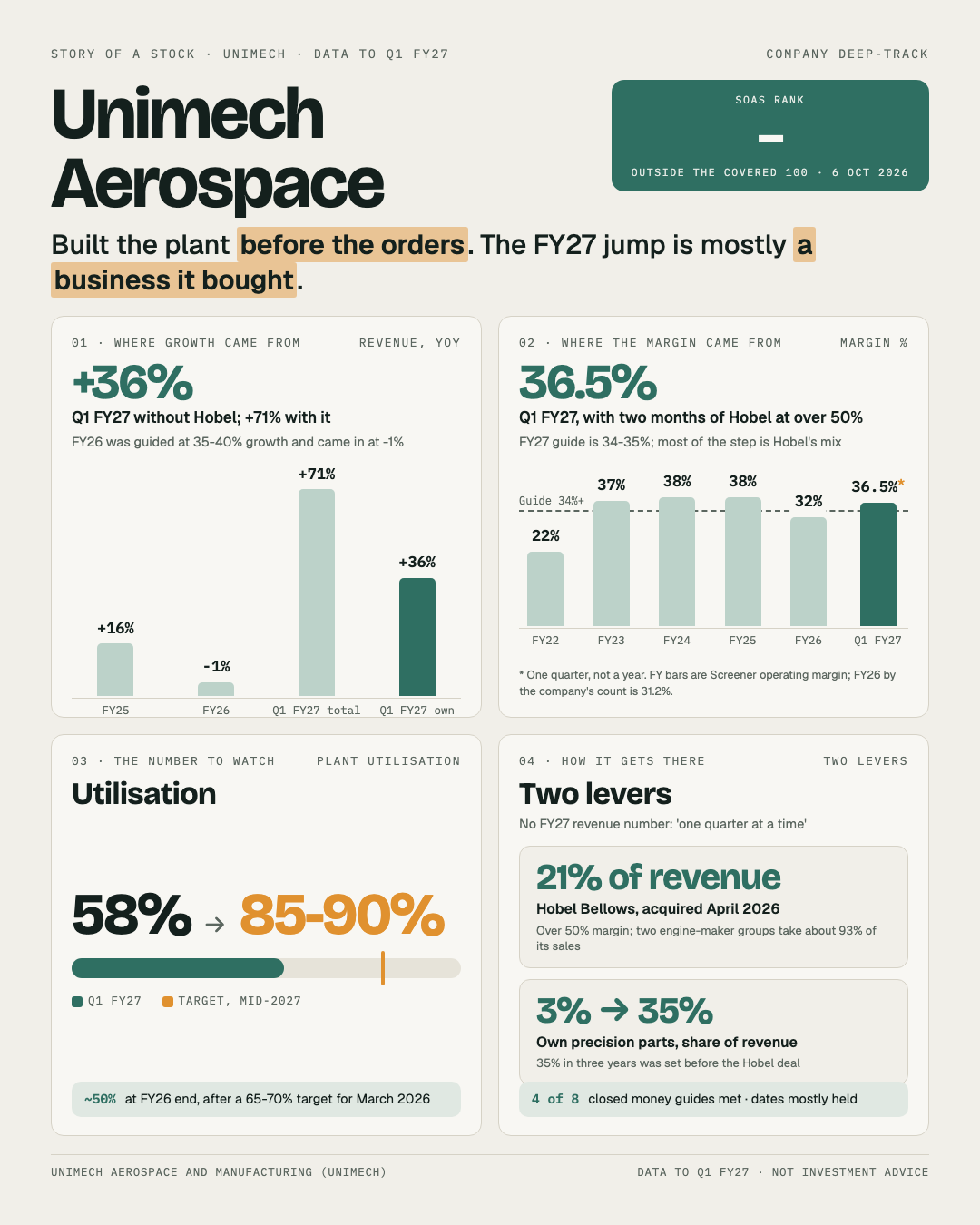
That's the Unimech story on one page. Below is the same story in words, built from eight calls, seven investor decks, two annual reports and eleven broker notes.
Picture a hangar built for twice the fleet that flies out of it. The rent is paid on every bay, full or empty, and the owner's plan is simple: win enough new routes that its own planes fill the space.
Unimech Aerospace built that hangar with its December 2024 IPO. It makes the tools that jet-engine and airframe makers use to build and repair their products, and it tripled its machine capacity ahead of the orders. Then US tariffs arrived, and FY26 left about half the bays empty.
In April 2026 it did something faster than winning routes. It bought a second hangar, Hobel Bellows, that came with its planes already parked.
Where this lives on the portal: the Unimech Aerospace company page.
1. What Unimech makes
Tools for the people who build jet engines
An engine like the LEAP is assembled, tested and overhauled on specialised fixtures, stands and gauges. Unimech makes them, for the engine makers and for the licensed suppliers who build to their designs. It works mostly to the customer's drawing, in many designs and small batches, and sells almost entirely abroad.
The work pays well: gross margin was about 70% in FY26.
A few buyers, most of them American
Three customers took 72% of FY26 revenue, and the largest alone took 44.5%. The US was 76% of revenue, and exports 89%. That concentration matters for everything that follows: when a handful of American buyers slow down, so does Unimech.
Three businesses today
Tooling is still the core, 76% of revenue in Q1 FY27. Hobel Bellows, bought in April 2026, was 21%. Unimech's own precision parts for semiconductor, nuclear and aerospace customers were about 3%.
2. How it got here
From a 2016 start to a 2024 listing
Unimech was incorporated in August 2016 and listed on 31 December 2024, after an IPO at ₹785 a share that raised ₹250 Cr of fresh money. It runs three plants in Bengaluru, the largest a 150,000 sq ft tooling facility in the aerospace SEZ at Devanahalli.
The IPO built the hangar
The listing money went into machines. Unimech tripled its machine capacity in FY25, betting that orders would follow, and set a target of 65-70% utilisation by March 2026.
Then came the deals
Over a few months the company changed shape. In January 2026 it signed a 51:49 joint venture with Saudi Arabia's Kanoo Group for a machining and repair unit in Dammam, still at a foundational stage. On 27 April 2026 it completed the purchase of Hobel Bellows, a Visakhapatnam maker of metallic bellows and exhaust assemblies for engine makers, for up to ₹450 Cr. And in Q1 FY27 it signed its first long-term parts contract, with the Austrian aerostructures supplier FACC, worth $7.5 mn over five years.
3. How the numbers have moved
Fast growth, then a stall
Revenue went from ₹36 Cr in FY22 to ₹94 Cr, ₹209 Cr and ₹243 Cr in FY25. In FY26 it stalled at ₹240.5 Cr. Operating margin climbed from 22% in FY22 to 37-38% for three years, then fell to 32% in FY26, as staff and plant costs built for growth met a year that did not grow.
Returns fell as the capital base jumped
Return on capital was 75% in FY24, earned on a small pre-IPO base. The IPO multiplied shareholders' funds, and much of the money sat as cash or as half-used machines. Return on capital fell to 22% in FY25 and 11% in FY26.
Profit leaned on interest, but cash kept up
Profit after tax was ₹63 Cr in FY26, down from ₹83 Cr. Part of it never came from the hangar: other income, mostly interest on unspent IPO money, was ₹46 Cr, 58% of pre-tax profit. The cash, though, was real. Operating cash flow was ₹61 Cr in FY26 against that ₹63 Cr profit, and ₹81 Cr in FY25 against ₹83 Cr.
The checks are clean: an unqualified audit, no promoter pledge, and related-party sales of 0.08% of revenue.
Why nothing protects those returns
Our moat call is no moat. Management describes tooling as "always a PO-to-PO business": each order stands alone, and nothing binds the customer to the next one. The approvals Unimech holds are ones a funded rival can earn, as Unimech itself did after 2016. FY26 showed it: the largest customer's share fell from 66.46% to 44.5% as it bought about a third less.
4. The last few quarters
The tariff year
FY26 was the year US tariffs reached Indian goods. Unimech's American customers stopped stocking tools and ordered only what they needed. Revenue dropped to ₹34 Cr in Q3 FY26, then recovered to ₹81.8 Cr in Q4, and the plants ran at about 50% at the year end.
A 71% quarter, a fifth of it bought
Q1 FY27 brought revenue of about ₹108 Cr, up 71% on a year earlier, at a 36.5% EBITDA margin. About ₹22 Cr of that was two months of Hobel. Without it, the business grew 36%.
The order book reads the same way. Unimech's own book was ₹180.2 Cr at 30 June, up from ₹93.4 Cr at Q4 FY25, but ₹87 Cr of it is one nuclear order. Hobel brings another ₹100.1 Cr.
5. Where growth comes from next
Hobel's first full year
Management gives no revenue number for FY27 and takes it "one quarter at a time". Our base case has reported revenue up 79-92%, about 55 points of it Hobel. With Hobel counted in both years, the same case is 18-25% a year over two years. Hobel earned a margin above 50% in FY26, and two engine-maker groups take about 93% of its sales.
Filling the bays
The number that decides the rest is plant utilisation: about 58% in Q1 FY27, against management's target of 85-90% by mid-2027. Each extra hour of work in a plant already paid for lifts the margin.
The planes it has to build itself
Unimech's own precision parts were 18% of revenue in Q1 FY26 and about 3% in Q1 FY27, against a 35% target set before the Hobel deal. The nearest help is the nuclear order, about half of it due in FY27. The Saudi venture is further out, with first revenue expected in FY28.
What growth will cost
Working capital ran at about 130 days in Q1 FY27 and is guided to 160 days plus by year end. The board has approved raising up to ₹750 Cr through a share sale, which management calls an enabling resolution, with the promoters at 79.8% and a minimum public shareholding to meet. Other income will be very moderate in FY27, so profit will grow slower than operating profit.
6. What management promised, and what it delivered
The record is mixed. Unimech has met 4 of its 8 closed financial guides, and its dates have mostly held, with 8 slips across 30 dated commitments.
The miss that mattered was FY26. Revenue growth was guided at 35-40%, with 40% called the minimum. In November 2025 that became "surpass last year's revenue", and FY26 came in 1% lower. Q4 was guided at ₹90-100 Cr and reported ₹81.8 Cr, which management counts as met before tariff concessions. Utilisation ended near 50% against 65-70%.
What it did keep: the FY26 margin guide of 30-32% was met at 31.2%. For FY27 the guide is a 34-35% EBITDA margin, most of the step coming from Hobel's mix. The ₹1,000 Cr revenue ambition for FY29 has not been restated since November 2025.
7. What the price already assumes
At ₹1,846 on 6 October, the price implies about 72% a year of near-term earnings growth. Our cases, which carry Hobel's full year and the 34-35% margin guide, give about 59% in the base case and 75% in the bull case, with 29% in the bear. The price sits in the upper half of that range.
The trailing numbers are a poor guide for now. The last twelve months hold only two months of Hobel and most of a year of interest on cash since spent, so Q2 FY27, the first full Hobel quarter, is the first clean read.
What would make me wrong
- The orders may already be coming. The own business grew 36% in Q1 FY27 without Hobel.
- Hobel could be a real lock. Management says 70% of its products are single-sourced. If that holds through a re-sourcing round, the moat call moves.
- Tariffs have eased. The US rate fell from 50% to 18% by February 2026.
The opposite error would be to read Q1 FY27's 71% as the run rate. Most of the gap between 71% and 36% was bought, not built.
The full read is on the Unimech Aerospace company page.
A hangar pays for itself when its own planes fill it. Unimech has bought a full one next door, and the price is set as if the first one were filling too.
This is a summary of what Unimech Aerospace's filings, earnings calls, annual reports and broker notes say. It is not investment advice or research.