TD Power Systems: Every table is booked. The kitchen sets the night
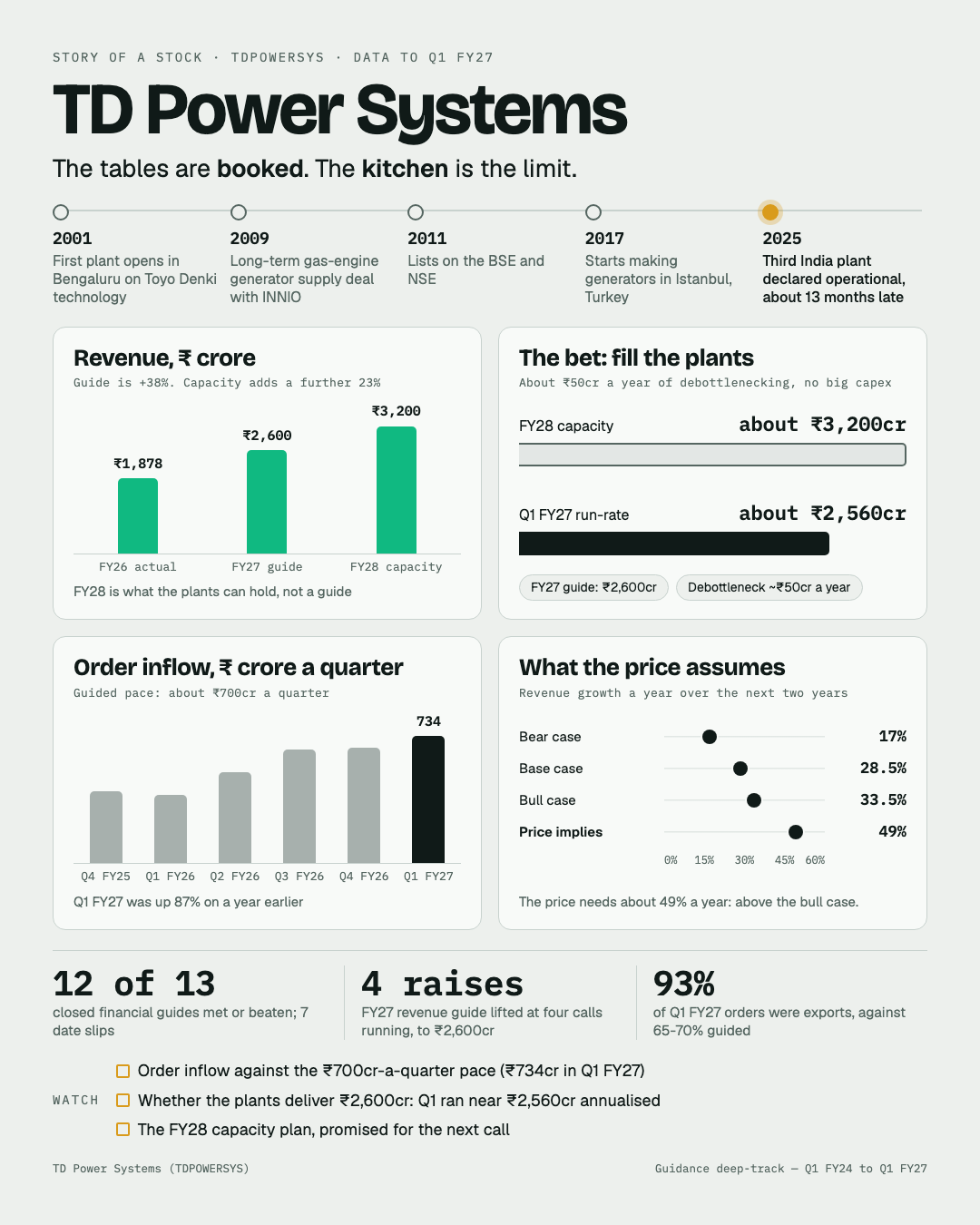
The whole story on one page. Below is the same thing in words, built from every transcript and deck the company has published, plus the filings and broker notes covering it.
Picture a restaurant where every table is booked for months.
The queue is not the question. The kitchen is.
TD Power Systems makes the generators that sit behind gas turbines and gas engines. Its customers are the handful of companies that build those machines, and they are ordering faster than the plants can cook.
So the interesting number is not orders. It is how many plates the kitchen can send out.
The central takeaway
The debate is no longer whether orders come. It is whether the kitchen can plate them, and what that is worth.
Management has raised its FY27 guide at four straight calls. It has told you the plants hold about ₹3,200 crore next year. It has not guided FY28.
At a glance
- The tables are booked. Order book ₹2,207 crore at 30 June, against about ₹1,960 crore still to deliver in FY27. That is 1.13 times.
- The guide keeps rising. FY27 revenue guide is ₹2,600 crore, up 38% on FY26's ₹1,878 crore, raised at four straight calls.
- The kitchen is nearly full. Q1 ran near ₹2,560 crore annualised. Capacity is about ₹3,200 crore, through debottlenecking of about ₹50 crore a year and no big capex.
- The record is good, with slips. 12 of 13 closed financial guides met or beaten. Seven date slips across six of 29 dated threads.
- Almost all orders are exports. 93% of Q1 FY27 order inflow, against 65-70% management once guided.
- Few promises are backed by an order. Of 31 live guides, 5 are order-backed, 20 are asserted and 6 are aspirations.
- The price asks for a lot. About 49% growth a year for two years, against a base case of 28.5%.
1. The tables are booked, and the guide keeps rising
Q1 FY27 revenue was ₹640 crore, up 71% on a year earlier and about a quarter of the FY27 guide.
To reach ₹2,600 crore, the next three quarters need about ₹653 crore each. That is 2% above Q1.
The order book covers it: ₹2,207 crore against about ₹1,960 crore left to deliver.
Order inflow was ₹734 crore in Q1, up 87% on a year earlier. Management guides to about ₹700 crore a quarter, and about ₹2,800 crore for the year.
The guide has also been beaten before. The final FY25 and FY26 revenue guides were beaten by 2.1% and 4.3%.
How far it goes: guides are management's own, and the order book is only as good as delivery.
2. One chair per engine, and the makers decide who sits
Asked whether it is always one to one, the MD said: "One turbine, one generator; one engine, one generator."
That makes demand follow the makers of turbines and engines. In gas, the MD said just four or five companies dominate the world market.
A new generator maker has to be qualified. He put that at two years. It is management's own claim, and it is stated for US gas-turbine makers.
There is also a long-term capacity agreement with INNIO that runs to 2030, with the numbers undisclosed. And on 14 August the company filed a 10-year build-to-print framework with Siemens Energy, with no volume or value given.
The returns fit a real position. Pre-tax return on capital went from 9.5% in FY21 to 29.5% in FY26.
But after tax it beat a 10-12% cost of capital only from FY23, in one upswing. I call the moat narrow and untested through a cycle.
How far it goes: the lock is management-asserted. The company does not disclose retention or exit costs.
3. The kitchen is the lever
The bet in the guidance is capacity fill. Every live guide leans on it.
In January the plants were said to hold ₹2,600-2,800 crore. With about ₹50 crore a year of debottlenecking, that is now about ₹3,200 crore, described by management as "not written in stone".
Nothing bigger is being built for FY28. The larger generators, above 100 MW, come later: full capacity around calendar 2027 at the earliest, the big ramp in calendar 2028. None of it is in the FY27 guide.
The third plant was declared operational on 18 December 2025. It opened about 13 months late, and in January the MD said sales had not yet felt it.
How far it goes: the FY28 capacity plan is promised for the next call, so it is a direction, not a number.
4. The kitchen has been late before
The record is strong on the numbers and looser on the dates.
Of 13 closed financial guides, 12 were met or beaten. But there were seven date slips across six of 29 dated threads.
The misses are specific. Gross margin was meant to return to a 33-34% band in the second half of FY26 and did not. Export share ran well above the 65-70% frame. The motors ambition was cut back from 30-40% of the company as first put in February 2024.
And only five of 31 live guides are backed by an order.
How far it goes: a company can be reliable on revenue and still late on its own timetable. Both are true here.
5. The price needs a bigger kitchen than the one on the plans
At 84.9 times trailing earnings, the shares trade at about twice their own five-year median of 39.6.
Work backwards and the price implies about 49% growth a year for the next two years.
Our bear case is 17%, the base 28.5% and the bull 33.5%. The price is above all three.
Now look at the kitchen. ₹2,600 crore is the guide. About ₹3,200 crore is the capacity. That is 23% more, once.
Growth beyond that needs a bigger kitchen, and the plans for one arrive on a later call.
How far it goes: the cases are built from management's own guide, and they move if it moves.
What would make me wrong
On the cautious side:
- Capacity may be a floor. The MD said if demand reaches ₹3,300-3,400 crore the company will do it.
- The guide has been beaten twice. The final FY25 and FY26 guides came in 2.1% and 4.3% above.
- The Siemens Energy framework is unsized. It could matter far more than any number here.
On the generous side:
- Concentration is high. 93% of Q1 orders were exports, and two customers were each over 10% of FY25 revenue.
- New equity is coming. The board approved a raise of up to ₹600 crore on 14 August, and a ₹75 crore promoter issue was allotted on 21 September. Returns on the larger equity will look lower.
- The moat is untested. One upswing is not a cycle.
The one question that matters
Quarterly revenue.
The FY27 guide needs about ₹653 crore a quarter. Q1 was ₹640 crore.
If the next quarter lands near ₹650 crore, the plants are doing what the guide says. If it stalls near ₹600 crore, the kitchen was the limit all along.
What I'll be watching
- Does order inflow hold the ₹700 crore-a-quarter pace after ₹734 crore in Q1?
- What does the FY28 capacity plan say on the next call, including the generators below 100 MW?
- Does gross margin get back to the 33-34% band it missed in FY26?
Final assessment
A booked restaurant with a kitchen close to its limit.
The record says the food arrives, a little late. The price says the kitchen will be much bigger.
The full read is on the TD Power Systems page.
Every table is booked. What matters now is how many plates leave the kitchen.
This is a summary of what the company's filings and the broker notes covering it say. It is not investment advice or research.