Steel Strips Wheels: The sign over the door says steel. The new customers walk to the back aisle
Pranav Yadav · · 8 min read
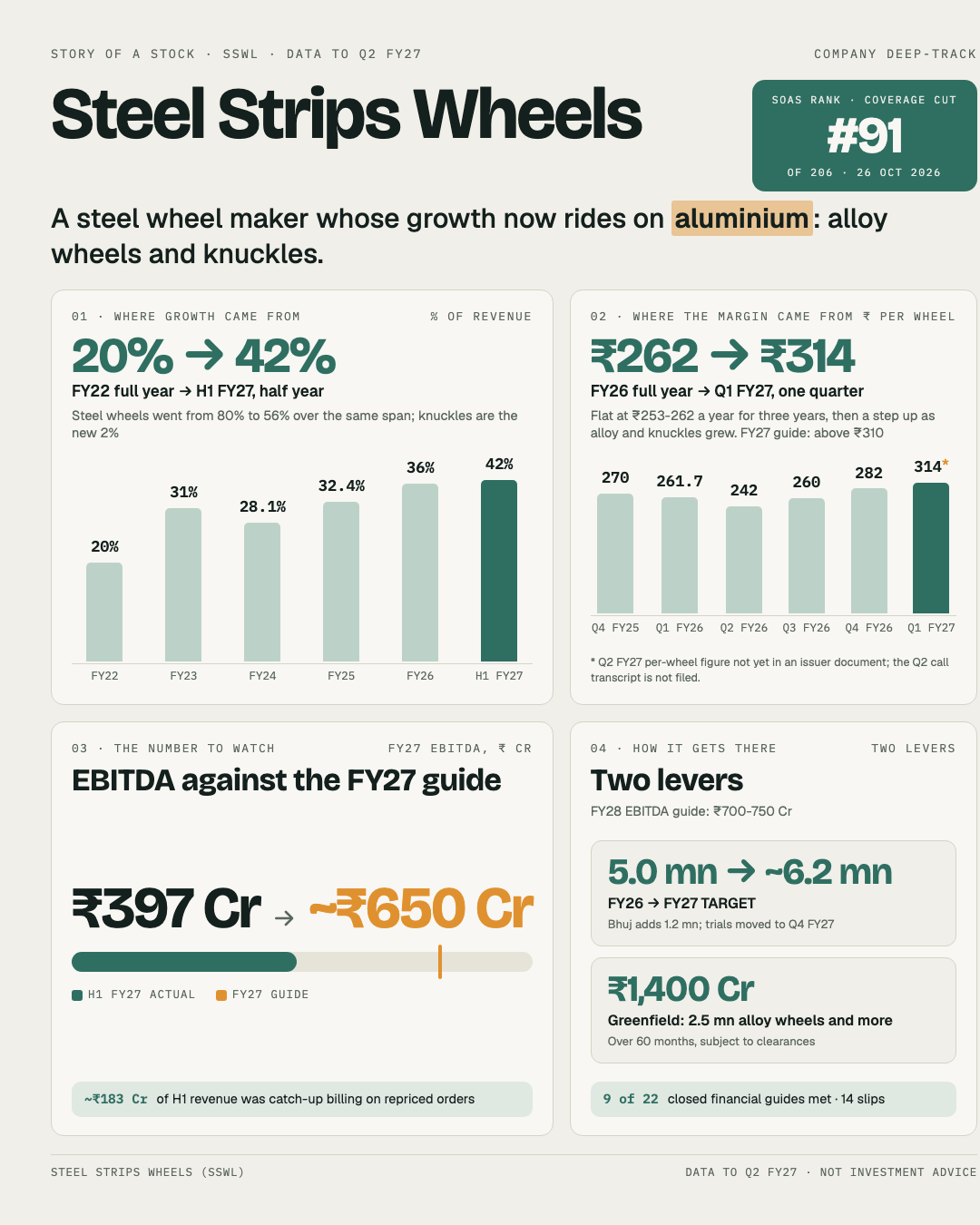
That's the Steel Strips Wheels story on one page. Below is the same story in words, built from eleven calls, fourteen investor decks and results filings, three annual reports and six broker notes.
Picture an old hardware shop with STEEL painted over the door. Most of the floor is still steel, and most of the till still rings for it. But the shoppers who are new this year walk past the front shelves to a smaller aisle at the back, where the goods are lighter, shinier and earn the owner about twice as much each.
Steel Strips Wheels is that shop. It has made steel wheels for cars, trucks and tractors since 1991, and the name is still accurate about most of its plants. Its growth, though, now comes from aluminium: alloy wheels for cars and, since late 2024, aluminium steering knuckles.
The question this post follows is simple. Can the back aisle grow fast enough, and earn enough, to change what kind of shop this is?
Where this lives on the portal: the Steel Strips Wheels company page.
1. What Steel Strips Wheels makes
Three products, one big and one growing
The company sells wheels to vehicle makers. Steel wheels go on cars, trucks, tractors, off-road machines and two- and three-wheelers. Alloy wheels go on passenger cars. Aluminium knuckles, the part that joins a wheel to the steering, are the newest line.
In H1 FY27, steel wheels brought in ₹1,927 Cr (about 56% of revenue), alloy wheels ₹1,439 Cr (about 42%) and knuckles ₹74 Cr (about 2%).
The back aisle earns more
Management judges the business on EBITDA per wheel, not on margin percentages, because steel and aluminium costs are passed on to customers through price resets and move the percentages around. On that measure a domestic car alloy wheel earns about twice a steel wheel, and management expects knuckles to earn more than steel too.
Customers spread across the industry
The company does not say how much revenue its largest customers take. It reports its share of each vehicle maker's steel-wheel buying instead: 32% at Maruti Suzuki, 56% at Mahindra, 86% at Honda, 100% at MG Motors, 65% at Ashok Leyland and 60% at Tata Motors.
2. How it got here
From one Punjab plant to five wheel plants
Steel Strips Wheels was incorporated in 1985 and started making steel wheels at Dappar, Punjab, in 1991. Export production began in 2007 with car wheels for PSA Peugeot Citroen. In 2017 it opened the back aisle, which made 20% of revenue by FY22: an alloy wheel plant at Mehsana with 1.5 Mn wheels of capacity, raised to 3 Mn in 2021 and 5 Mn by 2026. Tata Steel and Nippon Steel are strategic partners, with stakes of 6.9% and 5.4%.
A plant bought out of insolvency
In January 2024 it completed the purchase of AMW Autocomponent, an auto-parts maker with a site at Bhuj, through an insolvency resolution plan. The first plan for Bhuj was a large steel wheel plant. That plan was dropped, and Bhuj is now being built out for alloy wheels and knuckles.
Knuckles, the newest shelf
Knuckle sales began in the October-December 2024 quarter, for two vehicle makers. FY25 sales were about 47,000 knuckles worth ₹11.43 Cr, and FY26 reached ₹68.6 Cr.
3. How the numbers have moved
Sales grew every year, profit stood still
Revenue rose from ₹3,560 Cr in FY22 to ₹5,183 Cr in FY26. Profit did not follow: it sat at about ₹190-205 Cr in every year except FY24. Depreciation and interest rose with the new capacity and took the gain, and the operating margin slipped from 13% to 10%.
FY24's profit was a one-off
FY24 shows a profit of ₹675 Cr, but most of it was a one-time accounting gain of about ₹473 Cr from buying AMW in insolvency. The business that year was ordinary. The gain stayed in equity, so returns since then are measured on a larger base.
Returns drifted down, and nothing protects them
Return on capital employed was 21% in FY23 and 15% in FY25 and FY26. Cash has been real: operating cash flow ran above profit in most years. The checks are clean: an unqualified audit, no promoter pledge, and related-party dealings of 0.83% of revenue.
Our moat review finds no moat. Vehicle makers split wheel orders across several approved vendors and move share between them, and leading shares in truck steel wheels and car alloy wheels have not lifted returns much above the cost of capital.
4. The last few quarters
FY26: tariffs hit exports, profit per wheel stood still
US tariffs cut into steel wheel exports. Export revenue fell from ₹634.1 Cr in FY24 to ₹453.5 Cr in FY26, and EBITDA per wheel stayed flat at ₹262 for the year, after ₹253 in FY24 and ₹261 in FY25.
FY27: the back aisle shows up in the numbers
Q1 FY27 brought EBITDA per wheel of ₹314, the first real step in three years. Q2 FY27 revenue was ₹1,929.9 Cr, up 61%, with EBITDA of ₹234.8 Cr (12.2%) and profit of ₹118.8 Cr. Alloy wheels were 42% of H1 revenue, and the steel and alloy plants ran at 85% and 89% in H1.
One caution on the half-year
H1 FY27 revenue includes about ₹183 Cr of catch-up billing on purchase orders repriced for higher metal costs, ₹140 Cr of it in Q2. The company has not said how much of that reached EBITDA, so the record half is not a clean run-rate.
5. Where growth comes from next
More aluminium, in two steps
Bhuj adds 1.2 Mn alloy wheels and 0.6 Mn knuckles, taking alloy capacity to about 6.2 Mn and knuckles to about 1.1 Mn. Trial production is now due in Q4 FY27, with at least 80% use targeted for the first quarter of FY28, and the output is already sold. On 23 October 2026 the board approved a ₹1,400 Cr greenfield plant at Chhatrapati Sambhajinagar, built over 60 months and subject to clearances, with 2.5 Mn more alloy wheels, a car and off-road steel wheel line and hot stamping.
Our cases
Our base case has revenue growing about 20% a year to FY28 and earnings per share about 29% a year from FY26. The bull case is 27% revenue growth a year and the bear case 15%. H1 already delivered about half of the base case's FY27 revenue, and FY28 is held inside management's own EBITDA guide.
What growth will cost
FY27 capex is guided at about ₹600 Cr, debt is guided up about ₹200 Cr, and working capital took ₹227 Cr in H1 as receivables rose. The greenfield comes on top, at about 78% of FY26 net worth.
6. What management promised, and what it delivered
Of 22 closed financial guides, 9 were met or beaten (41%). Dated commitments slipped 14 times across 25 threads.
The misses cluster in the front of the shop. Wheel volume missed in FY24, FY25 and FY26 (21 Mn+ guided for FY26, 19.95 Mn delivered). Export targets were cut through FY25, and FY26 delivered ₹454 Cr against about ₹600 Cr guided. The Jamshedpur truck wheel expansion arrived about 19 months after its first date, and Bhuj has already slipped four to five months.
The record is better where the back aisle sits. FY26 revenue grew 17% against at least 15% guided, and FY26 EBITDA of ₹511 Cr beat the ₹470-480 Cr guide. For FY27, management guides about ₹6,500 Cr of revenue, about ₹650 Cr of EBITDA and EBITDA per wheel above ₹310, and H1 has already delivered ₹397 Cr of that EBITDA. FY28 EBITDA is guided at ₹700-750 Cr.
7. What the price already assumes
At ₹509 (26 October 2026), the price implies earnings growth of about 15% a year from today's trailing level. Trailing earnings already include the record half, so our cases restated from the same level sit at about 5% a year in the base case, 18% in the bull case and slightly negative in the bear case. The 15% sits between our base and bull cases.
Put plainly, the price is paying for the back aisle to keep growing past what management's own FY28 guide promises.
What would make me wrong
- The catch-up billing may be small at the EBITDA line. If H1's profit per wheel holds in H2 without it, trailing earnings are a clean base and the implied 15% looks closer.
- Bhuj could arrive on time and full. The output is pre-sold, and an on-time start would break the pattern of capacity dates slipping.
- The ₹1,400 Cr greenfield is a long bet. If it runs late or over budget, returns could fall again, as they did after the last round of building.
- The opposite error: treating the old record of missed volume and export targets as a guide to the aluminium business, which has delivered better.
The full read, section by section, is on the Steel Strips Wheels company page.
The sign over the door still says steel, and it is still right about most of the floor. Whether it gets repainted depends on how fast the back aisle fills.
This is a summary of what Steel Strips Wheels' filings and six broker notes say. It is not investment advice or research.