Shilpa Medicare: The guest list keeps arriving later than the invitation said
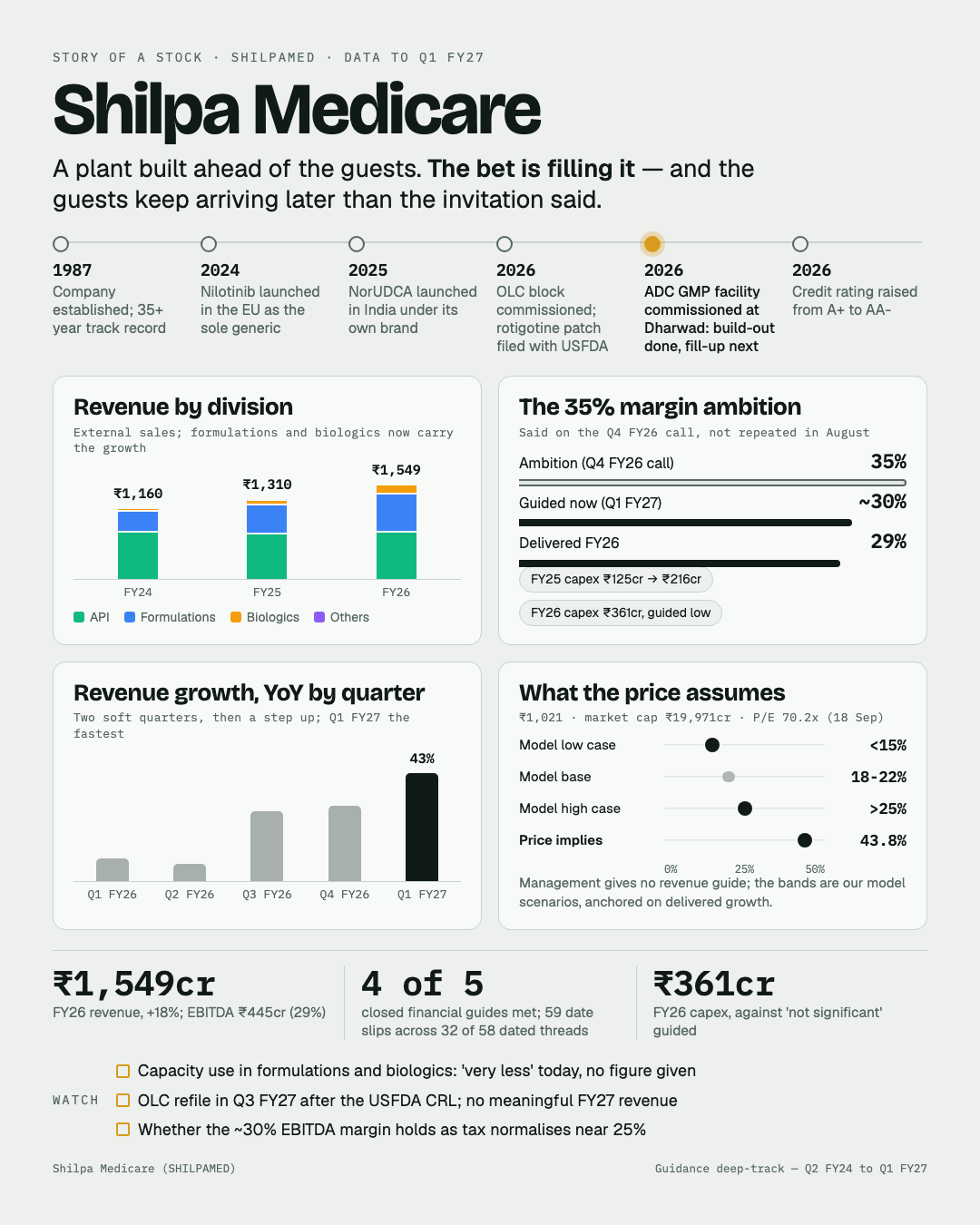
That's the whole Shilpa Medicare story on one page. Below is the same thing in words, built from every concall transcript and investor deck the company has published since late 2023, plus the broker notes that cover it.
Shilpa Medicare makes drug ingredients, finished medicines and biologics, and does contract manufacturing for other drug companies.
Think of a banquet hall built before the guest list was full.
The central takeaway
The building is done, and management says the reinvesting is largely behind it. What is left is the filling.
The debate is no longer whether Shilpa can build. It is whether the guests arrive on the dates on the invitation.
Management gives no revenue guide. So the invitation is a list of dated milestones, and that list keeps being reprinted with later dates.
At a glance
- FY26: revenue ₹1,549 Cr (+18%), EBITDA ₹445 Cr (29%), adjusted profit after tax ₹232 Cr.
- Q1 FY27: revenue ₹469 Cr (+43%), EBITDA ₹139 Cr (30%), reported profit ₹101 Cr.
- Mix of external sales: API 66% in FY24, 47% in Q1 FY27. Formulations 30% to 42%. Biologics 3% to 11%.
- The record: 4 of 5 closed financial guides met. But 59 date slips across 32 of 58 dated threads.
- Balance sheet: net debt to EBITDA 1.3x, from 6.7x in FY23. Rating raised from A+ to AA-.
- The bet: fill new capacity with complex launches and contract-manufacturing programmes.
1. The hall is built, and it cost more than the invitation said
Shilpa guided about ₹125 Cr of capex for FY25. It spent ₹216 Cr.
For FY26 it said capex would not be significant. It spent ₹361 Cr.
But the things it said it would build, it mostly built. The albumin plant, the oncology-drug block, the dedicated block for the OLC programme, and in June 2026 an ADC facility at Dharwad, all commissioned.
Management now says no significant biologics or albumin capex for about three years. The peptide block is due by the end of FY27.
2. Half the hall is already booked, and the rest is empty
Look at where the revenue comes from.
API was 66% of external sales in FY24. It is 47% now. Formulations and biologics have taken the difference, and revenue grew 43% in Q1 FY27.
On the Q1 call, management said capacity utilisation in the formulation and biologics blocks is "very less" today. It gave no percentage.
That is the honest state of the story. The room is there. Nobody has said how much of it is used.
And a full hall is not a locked one. I rebuilt the moat read from filings and found no evidenced moat. Reported ROCE was 8.8% in FY25 and is 12.5% now. The 18.3% figure is adjusted, and it leaves out biologics and new biological entities, which is where the empty capital sits.
3. The guests keep arriving later than the invitation said
This is where the record is weak.
Across 58 dated promises, 59 slips. Albumin's India Phase 3 trial has been pushed five times. The topical product's Phase 3 start moved five times before it began in January 2026.
The latest ones matter more.
- OLC, the partner-filed US programme: a USFDA complete response letter, refile in Q3 FY27, and management says no meaningful FY27 revenue.
- Rotigotine patch: the decks say EU launch in 1H FY27 and US in FY28. The call says only FY28, with no market named.
- The 35% EBITDA margin: called ambitious on the Q4 FY26 call, not repeated in August. Q1 FY27 says about 30%.
And of 44 live threads, 9 are backed by orders or committed assets. 30 are management's say-so. 5 are plain aspiration.
The guests are real. The dates are soft.
4. My model: what earnings could look like if the hall fills at this pace
This section is mine. It is a model, not management guidance, and it is not in any database.
The starting point is FY26 adjusted profit of ₹232 Cr, or ₹11.9 a share on 19.56 Cr shares (implied from market cap and price).
- Assumptions: revenue growth of 15%, 20% and 25% for the low, base and high case. EBITDA margin 28%, 30% and 30%, since management says about 30%.
- Costs: depreciation about ₹140 Cr in FY27 and ₹155 Cr in FY28 (Q1 run-rate is ₹35 Cr a quarter). Finance cost about ₹48 Cr, then ₹45 Cr (Q1 was ₹12 Cr).
- Tax: 25%, which management says it will normalise to, against about 18% in FY26. No credit for other income, because FY26 pre-tax profit held about ₹17-18 Cr of investment and associate gains.
- Low case: FY27 profit ₹233 Cr, ₹11.9 a share. FY28 ₹280 Cr, ₹14.3. Profit CAGR about 10%.
- Base case: FY27 ₹277 Cr, ₹14.2 a share. FY28 ₹352 Cr, ₹18.0. Profit CAGR about 23%.
- High case: FY27 ₹295 Cr, ₹15.1. FY28 ₹395 Cr, ₹20.2. Profit CAGR about 30%.
- Cross-check: base FY27 EBITDA of ₹558 Cr against Q1 FY27 annualised at ₹556 Cr.
- The drag: at an 18% tax rate the base CAGR would be about 29%. The tax step-up is what holds it near 23%.
I did not annualise Q1 profit. It carries a one-off reversal of deferred tax, so it overstates a normal quarter.
5. What the price already assumes
The stock was ₹1,021 on 18 September. Market cap is ₹19,971 Cr, and the price to earnings is 70.2 times.
The promoted reverse-DCF says that price implies about 43.8% a year of growth, held at flat margins.
Our own bands, anchored on delivered growth, are 18-22% for the base case, above 25% for the high case and under 15% for the low case. Management guides none of them.
On my model above, ₹1,021 is about 72 times base FY27 earnings per share and about 57 times FY28.
I am not telling you what that means. I am putting the two numbers next to each other: what the price implies, and what the evidence supports. The gap is yours to hold.
What would make me wrong
If I am too cautious, it will be for one of these reasons.
- The fill could be faster than the record suggests. Q1 FY27 revenue rose 43%, and the last three quarters were 28%, 30% and 43%.
- Deadlines are not revenue. Most of the 59 slips are R&D and regulatory dates. Financial guides were met 4 times out of 5.
- My tax step-up may be too heavy. If the company holds a lower rate, the base case moves toward 29%.
If I am too generous, it is because a plant that is mostly empty can stay that way for a while, and the OLC programme already shows what a single regulatory letter does to a revenue line.
The one question that matters
Can EBITDA margin hold at 30%, or reach the 35% management called ambitious?
It is 30% today, 29% for FY26. Filling the hall is supposed to lift it. If it stays at 30% while revenue grows, the fill is not adding margin.
What I'll be watching
- Does the OLC refile happen in Q3 FY27, and does any revenue follow?
- Does management put a number on capacity utilisation in the formulation and biologics blocks?
- Does the peptide block commission by the end of FY27, or move again?
Final assessment
Shilpa has finished building.
It has not yet shown how quickly the building fills.
The full read, including every guidance thread and the sources behind it, is on the Shilpa Medicare page.
A hall is judged by the nights it is full. The invitation is only a date.
This is a summary of what Shilpa Medicare's filings and broker notes say, plus one labelled model of mine. It is not investment advice or research.