Shivalik Bimetal: It sold the flour by the kilo. Now it wants to be paid for the bread
Pranav Yadav · · 7 min read
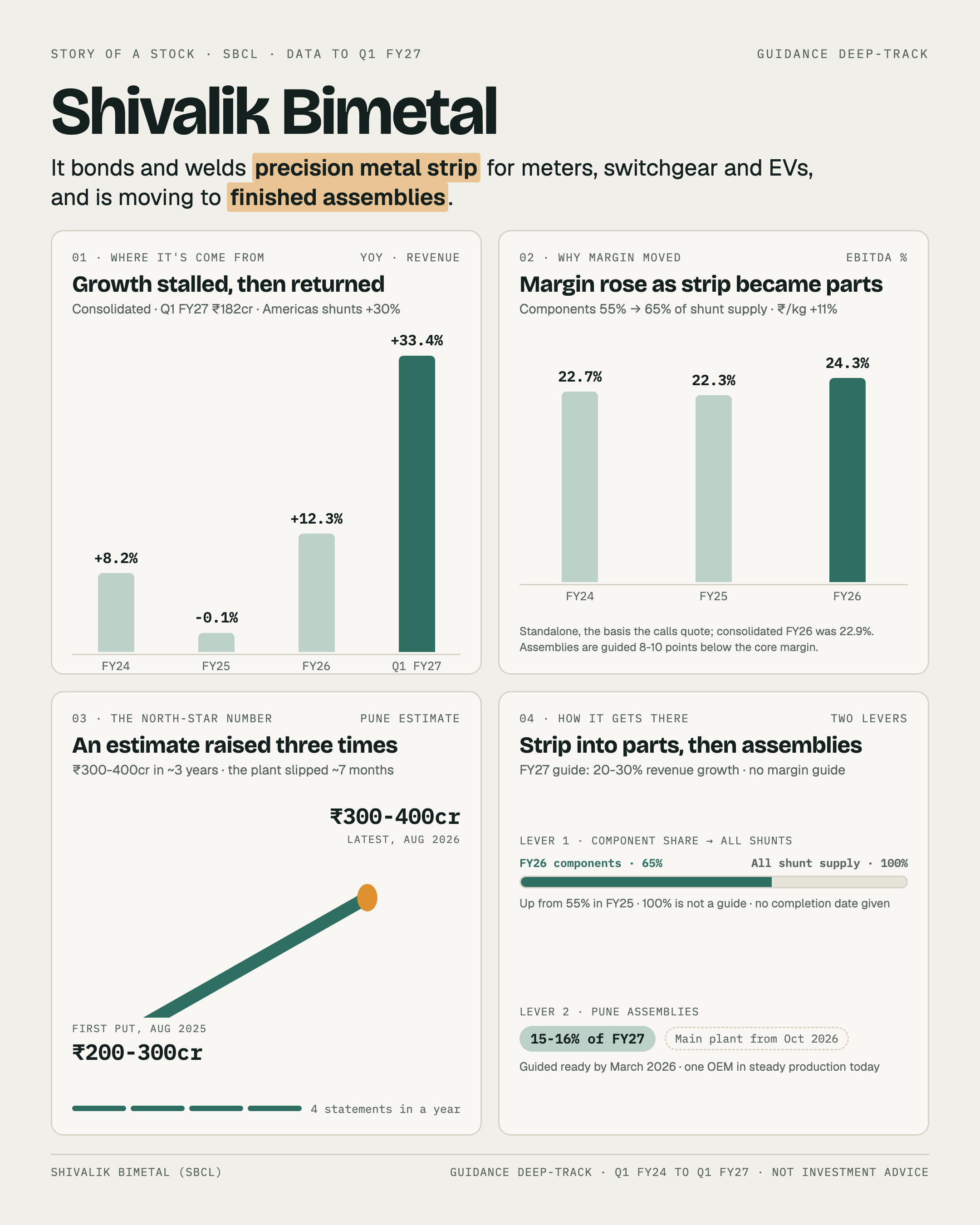
That's the Shivalik Bimetal story on one page. Below is the same thing in words, built from thirteen earnings calls and thirteen investor decks, Q1 FY24 to Q1 FY27, and the FY26 annual report.
A flour mill is paid by the kilo. A bakery is paid by the loaf, and the loaf earns more for every kilo inside it.
Shivalik Bimetal has spent most of its life as the mill. It bonds and welds precision metal strip that measures current in meters and cars, or bends with heat inside switchgear. Its largest shunt customer, a US resistor maker, bought the strip and did the baking itself. Now Shivalik wants to be the bakery: it cuts and welds the strip into finished parts, and a new Pune plant adds bus-bar and cell-connector assemblies.
Shivalik has appeared in this Journal once, on 10 August, in a post on what the price already assumes. The growth its price implied had gone from 19.8% to 23.1% in a fortnight. The price section below explains why that number now reads 40.7%.
The central takeaway
The record is mixed. Management met 6 of the 12 financial guides that have closed, and timing was more reliable, with 7 slips across 18 dated promises. Revenue is the weak part: the full-year guide was missed or cut in each of FY24, FY25 and FY26, while every margin guide held on standalone numbers.
The debate is no longer whether Shivalik can earn more from each kilo. It is whether a plant not yet fully running can carry a 20-30% year.
At a glance
- FY26 delivered: consolidated revenue of ₹570.9 Cr, up 12.3%, after 8.2% in FY24 and a flat FY25.
- The mix shift: finished components went from 55% to 65% of shunt supply in FY26.
- The FY27 guide: revenue growth of 20-30%, raised from 13-18% in November 2025, with no margin guide.
- The Pune bet: assemblies at about 15-16% of FY27 revenue and ₹300-400 Cr within about three years, at a lower margin than the core.
- The latest quarter: Q1 FY27 revenue grew 33.4% to ₹182.2 Cr.
- What the price assumes: about 40.7% growth a year for two years.
Where this lives on the portal: the Shivalik Bimetal guidance page.
1. Finished parts already earn more per kilo: the mill is baking before Pune adds anything
Shunt revenue grew 8.62% in FY26 to ₹230.68 Cr while the kilos shipped fell 2.23%. Revenue per kilo rose from ₹1,891 to ₹2,101, about 11%, and the CFO tied the gain to the move from strip to components.
Standalone gross margin rose from 46.57% to 49.39%, and standalone EBITDA margin from 22.28% to 24.32%. The deck credits product mix alongside cost control and efficiency, and no segment margins are disclosed.
This is the mill already baking, and it needed no new plant. Management expects the US customer to come back as a buyer of components rather than strip.
2. The lock is customer qualification, and it held while the largest customer cut orders
Our moat call is narrow, rated mid. A new shunt part takes 18-24 months to develop and qualify.
The test came from its own customer. The largest shunt buyer, once 38-39% of revenue, cut orders for three years, and Americas shunt sales fell about 23% in both FY25 and FY26. ROCE came down from 36% in FY23 to about 25%, still above the cost of capital, and management says it lost no business to the 50% US tariff.
Plain strip has no lock. The lock sits on finished parts, and the Pune assemblies have no record yet.
3. FY27's 20-30% guide leans on the Pune bakery, which runs fully only from October
Three things carry the guide: Pune assemblies at 15-16% of revenue, smart-meter revenue doubling again from ₹75-80 Cr, and the US customer back at its old peak.
Pune is the new bakery, and its main oven is not lit yet. Phase 1 serves one electric two-wheeler programme, and bus-bar revenue was "just a minimal addition" in Q1 FY27. The main plant runs fully from October 2026.
The estimate grew while the plant slipped. Pune revenue was ₹200-300 Cr over three years in August 2025 and ₹300-400 Cr by August 2026, raised three times. Assemblies are guided 8-10 points below the core margin. Of the 34 live promises we track, 3 are backed by orders, 22 rest on management's word and 9 are aspiration, so our forward read is ambitious and thinly evidenced.
4. Revenue guides fell short three years running, and three dates moved
FY24 was guided at 15-20% and grew 8.2%. FY25 was guided at 8-12% and came in at a 0.1% dip. FY26 was guided at 15-18%, cut twice by November 2025, and closed at 12.3%: met, but only against the lowered bar. The FY26 segment guides missed too: bimetals grew 2.85% against 12-16%.
The margin guides held. FY25's 22-24% landed at 22.28% and FY26's 22-23% at 24.32%, both standalone; consolidated ran lower, at 20.35% and 22.9%.
Three threads carry all 7 slips. The US customer's recovery was re-dated three times, from late 2024 to FY27. A new contacts plant was partly producing about 16 months late. The Pune plant, guided ready by March 2026, runs fully about seven months later.
5. What the price already assumes: about 41% growth a year, above every case we model
At ₹1,154 on 25 September, the reverse DCF implies about 40.7% growth a year over the next two years. Margins are held flat, so it reads as revenue growth. Our bear case is 10-15%, the base case 17-25% and the bull case 22-27%, so the implied rate sits about 14 points above the top of the bull case, and above the 30% top of management's own FY27 guide. The P/E of 62.4 is the highest in its five-year range, against a median of 37.6.
On 10 August the implied rate was 23.1%, and most of the move since is method. That reading held one growth rate for ten years. The valuation section now solves for a two-year rate, the horizon our growth cases use, which then fades toward 5% over the decade. On the old constant-rate method, today's price implies 24.6%.
What would make me wrong
- The quarter already ran ahead. Q1 FY27 grew 33.4%, and Americas shunts rose 30% to ₹15.83 Cr.
- The plant was built ahead of demand. Management says existing assets can support over ₹1,300 Cr of revenue against ₹571 Cr booked in FY26.
- Smart meters are a live driver. That revenue nearly doubled in FY26, and management expects it to at least double again.
The opposite error would be to read the clean FY26 audit as the last word. The auditor, Arora Gupta & Co, signed unmodified FY26 opinions and resigned on 6 August 2026, citing the resources the expanded audit needs; Walker Chandiok took over the next day. The CFO, Rajeev Ranjan, resigned the same day for personal reasons, effective 31 October. Net working capital rose from 217 to 258 days in FY26, and operating cash was 0.57 times profit.
The one question that matters
What share of FY27 revenue comes from Pune assemblies?
Management says about 15-16%. In Q1 FY27 it was a minimal addition from one customer programme. If the October plant moves the share toward that figure, the guide has its load-bearer. If not, the year rests on the US customer and smart meters.
What I'll be watching
- Does the main Pune plant run fully from October, and do two or three more cell-connector designs convert by year-end?
- Does Americas shunt revenue keep rising from ₹15.83 Cr a quarter?
- Does net working capital fall from 245 days, and what does the new auditor's first review say?
Final assessment
Shivalik has shown it can earn more from each kilo by shaping it. Its revenue promises have been less reliable than its margin promises, and the next step rests on a plant that reaches full operation only in October. The price has moved well ahead of that.
The full read is on the Shivalik Bimetal page.
A mill that learns to bake earns more from every kilo. The main oven in Pune is lit in October, and the price is already paying for the bread.
This is a summary of what Shivalik Bimetal's filings and earnings calls say. It is not investment advice or research.