Sansera Engineering: The parts it's betting on next never touch an engine
Pranav Yadav · · 7 min read
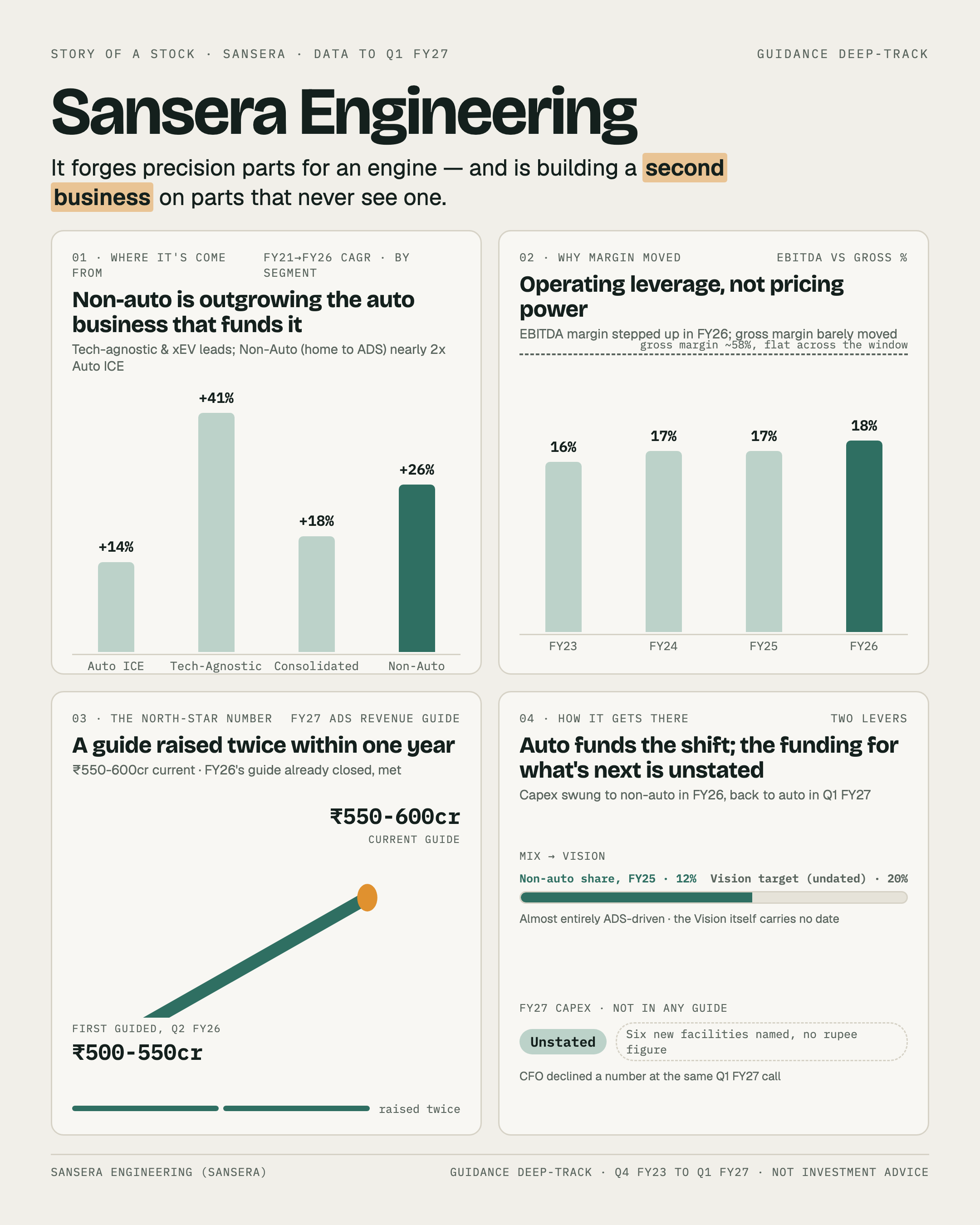
The page below is the same story in words, built from a full re-read of every Sansera transcript, deck and broker note we hold, fourteen quarters deep.
For twenty-odd years Sansera has made one kind of thing well: forged and machined parts that sit inside an engine, mostly other people's engines, on other people's two-wheelers and cars. Connecting rods. Crankshafts. The parts nobody names on a spec sheet but that fail expensively if they're wrong. That business still pays the bills. It is also, on the company's own numbers, the slowest-growing thing it does.
Everything Sansera has said about its future for the past three years points somewhere else: aerospace, defence and semiconductor equipment, a business it now calls ADS. None of these parts ever sit inside an engine. They sit inside an aircraft hydraulic system, a defence platform, a chip-fab tool. It is a genuinely different customer, a genuinely different qualification cycle, and, so far, a genuinely small business being asked to carry a very large ambition.
The central takeaway
The debate here is no longer whether Sansera's guidance can be trusted. Read against fourteen quarters of its own transcripts, it mostly has been. The debate is whether the specific bet it is now making, on ADS, carries the same kind of evidence the rest of its record does. It does not, yet, and the company's own numbers say so.
Where this lives on the portal: the Sansera Engineering guidance page.
At a glance
- Credibility: credible. 12 of 17 closed financial guides met or beaten (71%), and only 10 slips across 25 dated capex and milestone promises (0.40 per thread).
- Forward read: ambitious, thinly evidenced. Of 34 live promises, 10 are backed by something already banked (an order, a signed contract), 10 rest on management's word alone, and 14 are aspiration.
- Capex has missed every year for three years running — ₹339cr against a ₹280cr plan in FY24, ₹591cr against ₹425-450cr in FY25, ₹510cr against ₹375-400cr in FY26.
- The FY27 ADS revenue guide has been raised twice in one year, from ₹500-550cr to ₹550-600cr, while FY27 capex itself has never been given a number.
- The "20-20-20" mix target — 20% CAGR growth, 20% ROCE, 20% EBITDA margin — has been restated since the first call we read and has never once carried a date.
- The price implies 44.3% CAGR, well above even the company's own most optimistic scenario of 20%.
1. The record you'd be trusting is genuinely credible
Start with what actually checks out, because most of it does. Across fourteen quarters, Sansera closed 17 financial guides cleanly enough to score, and beat or met 12 of them. Sweden's subsidiary, once a drag, delivered an EBITDA margin of 11.4% against a 5-6% guide. The domestic ADS business hit its FY26 revenue target almost exactly. The FY24 EBITDA margin beat. None of that is a stretch to verify, because the company said it in a specific quarter and a later quarter confirmed or denied it. On timing, the same discipline holds: only 10 slips across 25 dated promises, a rate the deep-track scorer calls reliable. This is not a company that talks past its own numbers.
2. Capex is the one place the record actually breaks down
If there is a clean miss in this record, it is capital spending, and it has missed in the same direction three years straight. FY24 came in 21% over the standing plan. FY25 came in well over the range management had given. FY26 landed as much as 46% above what was guided at the start of the year. None of these misses were walked back or explained away; the numbers simply arrived higher than promised, quarter after quarter. That matters here specifically, because the ADS bet is a capital-intensive one, and the one number that would tell you how much capital it needs, the FY27 capex figure, has not been given. The CFO was asked directly at the August call and declined to answer, in the same breath as naming six new facilities.
3. ADS is real, growing fast, and still small enough that percentages mislead
Non-auto revenue grew at a 26% CAGR since FY21, against 14% for the core auto-ICE business, and the fastest-growing single segment, tech-agnostic and xEV components, grew at 41%. That is a genuine structural shift, not a rounding artifact. But ADS specifically only became large enough to guide on from FY26, and the FY27 target, ₹550-600cr, has already moved up twice within the year from where it first stood. A guide that gets raised twice in one year is a good sign about demand and a fair question about how firm the original number was. The company itself frames this as scaling from "a rounding error" to a genuine second engine; on the numbers, it is still early in that arc, not past it.
4. The target management keeps repeating has never once been dated
Every deep-track we read leans on one habit: does the company put a year on what it promises? Sansera's own long-term frame, 60% from auto-ICE, 20% from non-auto, 20% from xEV and tech-agnostic, alongside 20% revenue CAGR, 20% ROCE and 20% EBITDA margin, has been repeated across every call in our fourteen-quarter window in some form. It has never carried a year. Not "by FY28," not "by the decade's end." Just the number, restated. A target repeated without a date is not automatically false. It is simply not a commitment anyone can hold the company to missing, which is a different thing from a promise.
5. What the price already assumes
Working the current price back through a standard reverse-DCF, at the company's own required return and a ten-year fade to a 5% terminal rate, implies revenue growing at 44.3% a year. The more optimistic of Sansera's three growth scenarios tops out just above 20%. The price, in other words, is not pricing the base case, or even the company's own highest scenario; it sits well above both, in territory none of Sansera's three scenarios reach. The delivered five-year CAGR, for comparison, has been 18%.
What would make me wrong
- If FY27 capex, once finally disclosed, lands close to what the six new facilities plausibly cost, the "unfunded lever" argument weakens considerably, and the ADS ramp starts to look properly resourced rather than aspirational.
- If the ADS FY27 guide is met the way FY26's was, two raises in a year reads as management staying ahead of real demand, not as a soft number being talked up.
- The other error is treating a credible fourteen-quarter record as proof the next bet works the same way. A company can be honest about what it reports and still be wrong about what it is building toward; those are different questions, and this record only answers the first one.
The one question that matters
How much does the ADS build-out actually cost, and when does Sansera say so. Every other open question here, whether the FY27 guide holds, whether the mix target ever gets a date, collapses into this one: management has named the facilities and left the number blank. The next call is the one to watch for it.
What I'll be watching
- Whether the Q2 FY27 call finally attaches a rupee figure to FY27 capex.
- Whether the ADS FY27 guide gets raised a third time or holds at ₹550-600cr.
- Whether the 20-20-20 target ever picks up a year, or stays a number without a deadline.
Final assessment
Sansera has earned the benefit of the doubt on what it says happened. It has not yet earned it on what it says comes next, because the one number that would let a reader check the ADS bet against real capital commitment is the one number it hasn't given. Full detail, every thread and every source excerpt, is on the Sansera Engineering company page.
The parts inside the engine paid for this company's first four decades. Whether the parts that never see one can pay for the next one is still, on the record so far, an open question the company itself hasn't finished answering.
This is a summary of what Sansera Engineering's filings and broker notes say. It is not investment advice or research.