Navin Fluorine: Its biggest theatres opened late. Then the seats filled
Pranav Yadav · · 9 min read
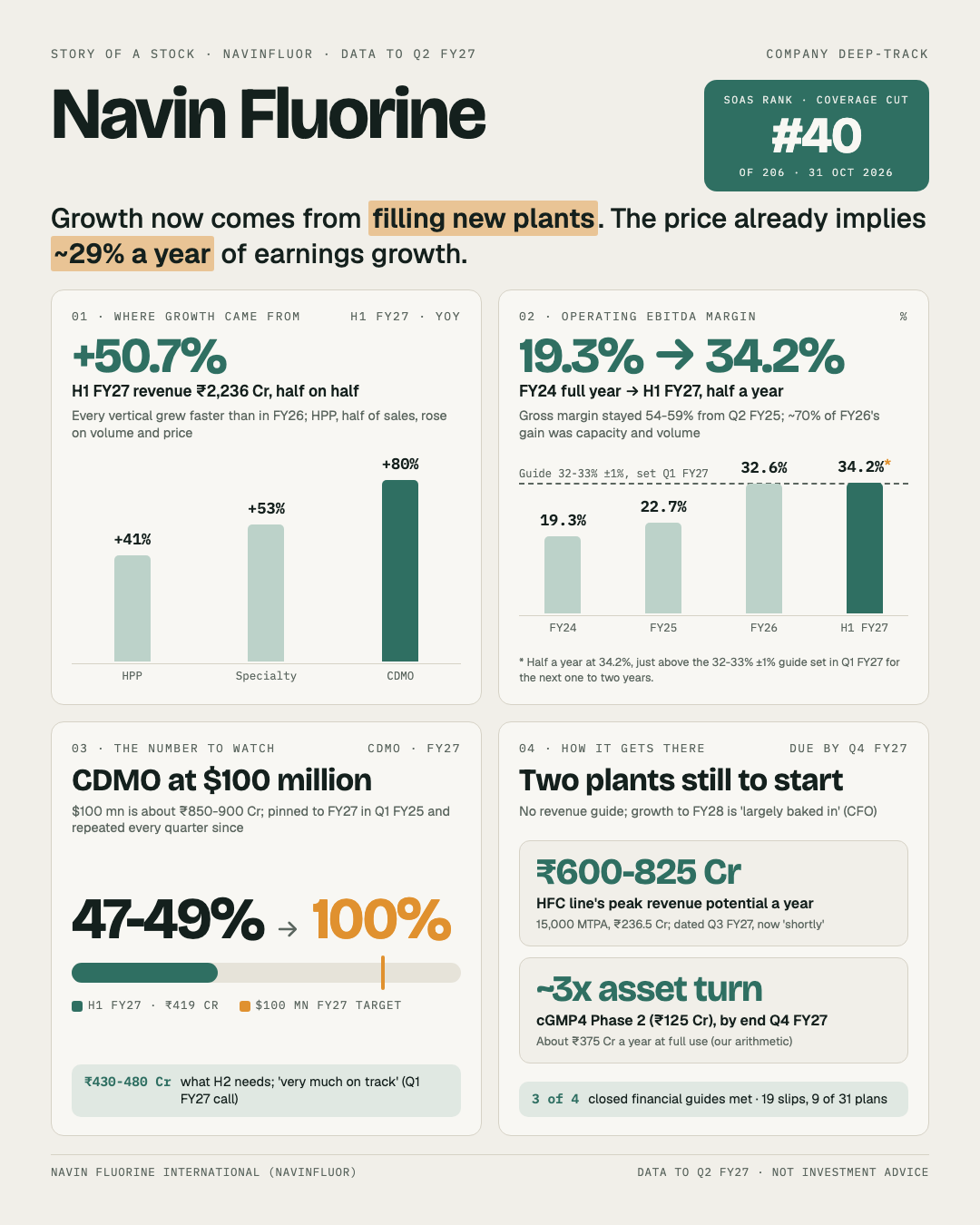
That's the Navin Fluorine story on one page. Below is the same story in words, built from 13 earnings calls, 16 investor decks and results filings, three annual reports and 33 broker notes. The Q2 FY27 call on 30 October exists only as a third-party transcript, so nothing here comes from it.
Picture a company that builds theatres and puts on the shows. Some are let to a single producer for years. The building is paid for before the first night, and the money comes only from the seats that fill.
Navin Fluorine is that company in chemistry. It has made fluorine chemicals at Surat since 1967, and in the last five years built a run of new plants, several for one named customer. The two biggest opened late, each about a year after its first date; the smaller ones mostly kept time.
Then the seats filled. FY26 revenue grew 41% at a 32.6% operating margin, and H1 FY27 grew 50.7%. Three more theatres are due by March 2027, and the last chapter asks how full the price expects them to be.
In June Navin was the V, a cycle turning, in a test of our quarterly score. This is the story behind it.
Where this lives on the portal: the Navin Fluorine company page.
1. What Navin Fluorine makes
One acid, three kinds of product
Navin makes its own hydrofluoric acid and turns it into three kinds of product. High Performance Products (HPP), 49% of FY26 revenue, are refrigerant gases such as R22 and R32, HFO refrigerants and inorganic fluorides. Specialty Chemicals, 35%, are fluorinated intermediates for agrochemical and pharma companies. CDMO, 16%, makes drug intermediates under contract for pharma innovators, at Dewas and at Manchester Organics in the UK.
Two-thirds goes abroad, over a third to three customers
Exports were about 67% of FY26 revenue, and 96% of CDMO's. Three unnamed customers each took 10% or more, together 38.5%; in FY25 only one crossed 10%. The company reports no margin by business.
Some theatres are let to one producer
The HFO plant at Dahej, by the company's account India's only one, makes refrigerant for one customer, under a contract first signed with Honeywell and now held by Solstice Advanced Materials. The Nectar specialty plant at Dahej was built for one customer, and the cGMP4 plant at Dewas serves a European pharma partner. A plant built for one customer fills at that customer's pace.
2. How it got here
Surat since 1967, then five years of building on debt
Navin was set up at Surat in 1967 as South East Asia's first integrated fluorochemicals complex outside Japan. Its last deal, control of Manchester Organics in the UK, came in 2011, so the growth in this story came from plants it built.
From FY22 to FY26 it spent ₹3,125 Cr on capex by my sum, and borrowings rose from ₹121 Cr in FY22 to ₹1,466 Cr in FY25. The HFO plant started in July 2022, the ₹540 Cr Nectar plant in December 2024 and the ₹450 Cr acid plant at Dahej in February 2026.
The two biggest opened late
Nectar was first dated for the end of 2023 and opened a year late, after four slips. The acid plant came four quarters after its first firm date. In July 2025 a ₹750 Cr share sale (QIP) added about 3% more shares, and ₹562.5 Cr of it repaid debt.
3. How the numbers have moved
Two flat years while the plants were built
Revenue went from ₹1,453 Cr in FY22 to ₹2,077 Cr in FY23, then ₹2,065 Cr in FY24 and ₹2,349 Cr in FY25. The operating margin fell from 26% to 19% in FY24, and profit from ₹375 Cr to ₹270 Cr. Everything hit that year: CDMO orders slipped, the HFO plant was slow to stabilise, specialty customers cut stock and R22 export prices fell.
Then the seats filled
FY26 revenue rose 41% to ₹3,314 Cr, the operating margin reached 32.6% from 22.7%, and profit more than doubled to ₹664 Cr. Specialty grew 44% and CDMO 59%. Management credits about 70% of the margin gain to new capacity and volumes, the rest to price. Not every seat filled: Nectar ran about half full, as planned, and its full house no longer has a date.
Returns dipped below the cost of capital, then came back
Return on capital employed was 19%, 20%, 11%, 11% and 21% from FY22 to FY26, against the 12-13% cost of capital we assume: for two years the capital came before the earnings. Cash kept pace, at 1.20 times profit over five years, and by Q1 FY27 management called the company net debt free. The forensic checks are clean: an unqualified audit, related-party dealings of 0.67% of revenue and no promoter pledge.
Why nothing keeps the seats full
Our moat call is no moat. R32, the biggest show, is open to rivals: other Indian producers are adding capacity. The HFO contract is priced on a cost true-up, which gives visibility, not pricing power. The European CDMO customer keeps a second supplier, and registered Navin itself within a year.
4. The last few quarters
Three quarters at 34%
Quarterly revenue rose from ₹758 Cr in Q2 FY26 to ₹1,191 Cr in Q2 FY27, up 57%, and the operating EBITDA margin was 34.2% in each of the last three quarters. In Q2, HPP brought in ₹604 Cr, up 49% on volume and price, Specialty ₹348 Cr, up 58%, and CDMO a new high of ₹239 Cr, up 78%. Half-year profit nearly doubled, to ₹512 Cr by my sum.
Gross margin and working capital moved the other way
Gross margin fell to 56.9% in Q2, from 58.7% a year earlier. Working capital, last stated at 81 days of sales, sat a day over its 75-80 day range and absorbed ₹183.74 Cr of cash in H1 FY27, against ₹108.69 Cr.
One theatre opened early, and the longest lease got longer
The ₹75 Cr debottleneck at Dahej started dispatching on 29 September 2026, a quarter ahead of its date, with a peak revenue of ₹140-160 Cr a year. In October the HFO contract was extended to December 2032, taking it to about $590 mn over 11 years, from $410 mn over seven.
5. Where growth comes from next
The biggest new theatre opens in a crowded town
A ₹236.5 Cr R32 line of up to 15,000 tonnes a year, due in Q3 FY27 and to be "commissioned shortly" by the Q2 deck, takes R32 capacity from 9-10 kt to about 25 kt. Management puts its peak revenue at ₹600-825 Cr a year, 18-25% of FY26 revenue, with 35-45% to be placed on five-year contracts. It opens into a market management expects to be oversupplied for five years. From 2028, India's Kigali freeze caps HFC output by a quota set on each producer's 2024-26 production.
Two more theatres for single producers
Chemours is paying 35% of a ₹120 Cr Surat plant for a data-centre cooling fluid, now due by the end of Q3 FY27 after two moves; its revenue is confidential. Phase II of cGMP4, ₹125 Cr for the European partner, is due by the end of Q4 FY27 and would support about ₹375 Cr of revenue a year at full use. CDMO aims for $100 mn in FY27, so after H1's ₹419 Cr, H2 needs about ₹430-480 Cr.
Our base case: 24-29% a year, at a margin below H1's
Management gives no revenue number and guides the operating margin instead, at 32-33%, plus or minus 1%, for the next one to two years, below H1's 34.19%. Our base case has revenue up 24-29% a year over two years and earnings up 22.9-29.8%; the bear case has earnings up 10.2-16.9%, the bull case 32.8-39.9%. H1 alone sets a floor: if H2 only matched H2 FY26, FY27 would still grow 23%. The next projects are funded from internal accruals.
6. What management promised, and what it delivered
The record is mixed, and it splits in two. On the numbers, Navin met 3 of its 4 closed financial guides, 75%. On the dates, 9 of its 31 dated plans slipped, 19 times in all.
The FY26 margin was guided at 25%, raised twice to "hitting or crossing" 30%, and came in at 32.6%; the FY25 exit margin was guided near 25% and printed 25.5%. The miss was the HFO plant's peak revenue of about ₹460 Cr in FY25, which it did not reach.
The dates slipped: Nectar a year late, the acid plant four quarters, Chemours two quarters so far, and Nectar's full house, dated FY27 for eight quarters, is now 75-80% use by the end of FY28. What was kept: the R32 lines and cGMP4's first phase on time, the debottleneck early, and net debt under half of equity throughout.
7. What the price already assumes
At ₹8,680 on 30 October, with Q2 FY27 in the trailing numbers, the price implies about 29.3% a year of earnings growth over the next two years. That is at the upper end of our base case of 22.9-29.8%, above the bear case and below the bull. Over five years Navin's profit grew 21% a year.
The trailing P/E of 48.6 sits below the bottom quartile of its own five-year range, 58.8, because profit rose faster than the price. It is about twice the median P/E of 24.6 in its Screener industry. Trailing profit is well above its five-year norm, so the price leans on this level holding and on the next three theatres filling to plan. Navin's two biggest openings both ran late.
What would make me wrong
- The late openings may be behind it. The debottleneck came a quarter early, and the Q2 deck gives the R32 line no new date.
- The margin guide may be the cautious kind. The FY26 guide was raised twice and still beaten.
- The quota could turn R32 into a licence. If R32 prices hold after 2028, with new capacity running, our moat call moves to narrow.
- The longest lease is signed. The HFO contract runs to December 2032.
The opposite error would be to read H1's 50.7% as the pace: H2 meets a stronger H2 FY26, the new R32 line opens into an oversupplied market, and management's margin guide sits below H1.
The full read is on the Navin Fluorine company page.
A theatre that opens late can still fill, and Navin's did. The price is set as if the next three open on their dates and fill as the last ones did.
This is a summary of what Navin Fluorine's filings, results documents, earnings calls, annual reports and broker notes say. It is not investment advice or research.