Laurus Labs: It used to serve one dish. Now it cooks for other chefs
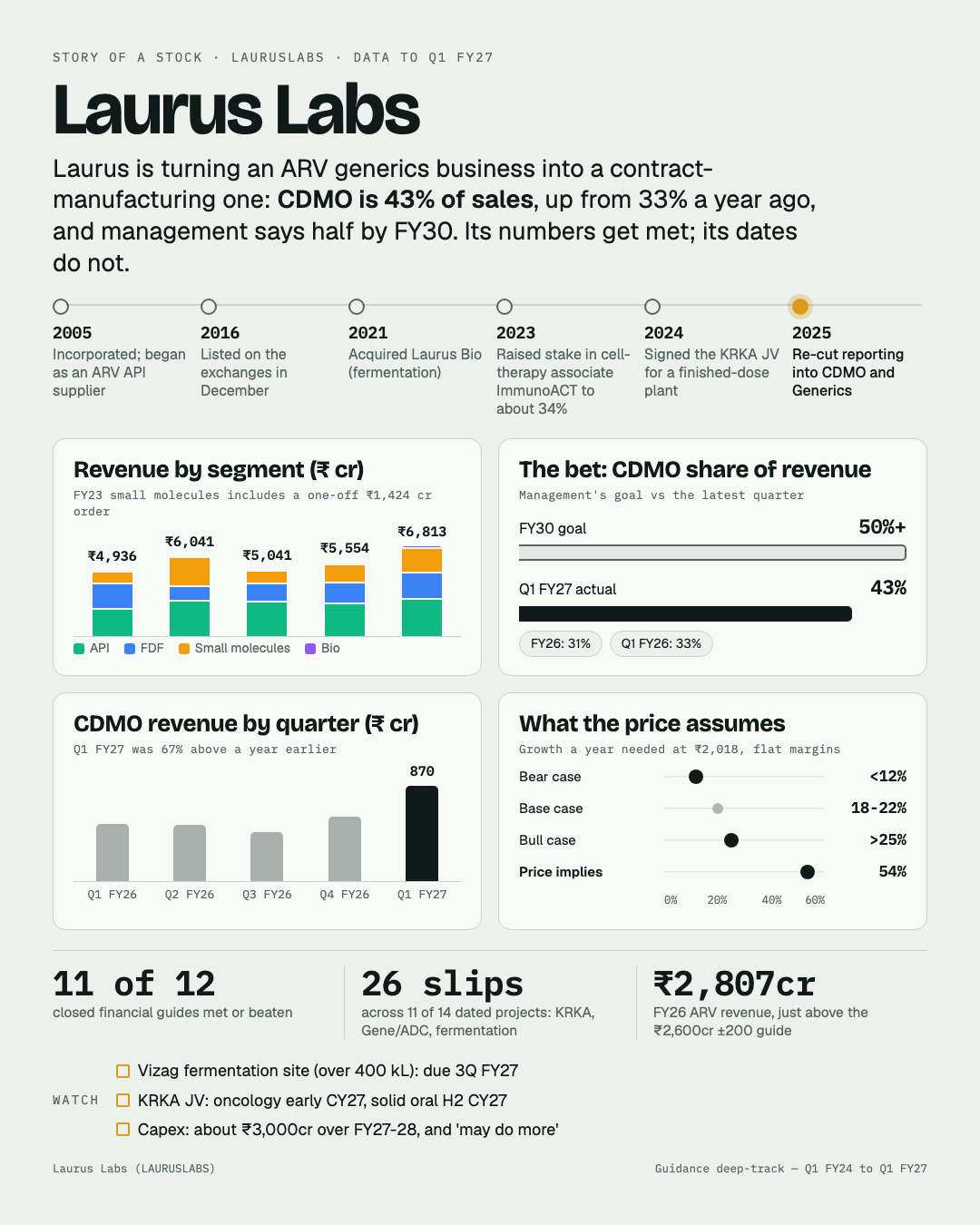
That's the whole Laurus story on one page. Below is the same thing in words, built from 13 concall transcripts, 14 investor decks and the broker notes that cover it.
A kitchen can make its living two ways.
It can serve one dish, in huge volume, to the same buyers, year after year.
Or it can rent itself out and cook other chefs' recipes.
Laurus Labs started with the first. It is building the second.
The house dish is anti-retroviral (ARV) medicine for HIV. The other chefs are drug companies that pay Laurus to develop and make their molecules, a business called CDMO.
The central takeaway
The house dish has stopped growing. The rented kitchen has not.
The debate is no longer whether Laurus can grow. It is whether the kitchen fills up as fast as it is being built.
At a glance
- CDMO share of revenue: 43% in Q1 FY27, up from 33% a year earlier and 31% for FY26. Management's goal is at least 50% by FY30.
- The house dish: ARV revenue was Rs2,807 crore in FY26, 41% of revenue. Management says it will stay near Rs2,800 crore in FY27.
- Margins: EBITDA margin was 26.8% for FY26 and 31.8% in Q1 FY27. Management says it is confident of maintaining or improving it, with no number attached.
- Capex: Rs1,070 crore in FY26. About Rs3,000 crore over FY27 and FY28, and management says it "may do more". Q1 FY27 alone was Rs394 crore, 19% of sales.
- The record: 11 of 12 closed financial guides met or beaten. 26 slips across 11 of 14 dated projects.
- What the price assumes: about 54% growth a year at flat margins, against a base case of 18-22%.
1. The house dish is holding still
Laurus began as an ARV supplier, and for FY26 it was still the biggest line.
In FY26 ARV brought in Rs2,807 crore. Management's guide was Rs2,600 crore, give or take Rs200 crore. It landed above the top of that range.
For FY27, management's own band is Rs2,500 crore, give or take Rs300 crore. On the Q4 FY26 call it said the Rs2,800 crore "will remain constant".
Flat is not a problem. It is the plan.
But flat means a shrinking slice. ARV was 41% of FY26 revenue and a third of Q1 FY27.
That is the base case. It pays for the kitchen, and it does not grow.
2. The rented kitchen is filling up
CDMO revenue was Rs1,082 crore in FY24, restated, and Rs2,080 crore in FY26.
In Q1 FY27 alone it was Rs870 crore, up 67% on a year earlier.
Small molecules did most of it: Rs835 crore. Bio, the fermentation arm, was Rs35 crore, down from Rs65 crore the quarter before.
Management says about half of last year's CDMO revenue was commercial supply, not trial batches.
It serves more than 275 clients, seven of them Big Pharma.
One caution on the base. FY23 small-molecule revenue of Rs2,167 crore included a one-off order of Rs1,424 crore. Read FY23 as a spike, not a level.
The growth is real. What the documents cannot show is how much of it repeats.
3. The lock is a waiting room
The one number management gives on switching is time. Adding a vendor, validating a product and getting it approved is "a 3-4 year process", it said on the Q4 FY25 call.
That is a real wall for a customer who wants to leave.
It is not yet a lock. Contract terms, second-source status and retention are undisclosed. Asked whether Laurus is the primary or the second source, management said those insights are "very difficult to divulge".
I rate the moat narrow, and the evidence for it weak.
Return on capital sat at 6.4% in FY24 and 9.7% in FY25 by the company's own measure, then reached 17.7% in FY26. I assume a cost of capital of 11-12%, so two of the last three years fell below it.
The wall exists. What is behind it has not been shown.
4. The numbers land. The dates slip.
Of 12 closed financial guides, 11 were met or beaten.
Of 14 dated commitments, 11 slipped, 26 times in all.
The Krka joint-venture plant was due to finish its first phase in mid-2027. In Q1 FY27 that became two dates: oncology early next year, solid oral in the second half of 2027.
The gene and ADC facility went from March 2026 to the end of 2026, lost its date for a quarter, then came back as mid-2027, and is now end-2027.
The fermentation site went from June 2026 to the end of 2026.
The second CAR-T plant at its associate ImmunoACT opened in March 2026, about nine months late.
Numbers Laurus controls arrive on time. Buildings and approvals arrive late.
That matters, because the CDMO share depends on buildings.
5. What the price already assumes
At Rs2,018 a share, the price needs about 54% growth a year to work, with margins held flat.
Laurus's revenue grew 7% a year over five years, 4% over three, and 23% over the last twelve months.
My base case is 18-22% a year, my bull case is over 25%, and my bear case is under 12%. Management guides no revenue number, so these are my ranges, not the company's.
The price sits at more than twice the bull case.
That is a statement about what the price needs. It is not a statement about whether Laurus gets there.
What would make me wrong
- Q1 FY27 may be the new floor. CDMO revenue jumped 48% on Q4 FY26. If Rs870 crore is the run-rate, the 50% goal comes before FY30.
- Margins have run ahead. EBITDA margin was 31.8% in Q1 against 26.8% for FY26. The 54% is worked out at flat margins, so if margins keep rising, less growth is needed.
- Late may not matter. A kitchen that opens late but full still works.
The opposite error is being too kind. Capex at 19% of sales and net debt of Rs2,656 crore mean a kitchen built ahead of its orders still has to be paid for.
The one question that matters
Does CDMO reach 50% of revenue?
It is 43% now. It was 33% a year ago. Management wants half by FY30.
What I'll be watching
- Does CDMO stay near Rs870 crore next quarter, or fall back?
- Does the fermentation site, over 400 kilolitres, start by the third quarter of FY27?
- Does capex settle at Rs3,000 crore, or does "may do more" turn into a number?
Final assessment
Laurus has shown it can hit a number.
It has not yet shown it can open a building on the date it gives.
The full read, including every guidance thread and the sources behind it, is on the Laurus Labs page.
A kitchen this size only pays if the chefs keep coming. So far they have. The calendar is the part that keeps slipping.
This is a summary of what Laurus Labs' filings and broker notes say. It is not investment advice or research.