KSH International: It charges by the gram on copper it never owns. The bigger workshop is still a date on a slide
Pranav Yadav · · 7 min read
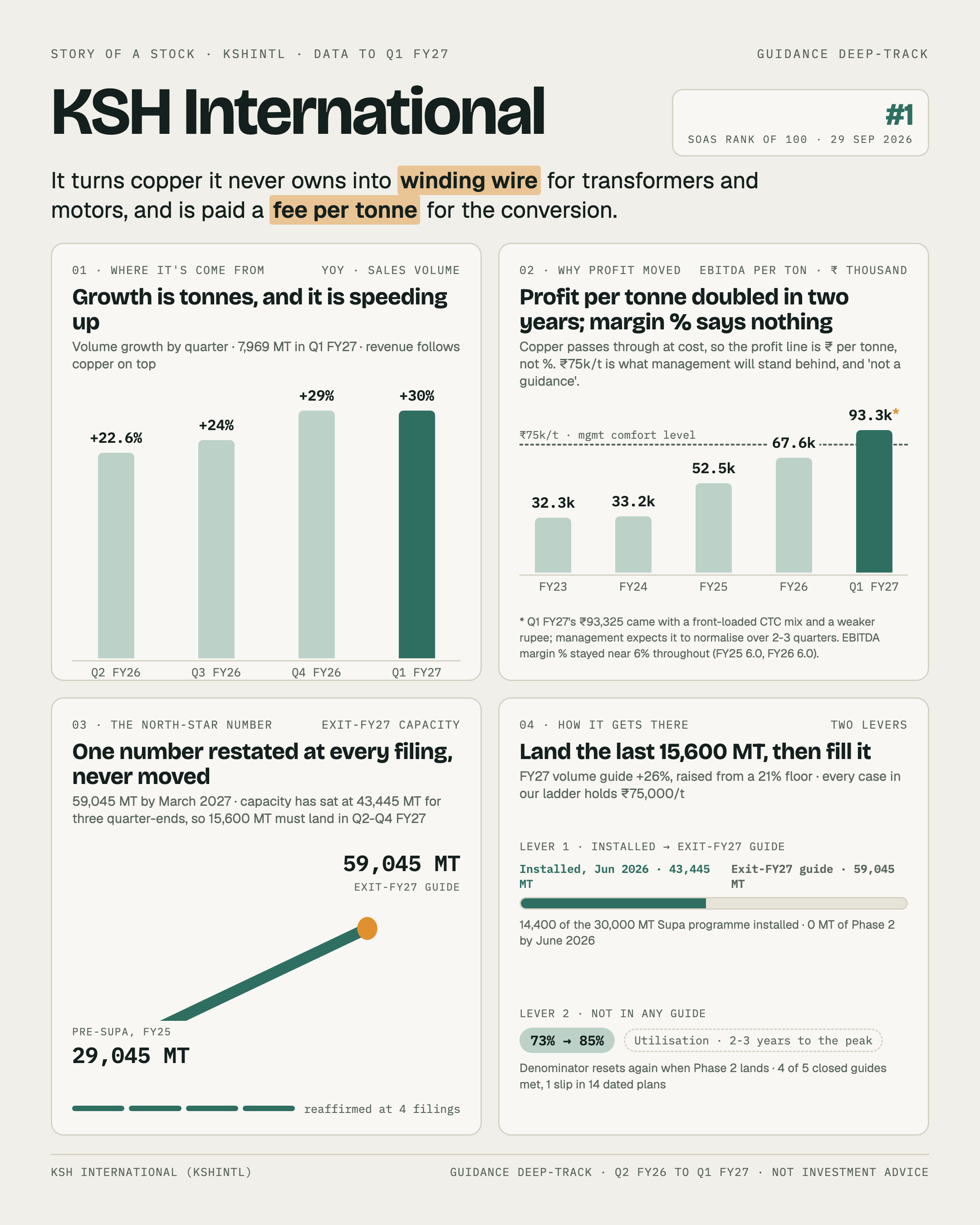
That's the KSH International story on one page. Below is the same story in words, built from four earnings calls, four investor decks, two annual reports and six broker notes.
A jeweller who makes you a chain bills you for two things: the gold, at the day's rate, and the making charge. The gold is not the jeweller's to keep. The making charge is.
KSH International is that jeweller, in copper. It makes magnet winding wire for transformers and motors. Copper passes through at market, so revenue moves with the LME; what it steers by is EBITDA per tonne, the making charge.
It listed on 23 December 2025; four calls are its whole public record.
In those calls the making charge went from ₹65,885 a tonne to ₹93,325. Management will only promise ₹75,000. And the workshop meant to double the grams has not grown in three quarter-ends.
The central takeaway
The record is short, and so far it holds. No KSH deck carries a revenue, margin or profit target; the calls hold 23 refusals to guide. It commits to tonnes, capacity and dates, and has met or beaten 4 of 5 closed financial guides. The one miss was FY26 volume, 28,168 MT against 28,500-29,500 MT, short by 1.2%. Of 14 dated commitments, one has slipped, a PEEK wire line for EV motors that is now undated.
The debate is no longer whether KSH delivers the tonnes it names. It is whether 15,600 MT of new capacity lands inside three quarters, and what each tonne earns once it does.
Three numbers have to move together for that: the tonnes filling the new capacity, the profit each tonne earns, and the days each tonne ties up cash before it is collected.
At a glance
- FY26 delivered: revenue ₹3,107 Cr, up 61%, on volume up 21%; profit ₹110 Cr, up 62%.
- The making charge: ₹67,625 a tonne in FY26, ₹93,325 in Q1 FY27; the FY27 comfort level is about ₹75,000, "not a guidance".
- The FY27 guide: volume growth of about 26%, raised from 21% in May 2026.
- Capacity: 43,445 MT at three quarter-ends running; 59,045 MT by March 2027, so 15,600 MT must land in Q2-Q4 FY27.
- IPO objects: ₹226 Cr of debt repaid; the copper-recycling line commissioned two quarters early.
- What the price assumes: about 35% earnings growth a year, at ₹985 on 28 September.
Where this lives on the portal: the KSH International guidance page.
1. The approvals are real, but three other jewellers hold the same ones
To supply a utility's transformer, a wire maker must be on its approved list, and a new entrant needs five to seven years to reach 765 kV. KSH is the only Indian supplier approved for HVDC at 400 kV.
Our moat call is no moat, rated weak. Precision Wires, Apar and Asta India sit on the same approvals, per a broker, and switching between them costs a customer little. The premium KSH earns per tonne is product mix, not a cost gap.
The approvals slow down new jewellers; they do not stop the ones already at the counter.
2. Demand is the transformer makers' order books, and imports were filling the gap
KSH's wire goes into transformers, so its demand is the transformer makers' order books. The FY26 annual report says those makers have capacities booked through 2029-30, with CG Power expanding 3.4 times to 85 GVA and Hitachi Energy and Siemens Energy doubling.
For CTC, management's own estimate on the Q4 FY26 call was about 40,000 tonnes of Indian demand in FY25, 70,000-75,000 by FY27-28 and 100,000-120,000 around 2030. About 1,000 tonnes a month was being imported because domestic makers could not supply it.
That is the issuer's own estimate, not a market study. Who fills the gap is the question section 1 leaves open.
3. FY27 rests on 15,600 MT that has not moved for three quarter-ends
The ladder: 29,045 MT in June 2025, 43,445 MT by that December after Supa Phase 1 opened, then 43,445 MT again in March 2026 and in June. At each of those quarter-ends it reaffirmed 59,045 MT by March 2027.
That leaves 15,600 MT to commission inside Q2-Q4 FY27. The Q1 FY27 deck says Phase 2 is "on track to come online in Q2"; the Q3 FY26 call had said "14 months", which lands in April 2027, and neither framing was withdrawn.
Utilisation was 73.4% in Q1 FY27 against an 85% yardstick, and the 26% volume guide is running at 30%; the fill is ahead of script, the commissioning is not yet shown.
4. It printed ₹93,325 a tonne and will only stand behind ₹75,000
It was ₹65,885 a tonne in Q1 FY26, ₹74,018 in Q4 FY26 and ₹93,325 in Q1 FY27, on CTC mix, exports and a weaker rupee.
The Q4 FY26 call gave three ranges that do not reconcile. The Q1 FY27 call gave one figure, about ₹75,000, then disowned it: "this is not a, a guidance", only "a level we are comfortable delivering".
I take management's own reasons at face value: the Q1 CTC mix was front-loaded and should normalise, and Supa's fixed costs are still to come. Our cases all hold ₹75,000 by FY28. None holds ₹93,325.
5. Profit is real, but the jeweller buys the copper first
A jeweller who buys the gold before the customer pays needs cash for the gold. KSH's profit went from ₹29 Cr in FY22 to ₹110 Cr in FY26, and operating cash flow was negative in four of those five years: ₹271 Cr of profit, ₹73 Cr of cash out.
The IPO repaid term loans, but total debt went from ₹316 Cr in March 2026 to ₹481 Cr in June. Working-capital days did fall, 71 to 65 to 60. Until the days fall faster than the tonnes grow, every 26% of volume needs new borrowing.
6. What the price already assumes: about 35% a year, between our bear and base cases
At ₹985 on 28 September, the price implies about 35% earnings growth a year. Our cases, built from the volume guide and ₹75,000 a tonne, put earnings growth at 31% in the bear case (volume 18%), 41.5% in the base case (volume 26%) and 47% in the bull case (volume 30%).
Against the record that is not a stretch: delivered profit growth has been 61% a year over three years and 50% over five. The multiple says something else: a P/E of 50.9 against a cable-industry median of 25.8, with no history of its own to set a band.
What would make me wrong
- The fill is ahead of script. Volume grew 30% in Q1 FY27 against a 26% guide; if Phase 2 lands in Q2 as the deck says, the base case is the floor.
- ₹75,000 may be the sandbag. Management has beaten its per-tonne guide once already; a year near the Q1 print breaks all three cases.
- The cash gap is growth, not leakage. Inventory and receivables rose with 61% revenue growth, and the audit is unmodified.
The opposite error would be to read four good quarters as a long record. The single largest commitment, 15,600 MT, has not yet come due.
The one question that matters
Installed capacity: 43,445 MT today, flat since December 2025, against 59,045 MT by March 2027. The Q2 FY27 deck, due around November, either prints a number above 43,445 or the first date has slipped.
What I'll be watching
- Does the Q2 FY27 deck show available capacity above 43,445 MT?
- Where does EBITDA per tonne settle once the CTC mix normalises, above or below ₹75,000?
- Do working-capital days keep falling from 60 while volume grows 26%?
Final assessment
KSH has kept every promise it has chosen to make, and it chooses few of them. The making charge it prints is well above the one it will stand behind, the capacity FY27 depends on is still a date on a slide, and the profit has not yet turned into cash.
The full read is on the KSH International company page.
The copper was never the jeweller's. What the price is paying for is a making charge it has quoted once and will not promise, on a workshop that has not yet opened.
This is a summary of what KSH International's filings, earnings calls, annual reports and broker notes say. It is not investment advice or research.