KRN Heat Exchanger: It built a hall six times the old one. The first season filled about 15% of the seats
Pranav Yadav · · 7 min read
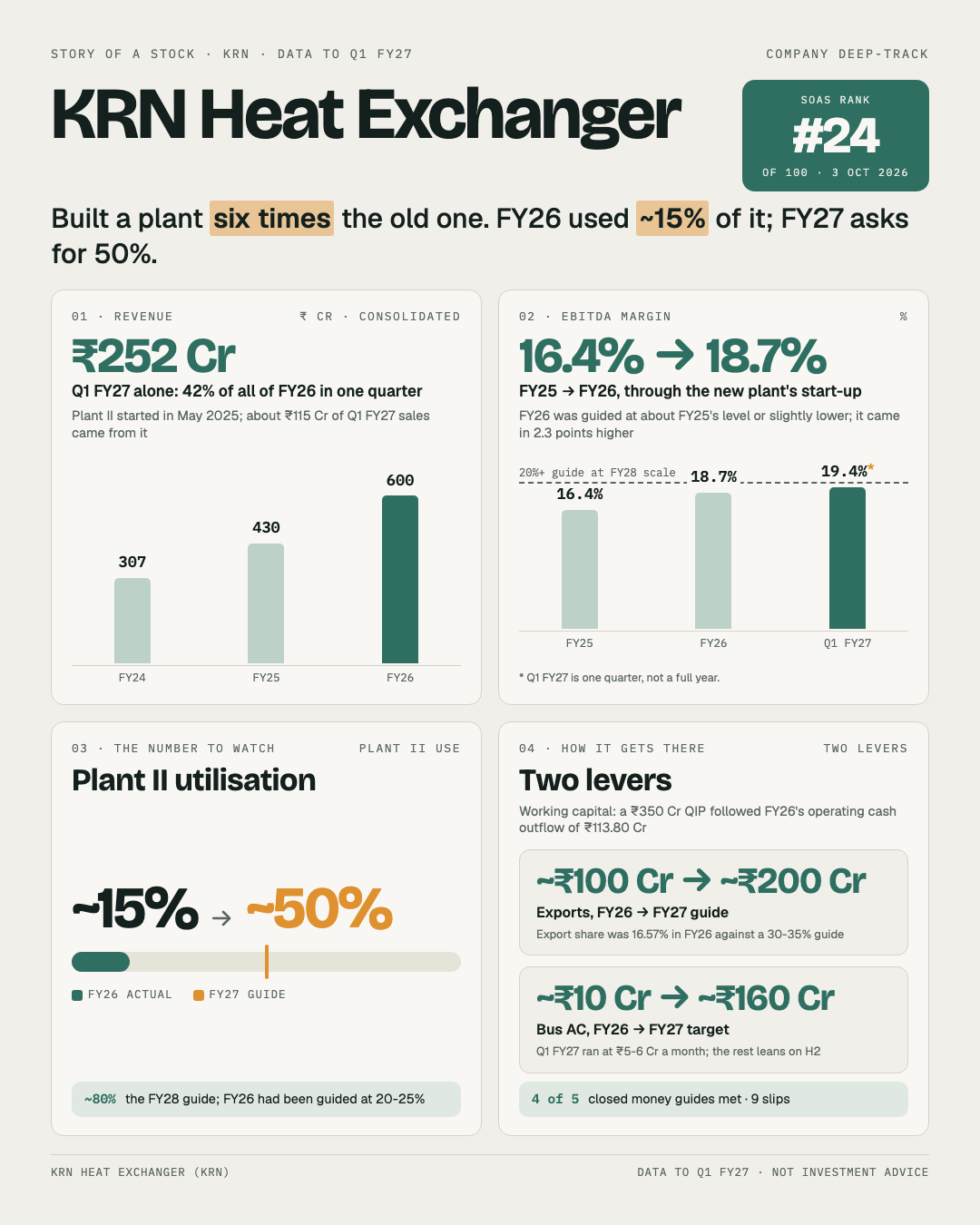
That's the KRN Heat Exchanger story on one page. Below is the same story in words, built from eight earnings calls, eight investor decks, two annual reports and one broker note, which is everything since it listed in October 2024.
Picture a theatre with one small hall that sells out every night. The owner raises money from the public and builds a second hall, six times the size, next door. The new hall opens on schedule. In its first season it fills about 15% of its seats.
KRN is that theatre. It makes the coils inside other companies' air-conditioners, refrigerators and data-centre coolers, at two plants in Neemrana, Rajasthan. The old hall is Plant I. The new one is Plant II, and the whole story now is about filling it.
The central takeaway
Management's money guides mostly land: 4 of 5 closed ones were met or beaten, and the FY26 margin came in 2.3 points above its guide. The promise that matters most did not. Plant II was guided to run at 20-25% of capacity in FY26, and the CMD put the year at about 15%.
The debate is no longer whether KRN can build capacity. It is whether it can fill a hall six times the old one in two seasons, when nobody is locked into buying its seats.
At a glance
- The business: fin-and-tube coils are about 95% of revenue; FY26 revenue was ₹600.06 Cr at an 18.74% EBITDA margin.
- The new plant: Plant II began on 31 May 2025 with a peak revenue capacity of ₹1,800-2,400 Cr, against ₹450 Cr for Plant I.
- Q1 FY27: revenue ₹252.32 Cr at a 19.44% margin, about ₹115 Cr of it from Plant II.
- The guide: Plant II at about 50% in FY27 and about 80% in FY28.
- Cash: operating cash flow was minus ₹113.80 Cr in FY26, and a ₹350 Cr QIP followed in June 2026.
Where this lives on the portal: the KRN Heat Exchanger guidance page.
1. The old plant ran full selling coils to other companies' air-conditioners
KRN's customers are the brands, and its ten largest made up 73.21% of FY25 revenue. Plant I has a peak revenue capacity of ₹450 Cr and runs at 84-86%. On the annual report's own measure, return on capital was 51.26% in FY23 and 31.54% in FY24, when the old hall was the whole business.
That is a good small theatre. It is also why the IPO money went where it did: the old hall had no empty seats left.
2. There is no lock on the door, so the new seats have to be won
Our moat call is no moat. The issuer names its own rivals, Spirotech Heat Exchanger and Prajai Heat Exchanger at home and European and North American suppliers abroad, and says Spirotech earns a similar gross margin. Customers split their orders: "maybe 80% we and maybe 20% they are buying from our competitors", in management's words.
Prices reset every quarter on copper and aluminium prices, and copper alone is 40-50% of the bill of materials. Return on capital fell to 13.64% in FY26 as the new plant entered the base. A hall anyone can build fills on service and price, not on a lease.
3. The new hall opened on time and filled about 15% of its seats
Of the ₹311.12 Cr the IPO raised, ₹235.76 Cr went into the subsidiary that built Plant II. It started commercial production on 31 May 2025, ahead of its Q2 FY26 date. The first-season guide was 20-25%, narrowed to about 20% in November 2025, and the year closed at about 15% by the CMD's account. The deck from the same day still said 20-25%.
This is where the record lives. Money guides: 4 of 5 met, with exports the miss. Dates: 9 slips across 6 of 25 dated plans, the longest being the Rajasthan incentive approval, which arrived about three quarters after its first date. The FY27 guide is about 50%, and Q1 FY27's ₹115 Cr from Plant II runs nearer 20-25% of its capacity.
4. The new audiences are data centres, exports, Bus AC and rail, and two are behind
Data centres went from about 7% of revenue in FY25 to about 16% in FY26, the fastest-growing audience. Exports were guided at 30-35% of FY26 revenue and came in at 16.57%. They reached 20.76% in Q1 FY27, and the FY27 plan is to double them from about ₹100 Cr to about ₹200 Cr. UAE buyers took 37.90% of FY26 exports, and freight there went from about USD 1,500 to about USD 6,000 a container.
Bus air-conditioning came with a small acquisition and made about ₹10 Cr in FY26 against a target of about ₹160 Cr for FY27. Q1 FY27 ran at ₹5-6 Cr a month, so the year now leans on the second half. Rail oil coolers are planned at about ₹40 Cr in FY27.
5. The box office has not caught up, and a share sale refilled it
Filling the hall has cost cash before it brought any in. Operating cash flow went from ₹21.44 Cr in FY25 to minus ₹113.80 Cr in FY26, as inventory rose from ₹95.85 Cr to ₹272.91 Cr and receivables from ₹92.96 Cr to ₹174.71 Cr. Short-term borrowings went from ₹32.04 Cr to ₹187.10 Cr.
The ₹350 Cr QIP in June 2026 was raised for working capital, and management says it covers two years. The annual report checks are clean: related-party dealings at 0.38% of revenue, no pledged promoter shares, an unmodified audit.
6. What the price already assumes: about 73% a year, on our base case
At ₹1,415 on 1 October, the price implies about 73% earnings growth a year for the next two years, solved assuming only half of profit turns into cash because FY26's did not. Our earnings cases are 37-49% in the bear case, 68-77% in the base case and 84-97% in the bull case.
That puts the price on our base case, which is itself built from the Q1 FY27 run rate and the utilisation guide, cut back for the FY26 misses. The trailing P/E is 92.3 against a median of 90 since listing.
What would make me wrong
- Q1 FY27 already ran ahead. Revenue of ₹252.32 Cr in one quarter is 42% of all of FY26.
- The margin held through the start-up. It was guided flat or lower for FY26 and came in at 18.74%, up from 16.40%.
- The FY28 frame is big. An analyst put 80% utilisation at about ₹2,000 Cr of revenue, and management answered "Still same."
The opposite error would be to read the incentives as earned. The PLI claim waits on ₹400 Cr of fin-and-tube revenue in FY27, and none of it was booked by Q1.
The one question that matters
Plant II utilisation: about 15% in FY26, guided to about 50% in FY27 and about 80% in FY28. Plant II's quarterly sales, about ₹115 Cr in Q1 FY27, are the closest live reading.
What I'll be watching
- Does Plant II's quarterly sales line climb toward half its capacity by Q4 FY27?
- Does Bus AC reach a monthly pace that makes ₹160 Cr possible in H2?
- Does operating cash flow turn positive before the QIP money runs down?
Final assessment
KRN delivered the building and most of its money guides, then missed the first-season target for the building's use. The price now asks for the base case on schedule, in a business where every seat has to be won again each quarter.
The full read is on the KRN Heat Exchanger company page.
The hall is built and the doors are open. What the price is paying for is the nights when it is full.
This is a summary of what KRN Heat Exchanger's filings, earnings calls, annual reports and a broker note say. It is not investment advice or research.