ideaForge: It farms on the Army's rain. The tank it filled lasts until December
Pranav Yadav · · 7 min read
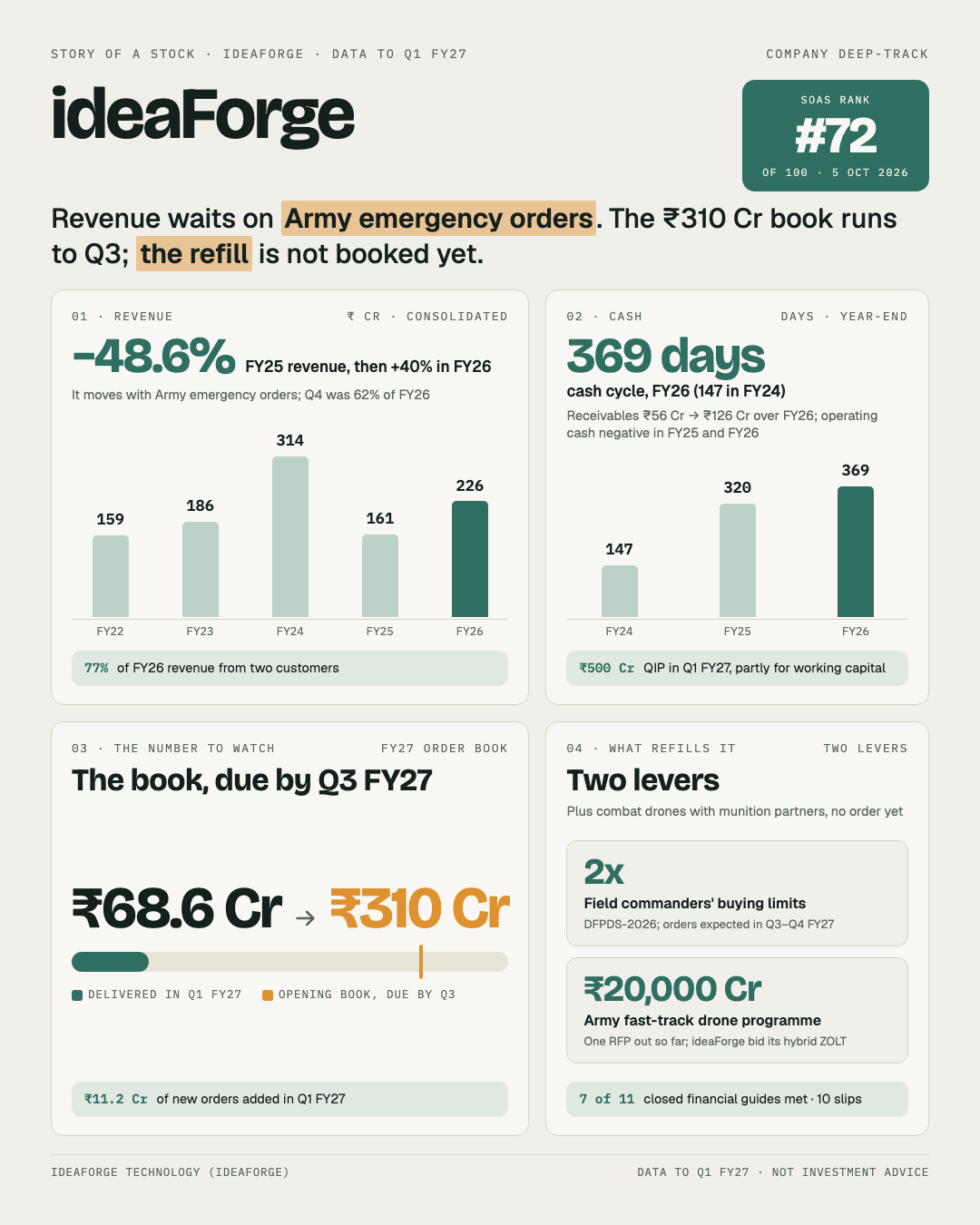
That's the ideaForge story on one page. Below is the same story in words, built from thirteen earnings calls, fifteen decks, three annual reports and four broker notes.
Picture a farm with no well, selling most of its crop to one buyer. In a wet year the harvest is large. In a dry year the fields sit idle, and the hands still have to be paid.
ideaForge is that farm. It builds surveillance drones in Navi Mumbai, and its rain is the Indian Army's emergency purchase rounds. At the start of FY27 its tank was full: a ₹310 Cr order book, due to be delivered by December.
The central takeaway
The record is mixed and splits along one line. ideaForge has met 7 of its 11 closed financial guides, and all seven were about delivering orders it already held. Three of the four misses rested on orders not yet won, such as FY25's margins and a meaningful export business. Its dates have slipped 10 times across 6 of 19 dated commitments.
The debate is no longer whether ideaForge can deliver a book it holds. It is whether the next book arrives before this one runs out in December.
At a glance
- Who buys: defence was 69% of FY26 revenue and civil 31%, mostly government; India was 99.9%.
- The swing: revenue of ₹314 Cr in FY24, ₹161.2 Cr in FY25 and ₹226.1 Cr in FY26.
- Profit: FY26 lost ₹17 Cr after tax, though Q4 alone made ₹60 Cr.
- Cash: the cash cycle went from 147 days in FY24 to 369 days in FY26.
- FY27: a ₹310 Cr opening book due by Q3, with ₹256.8 Cr left at 30 June.
Where this lives on the portal: the ideaForge guidance page.
1. It makes drones for the Indian Army and police, and two customers took 77% of FY26 revenue
ideaForge builds NETRA quadcopters and SWITCH hybrid drones, with its own autopilot, radios and payloads. Drones were 96.67% of FY26 revenue.
The civil side is mostly the state too: police, paramilitary and forest departments. The two largest customers took 77% of FY26 revenue. What that one market decides about drones in a year decides the harvest.
2. Revenue follows the Army's emergency rounds, and FY25 was a dry year: it halved
Revenue was ₹314 Cr in FY24, on emergency-round defence orders. In FY25 the election and slow procurement held back large orders, and revenue fell 48.6% to ₹161.2 Cr. FY26 recovered to ₹226.1 Cr on the next rounds, a ₹137 Cr order in June 2025 and ₹107.3 Cr in Q3, and 62% of it came in Q4 alone.
The swing is the defence rain: ₹235.8 Cr in FY24, ₹95.6 Cr in FY25, ₹156.5 Cr in FY26, with civil revenue near flat.
The costs did not swing with it. FY25 lost ₹62.3 Cr after tax, and FY26's EBITDA of ₹27.1 Cr included ₹22.3 Cr of other income. A farm sized for wet years makes its losses in the dry ones.
3. Every order is a fresh tender won on price after field trials, so nothing locks the buyer in
Our moat call is no moat. The Army runs field trials, and among the drones that pass, the lowest bid wins. The CEO has seen at most two makers qualify for one tender, and they then compete on price. By one broker's count RaphemPhibr out-sold ideaForge in FY25.
Return on capital was 48% in FY22, then 15%, 11%, minus 10% in FY25 and minus 3% in FY26. Gross margin is set contract by contract: 33.0% in FY25 on orders bid to win, 58% in FY26, swinging from 24% in a civil-heavy Q3 to 67.6% in a defence-heavy Q4. Every season the crop goes to the same inspection and the same auction.
4. Cash comes back more than a year after the sale, and R&D reaches profit later as amortisation
The cash cycle went from 147 days in FY24 to 320 in FY25 and 369 in FY26. Receivables more than doubled to ₹126.2 Cr, partly on Q4 billing. Operating cash flow was minus ₹76.8 Cr in FY25 and minus ₹63.4 Cr in FY26, and short-term borrowing reached ₹72.1 Cr from none.
The second lag is the seed. ideaForge spent ₹86.6 Cr on R&D in FY26, 38% of revenue, and recorded 94.2% of it as an asset. It reaches profit later as amortisation, which doubled from ₹13.8 Cr in FY24 to ₹27.4 Cr in FY26. In Q1 FY27 depreciation and amortisation of ₹14.2 Cr outweighed EBITDA of ₹4.3 Cr. The ₹500 Cr QIP in Q1 FY27 pays for both.
5. The ₹310 Cr book runs to December, and the next rain has been forecast late before
Q1 FY27 delivered ₹68.6 Cr of the book and left ₹256.8 Cr, about ₹128 Cr a quarter, close to twice Q1's pace. New orders in Q1 work out from the book at about ₹11.2 Cr, and a ₹23.62 Cr order followed on 30 September.
What refills the tank is a forecast in three parts. Field commanders can now spend about twice as much under DFPDS-2026, with orders expected in Q3 and Q4. The Army's ₹20,000 Cr fast-track drone programme has one tender out, where ideaForge bid its hybrid ZOLT. And the crop is changing: in July 2025 the company was "not directly looking at building a Kamikaze system", and by May 2026 one-way attack drones were "the broad pivot", with munition partners. There is no combat order yet, and the YETI logistics drone starts commercial work only in FY28.
The forecasts have been late before. A ₹300 Cr pipeline of tenders where it was the lowest bidder, set in May 2024 to convert within two quarters, has been re-dated three times; only the ₹137 Cr order came out of it, and its international part is still open. The first US order was set for FY25 and came a year after FY25 ended. The book itself has been delivered when promised: about 40% of it in Q4 FY26, the low end of the 40-45% guided.
6. What the price already assumes: more than 100% growth on today's profit, beyond our 48% bull case
At ₹706 on 5 October, ideaForge is worth ₹3,512 Cr on trailing profit of ₹3.9 Cr, a P/E of 782. Our reverse model cannot reach the price: even at 100% earnings growth in the first year, fading to 5% over ten years, the value stays below ₹706.
Our cases put revenue growth, at a flat margin, at 14-33% a year over two years in the base case, a midpoint of 23.5%, and 39-57% in the bull case, a midpoint of 48%. The bear case runs from minus 10% to plus 8%. The price sits beyond all three, so we have not rated it: trailing profit is too thin to price against.
What would make me wrong
- The refill could be the largest rain yet. Each fast-track case can run to ₹2,000 Cr, against FY26 revenue of ₹226.1 Cr.
- The gate is real even without a lock. Tenders under ₹200 Cr are closed to foreign makers by default, and trials now test for jamming.
- Billing a book shows the earning power. Q4 FY26 made ₹60 Cr after tax on a 67.6% gross margin.
The opposite error would be to read Q4 FY26 as the run rate. The year around it lost ₹17 Cr.
The one question that matters
Orders added in a quarter: ₹218.3 Cr in Q3 FY26, ₹11.2 Cr in Q1 FY27. Management expects more in Q3 and Q4 and gives no number.
What I'll be watching
- Does Q2 FY27 revenue come near the ₹128 Cr a quarter the book needs?
- Do field-commander orders, or a first fast-track award, show up in the book by March?
- Does operating cash turn positive as the ₹126.2 Cr of receivables come in?
Final assessment
ideaForge delivers the orders it holds. It has not shown orders arriving steadily enough to carry a cost base built for growth.
The full read is on the ideaForge company page.
A farm that waits on rain can have great years. What it cannot do is choose when the rain falls, and the price is set as if the next monsoon were already in the tank.
This is a summary of what ideaForge's filings, earnings calls, annual reports and broker notes say. It is not investment advice or research.