Entero Healthcare: It bought the shops and kept the shopkeepers. Now the tills have to pay for the street
Pranav Yadav · · 7 min read
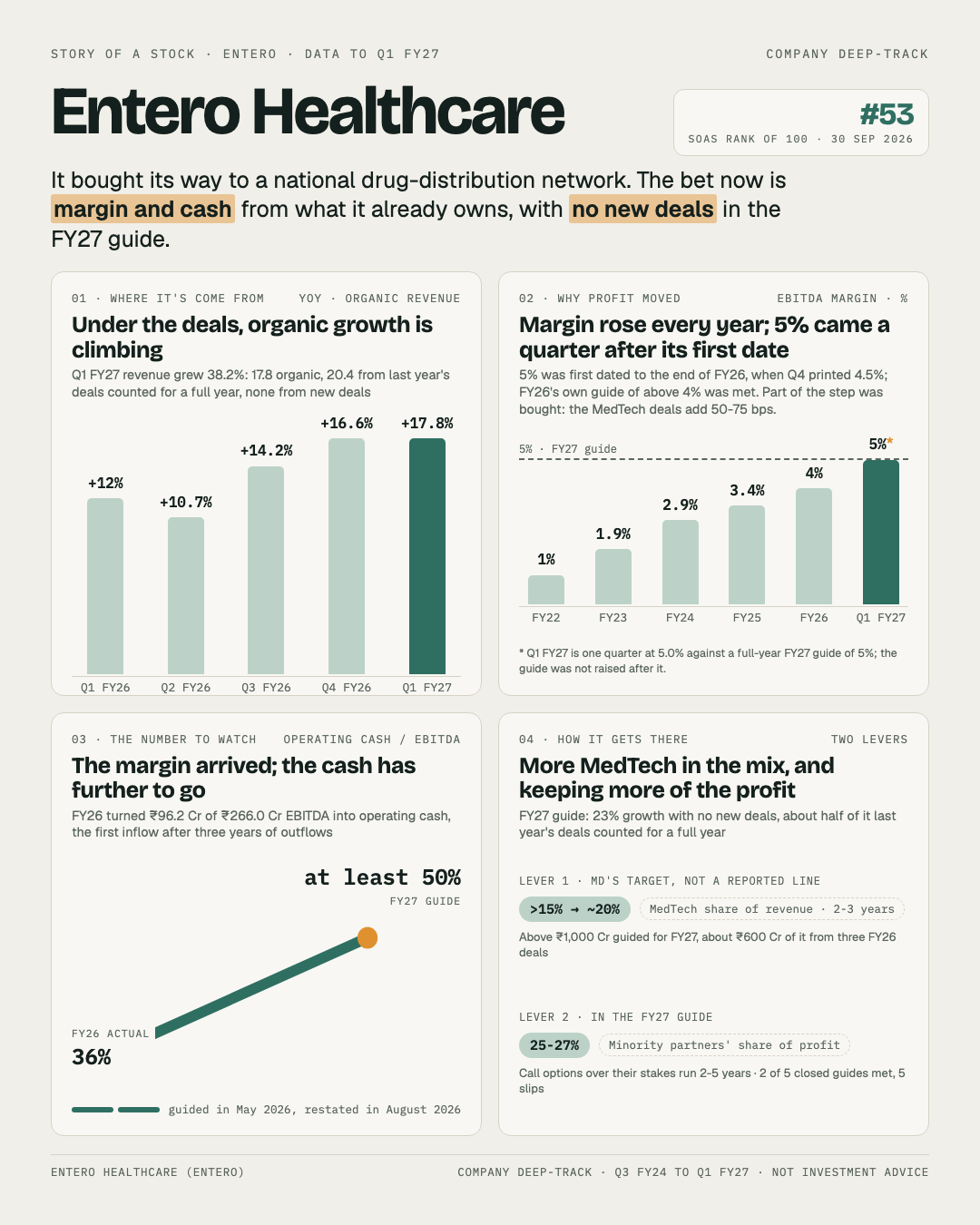
That's the Entero Healthcare story on one page. Below is the same story in words, built from eleven earnings calls, eleven investor decks, three annual reports and five broker notes.
Updated 30 September 2026: an earlier version said the 5% margin arrived a year late. It arrived one quarter after the end-of-FY26 date first set for it, and FY26's guide of above 4% was met.
Picture a trader who builds a chain by taking over the corner shops on a street. He pays for a majority of each and leaves the old shopkeeper in place, with a share of the till and an agreement to settle the rest later.
Entero Healthcare is that trader, in medicines. It supplies over 105,300 pharmacies and 3,600 hospitals from 136 warehouses, and it got there through 51 acquisitions of regional distributors, seventeen of them in FY25 and FY26.
The street is now assembled. For FY27 the company has guided growth with no new deals in it, so the question has changed from how many shops to what the tills bring home.
The central takeaway
The record is mixed. Entero has met 2 of its 5 closed financial guides: both FY26 guides landed, and all three set for FY25 missed. Five dates have slipped across 3 of its 8 dated commitments.
The debate is no longer whether Entero can keep adding shops. It is whether a 5% margin on acquired scale turns into cash for the owner, after the shopkeepers take their share.
At a glance
- FY26 delivered: revenue ₹6,591 Cr, up 29.3%; 13.4 points organic, 5.3 from earlier deals counted for a full year, 10.7 from new deals.
- The margin: EBITDA margin 3.4% in FY25, 4.0% in FY26 and 5.0% in Q1 FY27.
- The FY27 guide: about 23% growth with no new deals, a 5% EBITDA margin, and at least 50% of EBITDA as operating cash.
- Cash: ₹96.2 Cr of operating cash on ₹266.0 Cr of EBITDA in FY26, which is 36%, after a ₹76.9 Cr outflow in FY25.
- The shopkeepers' share: minority partners took ₹30.8 Cr of FY26's ₹145.8 Cr profit, and 26.7% of Q1 FY27's.
- What the price assumes: about 40% earnings growth a year, at ₹1,790 on 28 September.
Where this lives on the portal: the Entero Healthcare guidance page.
1. Growth was 29.3% in FY26, and less than half of it came from shops it already owned
Of FY26's 29.3%, only 13.4 points came from the business Entero already owned. The rest came from acquisitions.
The organic number has been rising: 12.0% in Q1 FY26, then 10.7%, 14.2%, 16.6% and 17.8% in Q1 FY27. That quarter's reported growth was 38.2%, and 20.4 points of it were last year's deals annualising.
One caution on the company's word "organic". It means growth without new deals. So the MedTech target of above ₹1,000 Cr for FY27 counts as organic, even though about ₹600 Cr of it comes from three acquisitions closed in FY26. What MedTech grows at by itself is not yet shown.
2. The network is large, but a funded rival can assemble one the same way
Our moat call is no moat. The reach was assembled with capital, and the two other national distributors, Keimed and Ascent Health, have the scale and the money to do the same.
The returns agree. On all capital, including the ₹749 Cr of goodwill paid for the shops, return on capital was 10% in FY26. The company's own figure of 14.6% leaves that goodwill out.
India has about 65,000 distributors, and the top three held 8-10% of sales in FY23, a prospectus figure that has not been re-measured since. A street with that many small shops is open to anyone with the capital.
3. The 5% margin arrived one quarter after the date first set for it
On its first call after listing, management set out an EBITDA margin of 5% or more within two to three years. In February 2025 it dated that to the end of FY26. In May 2025 it guided FY26 at above 4% instead and moved 5% to the year after.
FY26 closed at 4.0%, meeting that guide, with the fourth quarter at 4.5%. Q1 FY27 then printed 5.0%, the full-year FY27 guide in a single quarter, and management did not raise it.
The lever behind it is mix. MedTech, where Entero also markets the product for the manufacturer, earns more than plain distribution. Management puts it above 15% of revenue now and up to 20% in two to three years, and says the MedTech deals added 50 to 75 bps of margin. MedTech is not reported as a separate line, so this lever cannot yet be checked from the accounts.
4. FY25 missed all three financial guides; FY26 met both
FY25 was guided at 35-40% revenue growth and came in at 30%. The margin was to rise 100 bps and rose 52, and the 4% exit rate set for the fourth quarter came in at 3.7%. The plan to acquire ₹1,000 Cr of revenue that year ended at ₹792 Cr.
FY26 went the other way. Revenue growth met its 30% guide at 31.5%, on a like-for-like basis the guide was restated to mid-year, and the margin landed on its 4.0% floor. Operating cash was guided at ₹100 Cr or more and came in at ₹96.2 Cr, which management counts as achieved and our arithmetic does not.
One good year after one poor one is a thin record.
5. The profit has to reach the owner, and two hands take from the till first
The first is working capital. A distributor stocks the medicine and gives the pharmacy credit, so growth absorbs cash. Operating cash flow was negative in each of the four years to FY25 and turned to ₹96.2 Cr in FY26, 36% of EBITDA.
The second is the shopkeepers. Minority partners took ₹30.8 Cr of FY26's ₹145.8 Cr profit. In Q1 FY27 total profit grew 72%, and profit to Entero's own shareholders grew 37%.
Entero holds call options over those stakes, running two to five years. Exercising them will need the cash the first hand is absorbing.
6. What the price already assumes: about 40% a year, between our base and bull cases
At ₹1,790 on 28 September, the price implies about 40% earnings growth a year. Our cases carry the revenue guide through a margin moving from 4.0% to 5%, and put that growth at about 27% in the bear case, 36% in the base case and 43% in the bull case.
Two cautions. The earnings here are EBITDA, before the minority's share, so growth to shareholders will run below it. And enterprise value to EBITDA is 25.2, exactly its median since listing.
What would make me wrong
- The margin may already be past the guide. Q1 FY27 printed 5.0%, and management's stated aspiration is a margin above 6%.
- Organic growth is accelerating. It was 17.8% in Q1 FY27, and about 22% before the low-margin accounts the company chose to exit, per the MD.
- Cash has turned. Working-capital days fell from 66 to 59 over FY26, the first year of operating inflow.
The opposite error would be to read FY26 as the rule. The record has one good year and one poor one.
The one question that matters
Operating cash as a share of EBITDA: 36% in FY26, against at least 50% guided for FY27. The first reading comes with the half-year cash flow in the September-quarter results.
What I'll be watching
- Does first-half FY27 operating cash run at or above half of EBITDA?
- Does organic growth hold near 17.8% once last year's deals stop adding to the reported figure?
- Does the minority share of profit stay inside the 25-27% guided for FY27?
Final assessment
Entero has assembled the street and reached the margin it promised, a quarter after the date it first set. What it has not yet shown is a full year in which the profit arrives as cash and stays with its own shareholders.
The full read is on the Entero Healthcare company page.
The shops are bought. What the price is paying for is tills that fill faster than they ever have, with the shopkeepers still holding a share of each one.
This is a summary of what Entero Healthcare's filings, earnings calls, annual reports and broker notes say. It is not investment advice or research.