Coforge: It stopped quoting the speed. It kept quoting the fuel
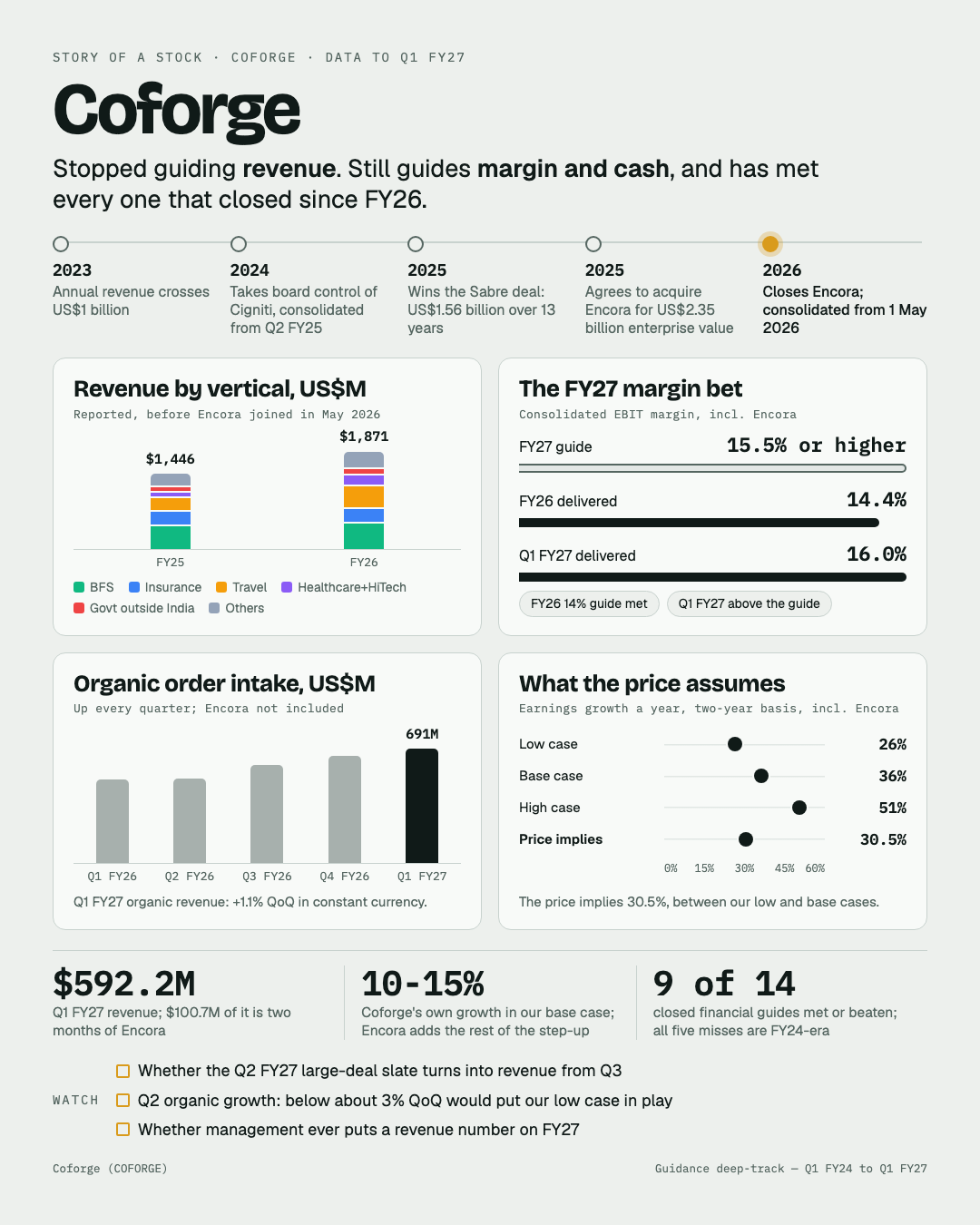
That's the whole Coforge story on one page. Below is the same thing in words, built from 14 concall transcripts and 12 investor decks, with broker notes used only as a cross-check.
Think of a car on a long trip.
The dashboard has a speedometer and a fuel gauge.
Coforge's management took the speedometer out after FY24.
It kept the fuel gauge, and reads it out loud every quarter.
Then in May 2026 it welded a second car onto the first. The trip meter jumped. The open question is how fast the original engine is going.
The central takeaway
The fuel gauge has been honest. The speedometer is missing.
The debate is no longer whether Coforge keeps its promises. It is how much of the coming growth is the second engine, and how much is the first one speeding up.
At a glance
- The guide: no revenue number for FY27. Management gave FY27 margins and cash instead: consolidated EBIT of 15.5% or higher and free cash flow at 100% of profit.
- The record: 9 of 14 closed financial guides met or beaten. All five misses are FY24-era.
- The timing record: 4 slips across 12 dated milestones, every one of them on the Cigniti deal.
- Reported basis: Q1 FY27 revenue was $592.2M, of which $100.7M is two months of Encora.
- Growth outlook: 24-29% a year for two years on that consolidated basis. Coforge's own business is 10-15% inside it.
- What the price implies: about 30.5% a year in earnings growth, against our low case of 26% and base case of 36%.
1. The fuel gauge has been read honestly since FY26
FY26's margin promise was a reported EBIT of 14%. It delivered 14.4%.
For FY26 it guided free cash flow at 70-80% of profit. It delivered 76.3%.
For Q4 FY26 it guided an EBIT of 15%. It printed 16.6% on the new accounting basis, or 15.2% on the old one that the guide was made on.
For FY27 the guide is a consolidated EBIT of 15.5%, later nudged to "15.5% or higher". Q1 FY27 printed 16.0%.
Every closed margin and cash guide since FY26 has landed. That is the one part of the dashboard I would call reliable.
2. The speedometer came out after it misread
FY24 is where the record breaks. Management guided 13-16% revenue growth in constant currency, and delivered 13.3%, at the bottom of its own band.
But it also guided an adjusted EBITDA margin of about 18.3%, and delivered 17.6%. Two quarterly margin steps, guided at 100 basis points and 150-200, came in at 39 and 102.
Then, in Q1 FY25, an analyst asked about guidance and the answer was: "we have taken a very conscious call. We have not given a guidance."
No revenue growth number has been given for FY25, FY26 or FY27. On FY27, the answer was that the intent is not "to offer hard numbers around it".
That is a fair choice. It also means the revenue line cannot be scored, only watched.
3. The second engine explains most of the jump
Encora, bought at a $2.35 billion enterprise value, had about $600M of revenue in FY26 at signing. It has been in the numbers only since 1 May 2026.
Our read is that FY27 reported growth is roughly 40-45%. About 30 points of that is Encora, all of it acquired.
After that, the base case has Coforge's own business growing 10-15% in FY28. That is what gets the two-year rate down to 24-29% a year on revenue.
Every growth number in this post is on that reported basis unless it says organic.
4. The original engine is warming up, not yet fast
The organic prints are modest. Q1 FY27 revenue grew 1.1% quarter on quarter in constant currency, or 5.2% once you strip out $19M of planned exits.
Management said the quarter would be flattish. It was.
The demand signal is stronger than the revenue. Organic order intake, which excludes Encora, has risen every quarter for five quarters, from $507M to a record $691M. A $230M five-year European programme was signed after the quarter.
The lock behind this is real but thin. Long engineering programmes create switching costs, and the top ten clients have been with the firm for over twelve years on average. But Coforge itself won Sabre, a $1.56 billion, 13-year deal, by displacing incumbents. So could someone else. Our moat call is NARROW, in the weak tier.
Two things nag. In Q1 FY27 the top ten clients grew 18.7% year on year against 33.3% for the whole firm, so the biggest accounts are no longer carrying it. And the December 2025 Encora package, with $2.5 billion combined revenue as one of its numbers, has not been restated on either call since.
5. The price already assumes a fast first engine
The share price was Rs1,841 on 18 September 2026. Working backward, it implies about 30.5% a year in earnings growth over two years.
Our low case for earnings growth is 26% a year. The base case is 36%. The high case is 51%. The price sits between the low case and the base case.
Delivered profit growth has been 33% a year over three years and 29% over five.
None of those numbers is a revenue guide, because there is not one. They are what we built from the margin guide and the base case, and they include Encora.
What would make me wrong
- The gauge is honest. Every margin and cash guide since FY26 has been met. A firm that is this accurate on fuel deserves some benefit of the doubt on speed.
- Encora's integration is running ahead. Its G&A fell 40% in Q1 FY27 against a 20-25% guide, and nothing on the Encora deal has slipped.
- The demand signal is unusually clean. Record organic intake and an organic order book of $1.75 billion at Q4 FY26, up 16.4% year on year, are not what a stalling engine looks like.
- I may be over-reading the missing speedometer. Withdrawing a guide after a miss is common, and it is not a broken promise.
The opposite error is also possible. FY26's growth leaned on travel, up 62%, while insurance grew under 5%. Sabre alone was about 45% of FY25 order intake, and its revenue schedule is not disclosed anywhere.
The one question that matters
How fast is the original engine going in the second half of FY27?
In Q1 it was 1.1% quarter on quarter, and management said the quarter would be flat. It also said the fast part starts in Q2, with most of the large deals showing up in revenue from Q3.
Our low case gets in play if Q2 organic growth comes in below about 3% quarter on quarter.
What I'll be watching
- Do the Q2 FY27 large deals turn into revenue from Q3, as management said?
- Is Q2 organic growth above roughly 3% quarter on quarter?
- Does management ever put a revenue number on FY27, or keep quoting only the fuel?
Final assessment
Coforge's record is mixed, and it is mixed in a useful way. The money side is dependable. The FY24 P&L promises were not, and the revenue promise was withdrawn rather than repeated.
The full read, including every guidance thread and its source, is on the Coforge page.
A dashboard with a fuel gauge and no speedometer tells you the car will not run dry. It does not tell you how fast the first engine is actually going.
This is a summary of what Coforge's filings, decks and broker notes say. It is not investment advice or research.