CCL Products: It has the kitchen. Vintage Coffee has the queue. Dinner costs the same
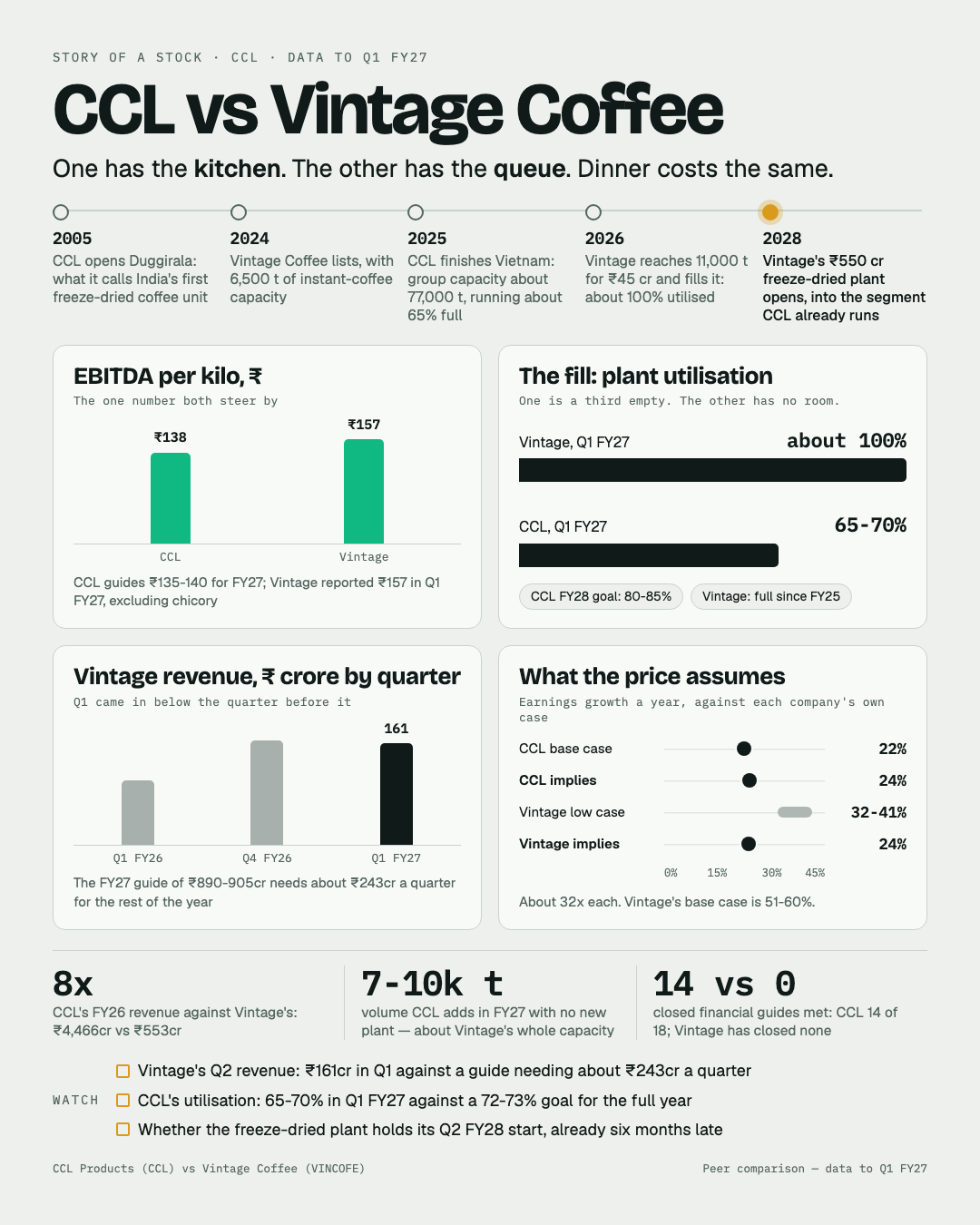
Both companies on one page. Below is the same thing in words, built from every transcript and deck each has published, plus the broker notes covering them.
India has exactly two listed companies that make instant coffee for other people's brands.
One is eight times the size of the other. They trade at almost the same multiple.
Picture two kitchens on the same street, charging the same for dinner.
The first is large, and a third of its tables are empty. It has already paid for every one of them.
The second is small, full, and turning people away. It is building an extension that opens the year after next.
The central takeaway
The question is not which company is better. Both make the same product the same way.
It is which risk you would rather own: a kitchen with empty tables, or a kitchen that still has to be built.
CCL has the oven and needs the orders. Vintage has the orders and needs the oven.
At a glance
- Same price, very different sizes. CCL did ₹4,466 Cr of revenue in FY26; Vintage did ₹553 Cr. Both trade at roughly 32 times trailing earnings.
- One kitchen is a third empty. The other has no room. CCL ran 65-70% full in Q1 FY27; Vintage ran at about 100%.
- CCL will add about as much volume this year as Vintage's whole plant makes. 7,000-10,000 tonnes in FY27, against Vintage's capacity of 11,000.
- Growth costs them opposite amounts. CCL plans no expansion capex for two years or so. Vintage is spending ₹550 Cr on one plant, taking peak debt up ₹400 Cr in FY28.
- Vintage's orders are booked. The plant is not. Letters of intent cover 70-80% of the new capacity, but first revenue is Q2 FY28 — six months late, at a cost that moved from ₹450 Cr.
- One record can be graded; the other cannot yet. CCL has met 14 of 18 closed financial guides. Vintage has met nine of nine, but every one was about building something.
- Neither sets the price of coffee. Both are cost-plus: add a margin to the beans, pass the rest through.
How both of these companies make money
Neither name is on a jar you would recognise. They make the coffee inside other companies' jars.
Both work on cost-plus terms. They source green coffee, add a margin, ship it. When coffee prices rise, revenue rises with them — and very little of that is the business getting better.
It is why CCL's turnover rose 43% in FY26 while volume rose about 19%. The rest was mostly beans.
Read volumes and per-kilo margin. Treat revenue growth as partly a coffee-price story.
1. One kitchen is a third empty. The other has no room left
CCL finished its Vietnam expansion in 2025. Group capacity is about 77,000 tonnes, and management says the plants ran about 65% full in FY26, 65-70% in Q1 FY27.
Vintage went from 4,500 tonnes to 6,500 to 11,000 in two years. That line runs at about 100%.
Same industry, opposite positions.
Everything else follows. A company with spare capacity grows by finding buyers. A company with none grows by pouring concrete.
How far it goes: CCL publishes a utilisation percentage but not its tonnage, so you can grade the ratio, not the base.
2. CCL's next 10,000 tonnes are already built. Vintage's next 5,500 cost ₹550 crore
CCL says 15% volume growth means 7,000 to 10,000 more tonnes in FY27. That needs no new plant and no new money.
Vintage's next 5,500 tonnes is a freeze-dried plant costing ₹550 Cr, about ₹150 Cr spent so far, with roughly ₹400 Cr of peak debt arriving in FY28.
Now look at what each is missing.
CCL's growth is nearly free, and entirely optional. It depends on customers wanting more, and the plants have sat near two-thirds full for a while.
Vintage's growth has to be paid for, and is largely spoken for. Letters of intent cover 70-80% of the plant before a kilo is made.
One has the asset and needs the demand. The other has the demand and needs the asset.
How far it goes: letters of intent are not contracts, and Vintage says they are subject to quality and price.
3. Eight times the revenue buys protection, not speed
CCL ships to more than 110 countries from plants in India, Vietnam and Switzerland.
Vintage runs one site in Hyderabad, and has said its top five or six customers are 45-50% of revenue.
So size is not buying faster growth here — Vintage is growing several times quicker. It is buying the ability to lose a customer, or a geography, and still be fine.
That is worth paying for. It is not what most people think they are paying for when they own the bigger company.
How far it goes: Vintage's concentration has fallen from the mid-70s, so the gap is closing.
4. The same dinner bill, two very different promises
Both trade at about 32 times trailing earnings. That is where the similarity ends.
Work backwards from CCL's price and it needs profit to grow about 24% a year to FY28. The base case built from management's own volume guide is about 22%.
CCL's price asks for slightly more than what management has already promised.
Work backwards from Vintage's price and it needs about 24% too. But Vintage's base case, built from its guidance, is 51-60% — and even the conservative case is 32-41%.
Vintage's price asks for less than its own conservative case.
Same multiple. One is priced for the promise being kept, the other for a good part of it not being.
How far it goes: our base case for Vintage moved about 15 percentage points in a month. It is the least stable number here.
5. One record can be graded. The other has nothing that has come due
This is the part worth keeping even if you forget the coffee.
CCL has made public promises for years, so you can score them. Fourteen of eighteen closed financial guides met.
The resets are telling. In July 2023 the pitch was 18-20% volume growth for two to three years; it is now about 15% for three to four. The FY28 utilisation goal was cut from 85-90% to 80-85% within three months. And the dates slip: eight slips across six of fifteen dated threads.
Vintage has met nine of nine closed commitments — every one about building something.
It has never closed a financial guide. Every revenue and margin number it has given is still in the future.
That is not a criticism. It is an age. But the records are not comparable, and the younger company will always look cleaner, because nothing has had time to go wrong.
The first date that came close already moved: the freeze-dried plant was meant to start in FY27, and is now Q2 FY28.
How far it goes: absence of a bad record is not a good record.
What would make me wrong
On CCL:
- My own moat read is "no moat". Returns on capital were 10-13% in FY22-25, near the cost of capital, and customers cap how much volume one supplier gets.
- The spare capacity may stay spare. Utilisation has sat near two-thirds for a while, and the goal for filling it was already cut once.
- Of 30 live guides, two are backed by an order or a contract.
On Vintage:
- The margin story depends on one unbuilt plant, entering the premium segment CCL already runs.
- A few customers matter a lot, at 45-50% of revenue.
- Prices reset every quarter. A full plant protects volume, not what each kilo earns.
If I am too harsh on either: CCL has beaten its volume guide for four straight quarters, and Vintage has met every building deadline but one.
The one question that matters
EBITDA per kilo — the number both steer by, and the only one directly comparable.
CCL guides ₹135-140 a kilo for FY27. Vintage reported ₹157 in Q1 FY27, excluding chicory. One broker's figures put Vintage ahead in FY24 and FY25 too.
If that holds, the smaller company is genuinely leaner, not just growing off a smaller base.
If it converges as Vintage scales, the edge was size all along, and the new plant has to do the work.
What I'll be watching
- Does Vintage's Q2 revenue step up to about ₹243 Cr? Q1 came in at ₹161 Cr, slightly below the previous quarter, and the FY27 guide needs that pace for three quarters running.
- Does CCL's utilisation reach 72-73% this year, on the way to the 80-85% it already trimmed once?
- Does the freeze-dried plant hold its Q2 FY28 start, or slip again?
Final assessment
These two are each other's only real listed comparison. Our competitive reads name each other and almost nobody else.
One has built a kitchen bigger than its queue. The other has a queue longer than its kitchen.
You are being asked the same price for both.
The full reads are on the CCL Products page and the Vintage Coffee page.
Empty tables and a waiting list are both problems. Only one can be fixed with money already spent.
This is a summary of what these companies' filings and the broker notes covering them say. It is not investment advice or research.