CCL Products: It built the road and fixed the toll. Then it cut the traffic forecast
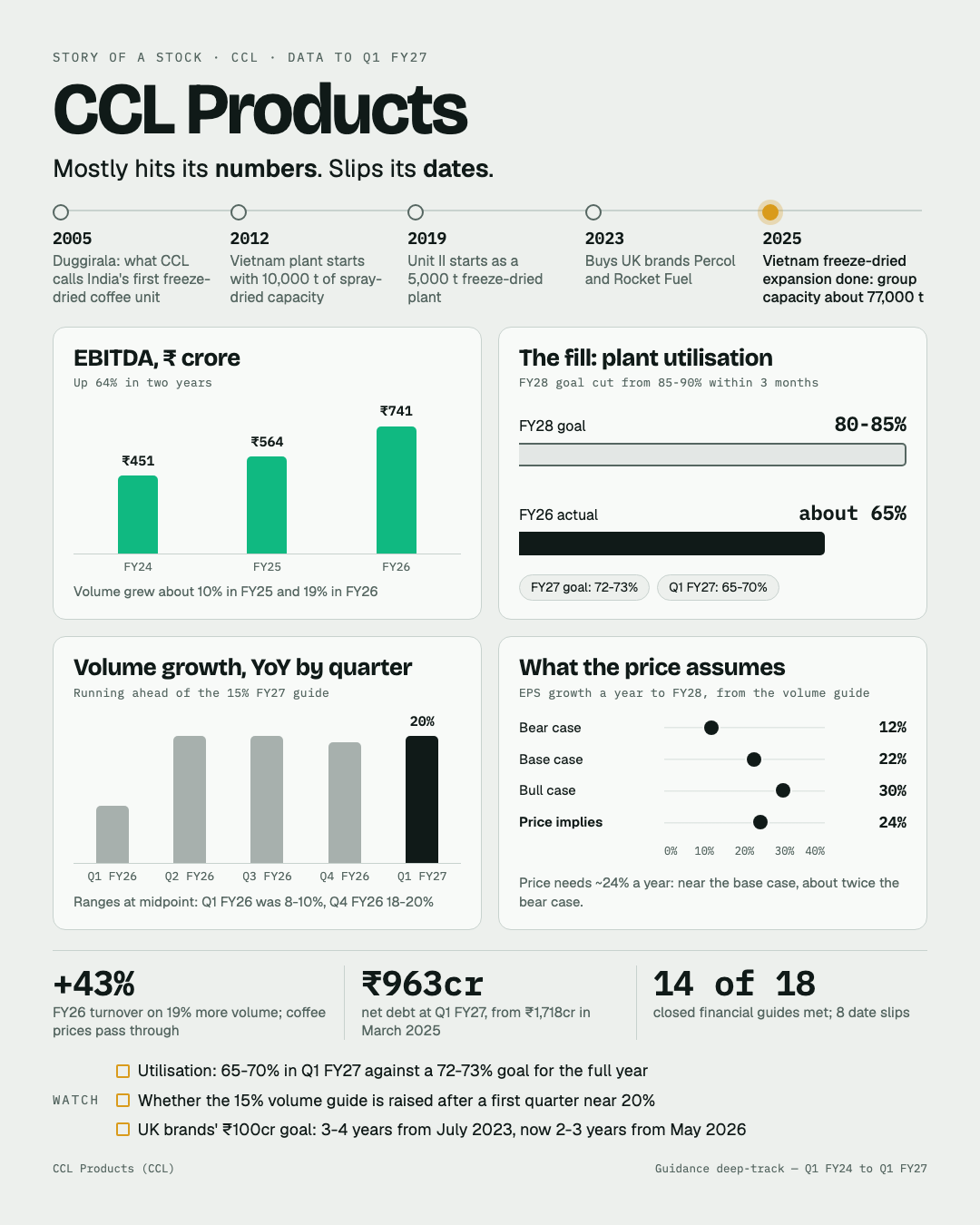
That's the whole CCL Products story on one page. Below is the same thing in words, built from thirteen quarters of concall transcripts, one investor presentation and nineteen broker and sector notes.
A toll road earns a fee for every vehicle that drives on it.
It does not care what the vehicle is carrying.
CCL Products makes instant coffee for other companies' brands, and it earns a fixed margin on every kilo, whatever coffee costs that month.
Its road is already built. The plants have roughly doubled, to about 77,000 tonnes, and they run about two-thirds full.
So the whole story is traffic. And the forecast for the traffic has already moved once.
The central takeaway
The base case needs no new road. It needs the existing one to fill.
The debate is no longer whether CCL can afford to grow. It is whether the plants fill on management's schedule, and the price already assumes they do.
At a glance
- The guide: about 15% volume growth in FY27 and for the next three to four years, EBITDA growing in line. EBITDA per kilo is held at Rs135-140 for FY27. Revenue is not guided, because it follows coffee prices.
- The record: 14 of 18 closed financial guides met. Eight date slips across six of fifteen dated threads.
- The cash: net debt of Rs963 crore at Q1 FY27, down from Rs1,718 crore in March 2025. Management's goal is about Rs800 crore, with no date.
- The evidence: of 30 live guides, two are backed by an order or a contract.
- What the price assumes: about 24% EPS growth a year to FY28, against 22% in the base case built from the volume guide.
1. The toll ignores the price of coffee
CCL says 100% of its business is on cost-plus terms.
It adds a margin to the green coffee it buys, so revenue moves with coffee prices. What it steers by is EBITDA per kilo.
Turnover rose 43% to Rs4,466 crore on about 19% more volume. The rest was mostly coffee prices passing through.
EBITDA rose 32% to Rs741 crore, against a guide of 15-20% that was later lifted to about 25%.
That is why management guides volume and EBITDA per kilo, and will not guide revenue.
For FY27 it holds EBITDA per kilo at Rs135-140. Its rule of thumb is that freeze-dried coffee earns 30-40% more per kilo than spray-dried, so mix is how the toll creeps up.
2. The road is already built
Group capacity is about 77,000 tonnes after the Vietnam freeze-dried expansion finished in 2025.
Management says the plants ran about 65% full in FY26 and 65-70% full in Q1 FY27.
It plans no expansion capex, and has said so since February 2024. The window keeps resetting forward: "next 2, 3 years", then "next 3, 4 years", most recently "next 2 years or so".
The cash then does the work. Net debt was Rs1,718 crore in March 2025 and Rs963 crore at Q1 FY27. Management's goal is about Rs800 crore, with no date attached.
3. Traffic is running ahead of the guide
For four quarters running, volume has grown about 20% year on year. The FY27 guide is about 15%.
After a first quarter of almost 20%, management said it stands by 15%.
That figure has been reset. In July 2023 the pitch was 18-20% a year for two to three years. Now it is about 15% for the next three to four.
FY24 delivered about 14%, FY25 about 10% and FY26 19%.
So the guide now sits at a level the business already clears. That is a cushion, and a sign the first pitch was too high.
4. The lever is how full the road gets, and that goal has already moved
The plan hangs on one number, utilisation: how full the plants are.
In May 2026 management said 15% volume growth means 7,000 to 10,000 more tonnes, which takes utilisation from about 65% to 72-73% in FY27, and to about 80-85% in FY28.
In February 2026 the FY28 figure was 85-90%.
Three months later it was 80-85%.
New plants fill slowly: about 30% of capacity in year one, 60% in year two, 80% in year three.
The next capacity decision only comes when utilisation nears 75-90%, with a lead time of nine to twelve months.
5. The numbers hold. The dates slip.
Fourteen of eighteen closed financial guides were met. EBITDA growth beat its guide in FY25, at 24.9%, and again in FY26.
The four misses: FY24 volume (14% against 18-20%), FY24 EBITDA growth, and the branded business's margin, twice. It guided 7-8% for FY25 and has held it at 5-6%.
The dates are the weak spot. Eight slips across six of fifteen dated threads.
The India spray-dried plant was due in March 2024 and started about three quarters later. The Vietnam freeze-dried plant moved from July-September 2024 to January-March 2025.
The UK brands' Rs100 crore sales goal was three to four years from July 2023. In May 2026 it became two to three years.
Management is mostly reliable on the number and loose on the calendar.
6. What the price already assumes
The share price was Rs1,066 on 18 September 2026, a market value of Rs14,229 crore.
Working backward, that price needs EPS to grow about 24% a year to FY28.
The base case built from management's own volume guide is 15% volume growth, which gives about 12% revenue growth and about 22% EPS growth a year. It holds EBITDA per kilo, costs below EBITDA and the share count flat, assumes a 17% tax rate, and trims FY27 revenue for lower coffee prices.
The bull case runs volume at the recent 20% pace and gives 30%. The bear case runs volume at 8%, my assumption, and gives 12%.
So the price asks for a little more than the base case, and about twice the bear case.
Profit has compounded at 11% a year over three years and 16% over five. The last twelve months grew 39%. The price asks for more than the longer record and less than the latest year.
What would make me wrong
- It is a toll road with rival roads alongside. My own moat read is "no moat". Customers cap how much of their volume one supplier gets, and a funded rival can build or acquire capacity. Returns on all capital were 10-13% in FY22-25, near the cost of capital. If customers stay cautious and contracts stay short, the traffic will not come.
- The guide is thinly backed. Of 30 live guides, two are backed by an order or a contract. Only the term-loan schedule and a renewable-energy contract are externally backed. The rest is management's word and long-range vision.
- The other error is being too harsh. Volume has run at about 20% against a 15% guide. Net debt beat its own path, at Rs1,073 crore in March 2026 against Rs1,200 crore guided. A modest guide on plants this empty could simply be beaten again.
If I am too harsh, it is because I am weighing the slipped dates over a record of beating a modest number.
The one question that matters
Do the plants reach 72-73% utilisation in FY27?
It was about 65% in FY26 and 65-70% in Q1 FY27. Management's own arithmetic is 7,000 to 10,000 more tonnes of sales.
Everything else hangs off it: the debt goal, the branded push, and the price.
What I'll be watching
- Does utilisation move toward 72-73% in the Q2 and Q3 prints, or does the FY27 goal go the way FY28's did?
- After a first quarter near 20%, does the 15% volume guide stay put, or quietly move?
- Does the UK brands' Rs100 crore goal keep moving out? It is now two to three years from May 2026.
Final assessment
CCL has mostly proved it can hit the number it commits to.
It has not yet proved it can hit the calendar it sets, and the calendar is what the whole plan runs on.
The full read, including every guidance thread and the sources behind it, is on the CCL Products page.
A toll road does not earn for being built. It earns when the traffic turns up.
This is a summary of what CCL Products' filings and nineteen broker and sector notes say. It is not investment advice or research.