CarTrade bought its way to scale. Now it wants more from each user
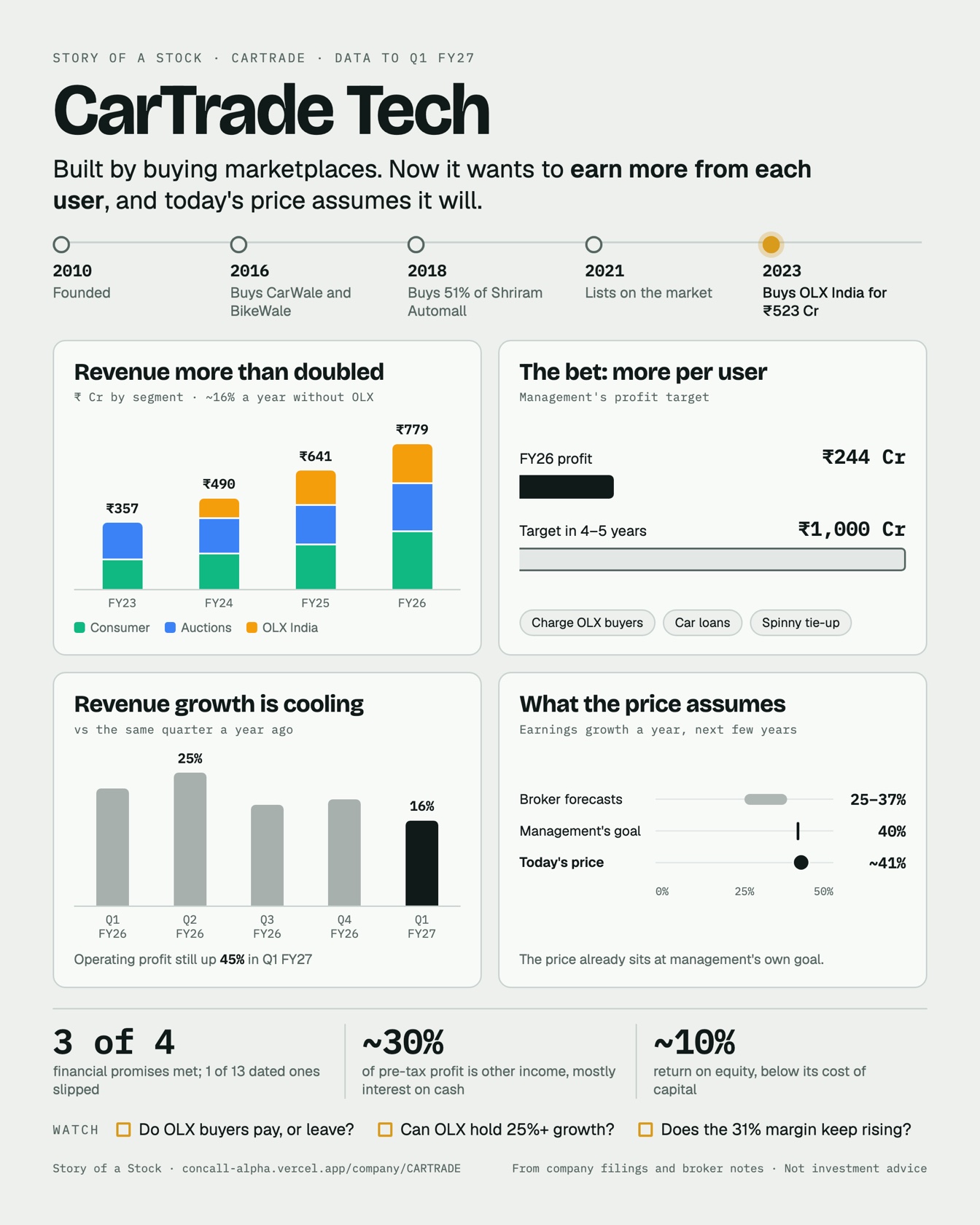
That's the whole CarTrade story on one page. Below is the same thing in words, built from every concall transcript and investor deck the company has published since Q2 FY24, plus a handful of broker notes.
How it got here
CarTrade started in 2010 as an online car marketplace and grew by buying bigger businesses: CarWale and BikeWale in 2016, 51% of Shriram Automall (vehicle auctions) in 2018, a stock market listing in 2021, and then OLX India in August 2023 for ₹523 Cr.
OLX was the turning point. Revenue went from ₹357 Cr in FY23 to ₹779 Cr in FY26. Costs grew far more slowly, so the operating margin went from 24% in FY25 to 33% in FY26. Without OLX, the older businesses grew about 16% a year.
What it owns today
- Consumer, 40% of FY26 revenue. CarWale and BikeWale, where people research cars. Car makers pay about 70% of this revenue and dealers about 30%.
- Auctions, 33%. Shriram Automall, about 55% owned, which sells vehicles for banks, lenders and owners.
- OLX India, 28%. Used goods of every kind, with about 63% of India's used-car listing value.
Almost all of the traffic is free: 92–100% of visitors arrive without paid ads.
The bet
Management's plan is to earn more from the users it already has, rather than pay to find new ones:
- charge OLX buyers for the first time (Elite Buyer)
- sell premium plans to sellers and verify listings
- add car loans with IDFC FIRST and a used-car retail tie-up with Spinny
The targets are ₹1,000 Cr of profit in 4–5 years, about four times FY26's ₹244 Cr, and a "40-40" goal: 40% profit growth a year with margins above 40%.
The record so far
Management has mostly done what it said it would. Of the four financial promises that have played out, three were met, and only one of 13 dated promises slipped.
The miss is worth knowing. OLX growth was meant to speed up in Q4 FY26. A new product launched 45 days late and growth slowed to 16% instead. It jumped to 29% the next quarter, but against a weak quarter a year earlier.
Right now
Revenue growth is cooling: 25% in Q2 FY26, 16% in Q1 FY27. Consumer visitors grew 7% and vehicles sold at auction were about flat. Operating profit still rose 45%, because each user and each vehicle is earning more. That is the bet starting to show in the numbers.
The fine print
- About 30% of pre-tax profit is other income, mostly interest on ₹1,321 Cr of cash.
- The tax rate was 16% in FY26 and is heading to 23–24% as OLX's old losses run out.
- Return on equity is about 10%, which management agrees is below its cost of capital, because of that cash.
- The edge is OLX's buyer–seller network, not brand or lock-in. The risks are AI search answering car questions directly, and Facebook Marketplace.
What the price assumes
Our valuation section asks what growth today's price already assumes. For CarTrade the answer is about 41% earnings growth a year over the next few years. Management's own goal is 40%. The broker forecasts I have range from about 25% to 37%.
What I'm watching
- Do OLX's business buyers pay, or leave, as charging rolls out over the coming months?
- Can OLX keep growing 25% or more once it's up against a normal quarter?
- Does the 31% margin from Q1 FY27 keep rising through the year, as management guides?
The full read, including every guidance thread and the sources behind it, is on the CarTrade page.
This is a summary of what CarTrade's filings and a few broker notes say. It is not investment advice or research.