Bondada Engineering: The builder wants to be a landlord. First it has to finish the houses it sold
Pranav Yadav · · 6 min read
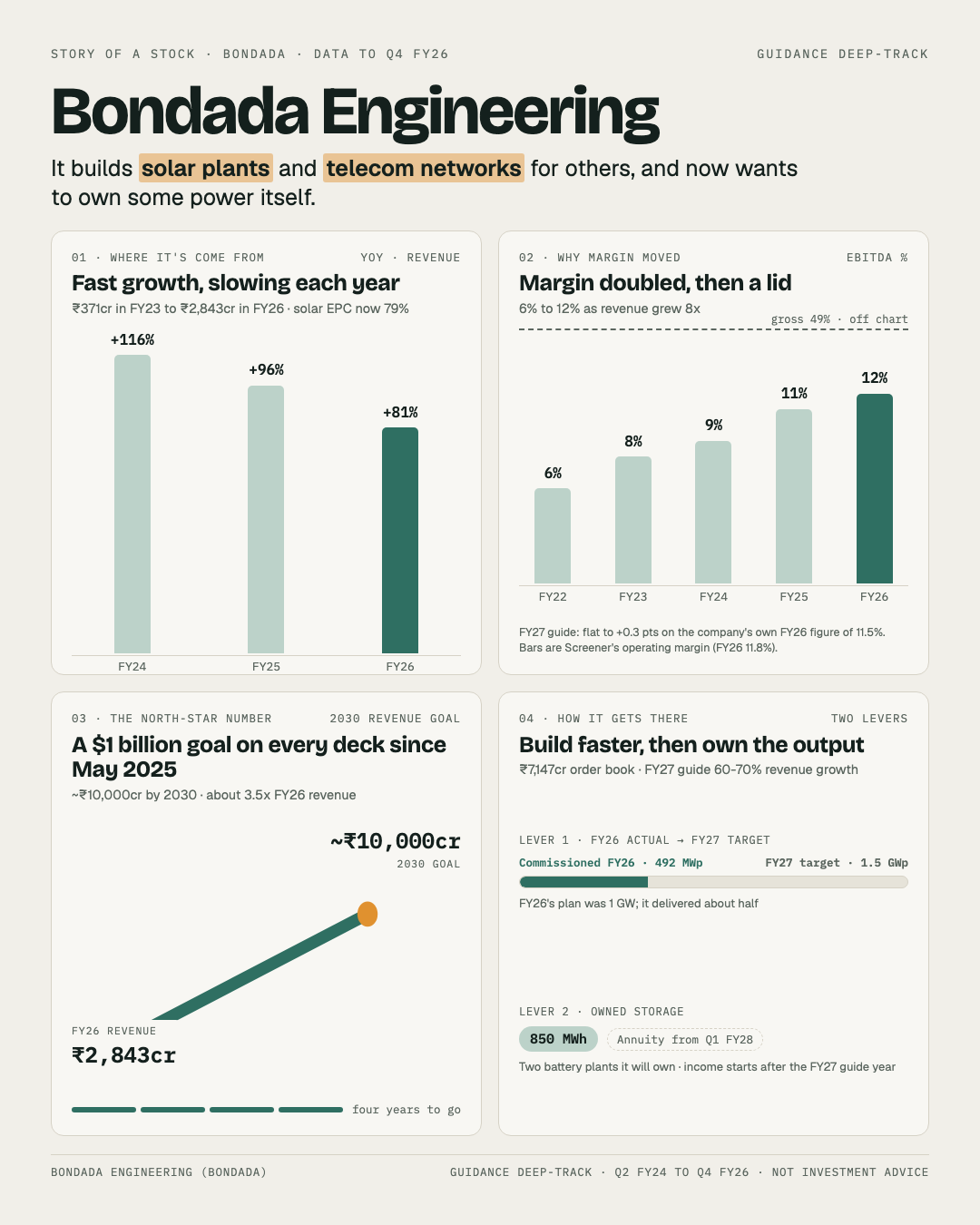
That's the Bondada Engineering story on one page. Below is the same thing in words, built from three earnings calls, a written investor-meeting summary, twelve investor decks and the FY26 annual report, Q2 FY24 to Q4 FY26. Bondada joined our coverage on 28 September, so this is a first read, not an update.
A builder gets paid when the house is finished and handed over. The margin is thin, the next job has to be won again, and the builder carries the cost of every half-built house in between. A landlord earns rent every month for years, but first has to own the building.
Bondada Engineering, in Hyderabad, is a builder. It puts up solar plants for state power companies, NTPC and Adani, and it builds and maintains telecom towers and fibre for Jio, Airtel and BSNL. Renewables were 79% of FY26 revenue, up from 28% two years earlier.
Now it wants to be a landlord: to own 850 MWh of battery storage and a 2 GW solar park of its own, and collect rent on them. Before any of that pays, it has a ₹7,147 Cr order book of houses to finish.
The central takeaway
The growth is real and the promises ran ahead of it. Revenue more than tripled in two years, yet management met only 1 of the 4 financial guides that have closed. Dates held better: 6 slips across 26 dated promises.
The debate is no longer whether Bondada can win orders. It is whether it can finish them fast enough, and turn the finished work into cash, to pay for the buildings it wants to own.
At a glance
- Revenue: ₹801 Cr in FY24, ₹1,571 Cr in FY25 and ₹2,843 Cr in FY26, up 96% and then 81%.
- The record: 1 of 4 closed financial guides met; both yearly revenue guides missed.
- Margin: EBITDA margin of 11.5% in FY26, up 62 basis points, in line with its guide.
- Orders: ₹7,147 Cr at 31 March 2026, against a guide of ₹8,000-9,000 Cr.
- The build rate: 492 MWp commissioned in FY26 against a 1 GW plan; 1.5 GWp targeted for FY27.
- Cash: operating cash flow of minus ₹141 Cr in FY25 and plus ₹125 Cr in FY26.
Where this lives on the portal: the Bondada Engineering guidance page.
1. Revenue more than tripled, but each year landed below the guide
In May 2024 the CFO wrote that FY25 would sustain or beat FY24's 117% growth. FY25 grew 96%. In May 2025 management said FY26 would repeat that growth, and the September 2025 AGM deck raised it to doubling. FY26 grew 81%.
The margin guide held. Management asked for a flat to slightly higher EBITDA margin in FY26, and it rose from 10.9% to 11.5%. A products-business guide of 35-40% growth did not: products shrank from 14% of revenue to 7%.
So the base is large and growing fast, but the guide has run a year ahead of the houses each time. The FY27 guide of 60-70% is the first one set below the growth just delivered.
2. It wins tenders on price, so there is no moat to lean on
Almost all of Bondada's work comes through tenders from state utilities, NTPC and large developers. On the Q4 FY26 call management said it lost an NTPC tender because "of our pricing actually we were not L1", and that it stays out of reverse auctions past a certain point.
That is a builder's market: the client picks the lowest credible bid, and the builder earns on execution. The Jio maintenance contract, about 70% of services revenue in FY25, earned 5-8%. We call the moat none, and the tier weak.
3. Build speed is the whole FY27 plan
The FY27 guide rests on one number: commissioning. Bondada commissioned about 1.3 GWp in total up to March 2026, 492 MWp of it in FY26, against the 1 GW management planned for that year. For FY27 it targets 1.5 GWp, three times what it just delivered.
The orders are there. Adani's 650 MW order was about 20% done in April, with commissioning now put at March 2027, around five months later than the contract implied. The builder has houses sold. It has to finish them at three times last year's pace.
4. Profit has been slow to turn into cash
Between FY23 and FY26 Bondada reported ₹388 Cr of profit and about minus ₹4 Cr of operating cash flow. FY26 turned positive at ₹125 Cr, but the annual report shows other payables jumping from nil to ₹346 Cr in the same year, alongside a supplier-payment facility started in Q4.
Contingent liabilities are 64% of net worth, almost all of them bank guarantees on projects under construction. That is a builder's normal exposure, not litigation, but it grows with every house.
The landlord plan needs capital on top of this. The first 250 MW of the Andhra Pradesh park needs about ₹250 Cr of equity, and management has said it would dilute to fund it. The battery plants start earning rent only from Q1 FY28.
5. What the price already assumes
At ₹272 the shares trade at about 14 times earnings, against a median of about 42 since listing in September 2023. A reverse DCF puts the earnings growth the price implies at about 3% a year over the next two years, if all of profit became cash.
Our own cases, built on management's guide, put earnings growth at about 24-34% a year in the low case, 39-48% in the base case and 48-54% in the high case. The implied 3% sits far below all three. Because Bondada's cash conversion has been poor, the valuation read is held at the middle of the range until the accounts show the cash.
What would make me wrong
- Commissioning reaches 1.5 GWp in FY27, the ₹2,850 Cr of orders it was lowest bidder on converts on time, and the 60-70% guide lands.
- FY27 operating cash flow stays positive without another jump in payables, and the payables facility turns out to be timing, not funding.
- The battery plants go live on schedule, the Tamil Nadu one by 31 December 2026, and the rent starts arriving in FY28.
The opposite error would be to read three years of fast growth as proof the plan will land, when both yearly revenue guides missed and the cash has lagged the profit.
The one question that matters
How fast can Bondada commission? It did 492 MWp in FY26, and management wants 1.5 GWp in FY27 and the 7.8 GW portfolio built over two to two-and-a-half years.
What I'll be watching
- H1 FY27 commissioning against the 1.5 GWp target, and whether Adani's 650 MW finishes by March 2027.
- Operating cash flow and other payables in the H1 FY27 results.
- Whether the Tamil Nadu battery plant goes live by 31 December 2026, and what equity the solar park needs next.
Final assessment
Bondada has the orders, a margin that held, and a growth record most companies would want. What it has not shown is that its guides can be taken at face value, or that its profit arrives as cash. The price assumes little growth; the plan assumes a great deal.
The full read, with every guide and its trail, is on the Bondada Engineering company page.
The builder has sold more houses than it has ever built. It becomes a landlord only after it hands them over, and gets paid.
This is a summary of what Bondada Engineering's filings and earnings calls say. It is not investment advice or research.