Bhagyanagar India: It keeps five paise of every copper rupee. The shop is moving to a new name
Pranav Yadav · · 9 min read
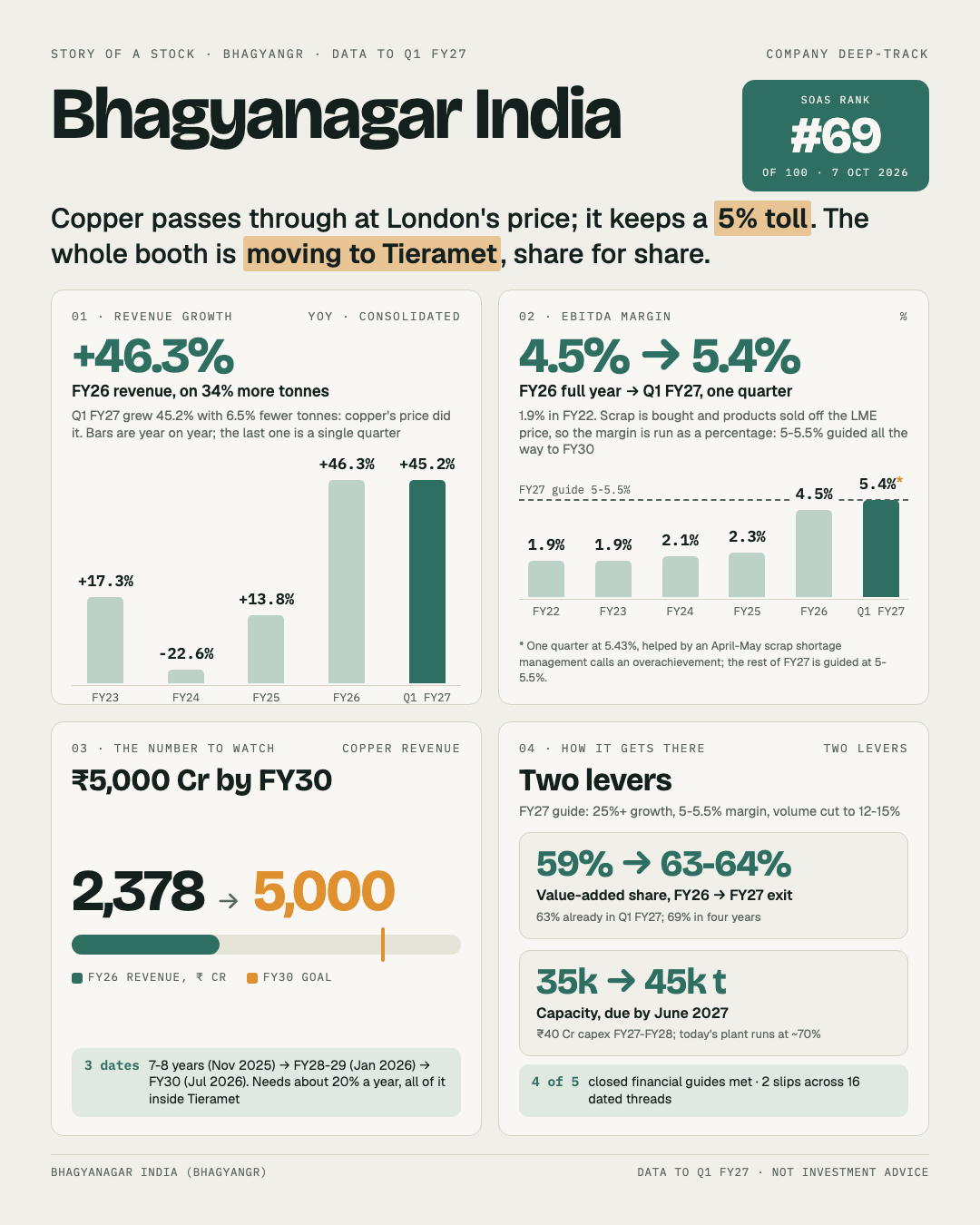
That's the Bhagyanagar India story on one page. Below is the same story in words, built from four earnings calls (Q2 FY26 to Q1 FY27), four investor decks and the FY25 and FY26 annual reports. No broker covers the company.
Picture a commission agent at a metal market. Every kilo of copper that crosses his scale, he keeps five paise of each rupee it is worth. He never sets the price; that is fixed in London each morning. When copper gets dearer he earns more per kilo for the same work, and when fewer kilos cross the scale he earns less, whatever the price.
Bhagyanagar India is that agent. It buys copper scrap at 86-95% of the LME price, melts it into bus bars, strips and wire, and sells at an LME-linked price plus a margin it manages as a percentage. In FY26 copper rose, the kilos rose too, and the five paise became ₹43 a kilo. In the latest quarter the kilos fell and the price did all the work.
And the agent is packing up. The whole copper business is being lifted into a new listed company, Tieramet, share for share. What stays behind under the Bhagyanagar name is a windmill and three plots of land.
Where this lives on the portal: the Bhagyanagar India company page.
1. What Bhagyanagar makes
Scrap in, five product lines out
Bhagyanagar buys copper scrap from more than 30 countries and processes it at two Hyderabad units with 35,000 tonnes a year of capacity. Out come bus bars (31% of Q1 FY27 revenue), parts for auto-electrical and switchgear makers (16%), enamelled wire and transformer conductors (12%), plain rods and ingots (37%) and by-products (3%). The first three are value-added; the rods are commodity.
Where the five paise come from
The customers are 500-plus OEMs, mostly in southern India; exports were 10% of FY26 product sales and 18% of Q1 FY27's, most of it commodity. Value-added products earn 6-12% EBITDA, with data-centre bus bars at about 10%; commodity earns about 2-2.5%. The blend, at 63% value-added, is the 5% margin management guides, and because both scrap and sales are priced off the LME, a 20% move in copper moves EBITDA per kilo by 20% with nothing changing in the business.
2. How it got here
Forty years in Hyderabad
The company was incorporated in 1985 by G.M. Surana. Finnish continuous-cast rod equipment took it to 10,000 tonnes in 1988. The step management calls the game changer was 2014-2017, when it built a scrap-recycling plant on 60 acres at Toopran and reached 25,000 tonnes. Capacity went from 30,000 to 35,000 tonnes in FY26, the year the silver-plated data-centre bus bar was launched.
The scheme that moves the shop
The copper business does not sit in the listed company. It sits in a wholly owned subsidiary, and the listed entity on its own is a 9 MW windmill. A Composite Scheme of Arrangement merges the subsidiary into the parent, then demerges the whole copper undertaking into Tieramet Limited, to be listed with an identical shareholding, 1:1.
The NCLT hearing was set for 9 June 2026, then listed for 7 August, and the FY26 annual report of 27 August says the order is reserved. Third-party trackers report a sanction order dated 7 September; it is not in the issuer filings we hold, so this page treats the order as reserved.
3. How the numbers have moved
Four thin years, then one fat one
Revenue went ₹1,574 Cr in FY22, ₹1,847 Cr, ₹1,429 Cr, ₹1,626 Cr, then ₹2,378 Cr in FY26, up 46%. The operating margin sat at 1.9-2.3% for four years and reached 4.5% in FY26; return on capital was 8-9% in each of FY22 to FY25 and 20% in FY26.
FY24's ₹46 Cr profit was mostly a ₹43 Cr gain on assets sold. FY26's jump was the real business: 34% more tonnes, the value-added share of volume up from 54% to 59%, and EBITDA per kilo from ₹20 to ₹43. Profit was ₹50 Cr.
Profit grows; cash lags by design
Copper sits in stock at cost and OEMs get credit, so working capital grows with every kilo. Operating cash flow was negative in three of the five years to FY26; FY26's ₹59 Cr against ₹50 Cr of profit was the first clean year in a while. Working capital rose from ₹157 Cr to ₹230 Cr and borrowings stood at ₹259 Cr, about ₹37 Cr of it from the Surana family and its companies.
The FY26 audit opinion is clean, with one emphasis of matter: a ₹103 Cr GST demand on the copper subsidiary, contested and not provided for, which takes contingent liabilities to 41.8% of net worth. Promoter shares pledged during FY26 were released by August.
No moat, in management's words
Our moat call is no moat. The lock-in is real but relational: OEMs that have bought every month for about 35 years, approvals a switch would need to repeat. None of it is contracted. Management "won't say that the entry barriers are too high" and calls the work "not rocket science".
4. The last few quarters
Each kilo earns more, and there are fewer kilos
EBITDA per kilo has risen for five quarters running, from ₹28.68 in Q1 FY26 to ₹72.55 in Q1 FY27, with the margin going from 3.33% to 5.43%. Part of that is mix and operating leverage; the rest is a higher copper price passing through a near-fixed percentage. Management called the 5.43% an overachievement, helped by an April-May scrap shortage, and guides 5-5.5% for the rest of the year.
Tonnes went the other way. Volume has fallen three quarters running to 5,278 t, down 9.5% on the quarter and 6.5% on a year earlier, after Gulf shipping diversions held up scrap in April and May. Revenue still rose 45%, on realisation of ₹1,279 a kilo, 51% higher than a year before.
The mix is already at this year's target
Value-added products were 52% of sales in Q1 FY26 and 63% in Q1 FY27, inside the 63-64% band set for the FY27 exit. The fast part of the shift is over, by management's own account.
5. Where growth comes from next
The FY27 book
Revenue growth of at least 25% at a 5-5.5% EBITDA margin. In May the 25% was split as 20% volume and 5% price; in July, after the lost tonnes, volume was cut to 12-15% and the price leg put at about 30%. That volume needs about 6,900-7,100 tonnes a quarter against 5,278 t in Q1.
Two levers and a bigger plant
The first lever is mix, from 59% of FY26 volume to 63-64% at the FY27 exit and 69% in about four years. The second is capacity, from 35,000 to 45,000 tonnes by June 2027 on ₹40 Cr of capex. Behind both sits the number management keeps restating: ₹5,000 Cr of copper revenue by FY30, which needs about 20% a year from ₹2,378 Cr.
The cases, and what growth costs
Our base case has revenue growing above 22% a year over two years and earnings above 29% as the margin moves from 4.46% to the guided band; the bull case is revenue above 30% and earnings above 38%; the bear case is revenue under 12% and earnings about 24%. Two-thirds of the base case's FY27 growth is copper's price, not tonnes.
The cash cycle was 66 days at March 2026 and is expected to hold, so more tonnes at a higher copper price means more capital tied up. A ₹52.25 Cr preferential issue went mostly to working capital; the next tranche is to happen in Tieramet, not here.
6. What management promised, and what it delivered
The record is one year of calls, and so far credible: 4 of 5 closed financial guides met or beaten. FY26 revenue growth was guided at 35-40% and came in at 46%; the FY26 margin was guided at 4-4.5% and landed at 4.46%; the Q1 FY27 margin was guided at 5% and printed 5.43%.
The miss was Q1 FY27 volume. In May management said tonnes would be "much, much higher" than Q1 FY26's 5,646 t; they came in at 5,278 t, 6.5% lower, and the volume guide was cut from 20% to 12-15% on the next call.
Dates have mostly held, with 2 slips across 16 dated commitments: the NCLT hearing moved two months and a land joint venture was re-dated. The ₹5,000 Cr goal has been re-dated three times in nine months, from "7 to 8 years" in November 2025 to FY30 by July. Set against FY26, the forward book is conservative: 25% growth after 46%, volume 12-15% after 34%, a margin band Q1 FY27 already printed.
7. What the price already assumes
At ₹454 on 7 October, the price implies about 55% a year of near-term earnings growth. Our cases run 24% in the bear case, 29% in the base and 38% in the bull, so the price sits above all three. EV/EBITDA is 13.6 against a five-year upper quartile of 12.0, and price to book is 5.6 against a five-year median of 1.4, on earnings above the company's normal level.
The price is also paying for a business that is leaving the ticker. Every growth number on this page belongs to the copper undertaking that the Scheme moves into Tieramet, 1:1, on sanction; a shareholder today gets the same shares in Tieramet and keeps the Bhagyanagar shares, which will then hold a windmill and three plots of land.
What would make me wrong
- Copper may keep rising. At a 5% toll, every rise in the LME price lifts EBITDA per kilo with no extra work.
- The June run-rate may be the real one. 2,200 t in a month annualises above the cut 12-15% guide; a Q2 near 7,000 t would make the Q1 miss a Gulf story, not a demand story.
- The mix could run past the guide. Data-centre bus bars at about 10% margins were roughly 600 tonnes in Q1 FY27, and 35-year monthly buyers may be worth more than a no-moat call allows.
The opposite error would be to read ₹72.55 a kilo as the business getting better by that much. Most of that number is copper's price, and it can go the other way.
The full read is on the Bhagyanagar India company page.
Five paise on every rupee is a fine living while the rupee gets dearer and the sacks keep coming. The sacks slowed last quarter, and the agent is moving to a new shop with a new name.
This is a summary of what Bhagyanagar India's filings, earnings calls and annual reports say. It is not investment advice or research.