Azad Engineering: A workshop for every client, and nobody pays before the fitting
Pranav Yadav · · 7 min read
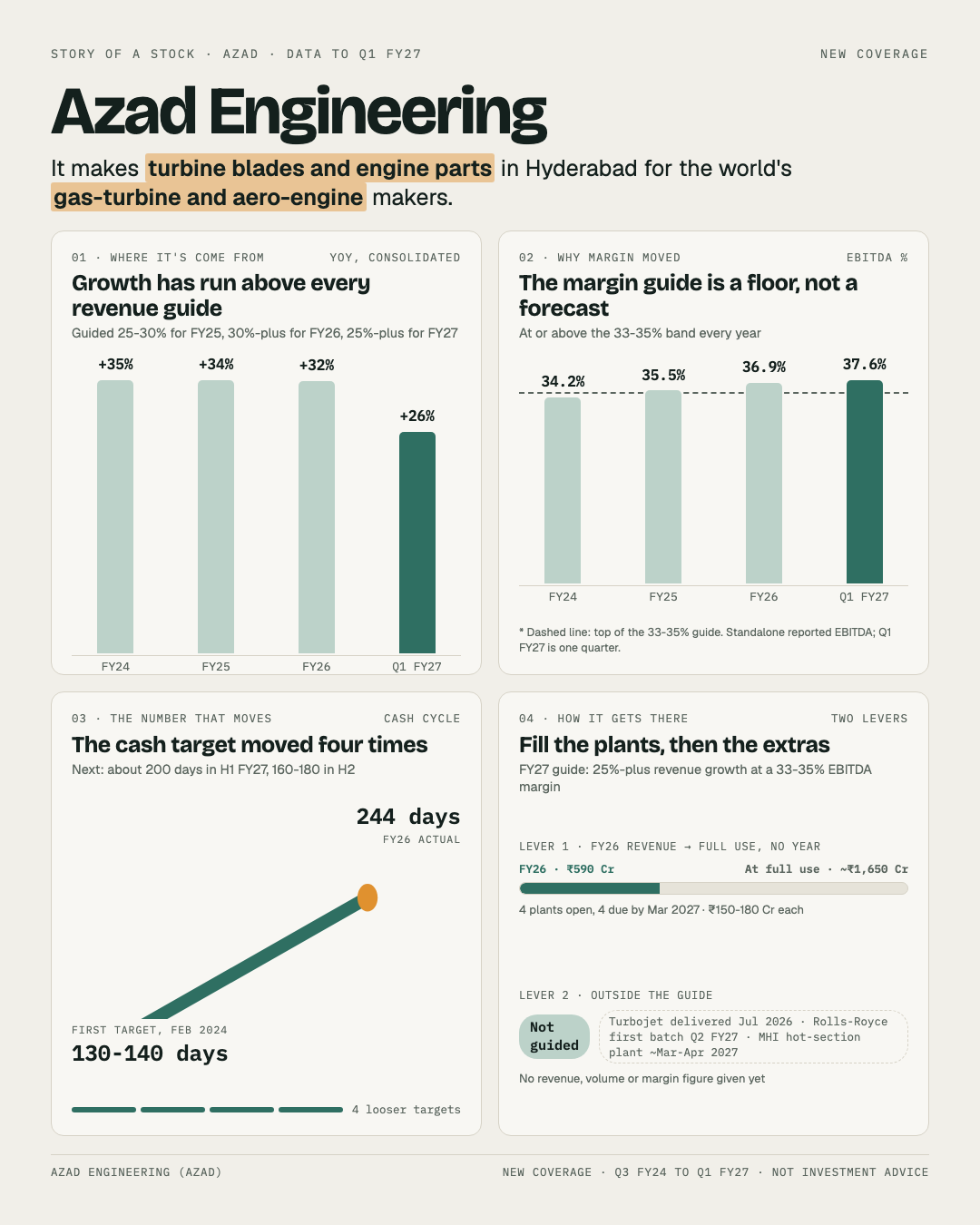
That's the Azad Engineering story on one page. Below is the same thing in words, built from ten earnings calls and eleven investor decks, Q3 FY24 to Q1 FY27, and the FY26 annual report. Azad joined our coverage today, so this is a first read, not an update.
A made-to-measure tailor works differently from a shop. Each client gets their own pattern, often their own cutting table. Nothing is paid for until the client comes in for the fitting and signs off. And the cloth for next season's suits sits on the shelves long before any of it is sold.
Azad Engineering, in Hyderabad, is that tailor for the world's turbine makers. It machines turbine blades and critical engine parts for GE Vernova, Siemens Energy, Mitsubishi Heavy Industries and Baker Hughes, and for Rolls-Royce, Honeywell and Pratt & Whitney Canada in aerospace. Exports were 93% of FY26 revenue.
It is building eight plants on one campus, each dedicated to a single customer. Four are open and four are due by March 2027.
The central takeaway
The record is mixed. Management met 9 of the 12 financial guides that have closed, and every company-level revenue and margin guide landed. The dates are another matter: they slipped 12 times across 9 of 20 dated promises, and the cash cycle target has been loosened four times.
The debate is no longer whether the orders exist. It is whether the fittings clear fast enough to turn the cloth on the shelves into cash.
At a glance
- FY26 delivered: revenue of ₹603 Cr consolidated, up 32% (₹590 Cr standalone, up 30.3%).
- Margin: EBITDA margin of 35.5% in FY25, 36.9% in FY26 and 37.6% in Q1 FY27, against a 33-35% band.
- Orders: an order book of about ₹6,500 Cr, a little under 11 times FY26 revenue.
- The plants: four dedicated plants open, four due by March 2027, each worth ₹150-180 Cr a year at full use.
- The FY27 guide: revenue growth of 25%-plus, built only on parts already qualified.
- Cash: working capital of 244 days at the end of FY26, up from 202 a year earlier.
Where this lives on the portal: the Azad Engineering guidance page.
1. The revenue and margin guides have landed every year
In May 2024 management guided 25-30% revenue growth for FY25. It delivered 32.9% on a standalone basis. For FY26 it guided 30%-plus, cut that to 25-30% in August 2025 while calling the year one of stabilisation, and then delivered 30.3%, clearing both.
The margin guide has been a floor rather than a forecast. The band is 33-35%, and the reported margin has sat above its top every year since. Q1 FY27 grew 26.8% at a 37.6% margin, on the 25%-plus guide.
So the base case is banked. What the record does not show is the next step: growth above 30% was first promised for FY26, and the CEO now ties it to FY28.
2. Each part needs its own sign-off, which is both the moat and the delay
A turbine maker does not qualify a supplier once. It qualifies each part, and the company puts that process at 30 to 48 months. Once a part is signed off, moving it elsewhere means doing the fitting all over again. The eight-year, single-source contract Mitsubishi Heavy signed for hot-section nozzle vanes in March 2026 is that lock in writing.
The lock is real but not wide: Azad itself broke in on time, capital and price. Reported return on capital was 9.2% in FY26 as new plants filled, and 15.3% on the company's adjusted basis. We call the moat narrow, and weak within narrow.
Updated 28 September 2026: a second pass raised the moat to narrow, middle tier. The IPO and QIP reset the capital base, so returns since listing are untested rather than weak.
The same sign-off is also why revenue lags the plants. A new line has to be requalified part by part before it bills. The evidence supports a switching cost; it does not yet show the returns that would make it a wide one.
3. Filling eight customer plants is the whole plan, and half are still being built
On the company's own arithmetic, the old plants can do about ₹450 Cr of revenue. The eight new plants add about ₹1,200 Cr at full use. FY26 revenue was ₹590 Cr standalone, so the tailor is working at a little over a third of the space it is building.
Management puts no year on full use; it expects a larger step up from the second half of FY27 and maximum use from FY28. The ₹6,500 Cr order book shows the clients exist: signed long-term contracts, net of the ₹600 Cr delivered in FY26.
Three things sit outside the 25%-plus guide: the turbojet engine delivered to DRDO in July 2026, Rolls-Royce parts, and the new Mitsubishi hot-section line. None has a revenue figure yet.
4. The dates and the cash cycle are where the record slips
The misses cluster in two places: timing, and cash. The turbojet was first due in the first half of FY26 and arrived in July 2026, after three re-dates. Rolls-Royce revenue was guided from FY25, then FY26, then FY27. Plant utilisation was meant to reach 70%-plus by the end of FY26 and is now a FY28 story.
Then the cloth on the shelves. In February 2024 the cash conversion target was 130-140 days. It became 140-150, then 170-180 by the end of FY26. FY26 closed at 244 days, operating cash flow was negative ₹123 Cr, and inventory rose from ₹133 Cr to ₹327 Cr in two years. The new target is about 200 days in the first half of FY27 and 160-180 in the second, partly by discounting export bills.
Three segment guides also missed: energy in FY25, and aerospace and oil and gas in FY26. The company-level numbers held anyway, because another segment made up the gap each year: aerospace nearly doubled in FY25, and energy grew 34% in FY26.
5. What the price already assumes
At ₹2,720 the shares trade at about 124 times earnings, against a median of about 102 since listing in December 2023. A reverse DCF puts the growth the price implies at about 60% a year in earnings over the next two years.
Our own cases, built on management's guide, run from a low case of about 14% a year, through a base case of about 24%, to a high case of about 29%. The implied 60% sits above all three, by roughly double the high case. The price carries the plants at full use and the engine programmes on top.
What would make me wrong
- The four new plants ramp faster than guided, and the second half of FY27 shows the step up above 30% a year ahead of FY28.
- The turbojet or Rolls-Royce turns into a volume order with a number attached, adding growth the 25%-plus guide leaves out.
- Working capital falls to the 160-180 day target by March 2027, and operating cash flow turns clearly positive.
The opposite error would be to read the strong revenue record as proof the dates will hold, when the dates are exactly where this company has slipped.
The one question that matters
When do the new plants bill at scale? Today Azad does about ₹590 Cr of revenue against about ₹1,650 Cr of capacity at full use, and management points to the second half of FY27 for the first real step.
What I'll be watching
- Revenue growth in Q3 and Q4 FY27 against the 25%-plus guide, and whether it moves above 30%.
- Working-capital days in the first half of FY27 against the target of about 200.
- Whether the next four plants open by March 2027, and when Rolls-Royce ships its first qualification batch.
Final assessment
Azad has the clients, the contracts and a margin that has held above its band. What it has not shown is that it can keep a date or bring its cash cycle in, and the price assumes both.
The full read, with every guide and its trail, is on the Azad Engineering company page.
The tailor has the orders and the workshops. The suits still have to pass the fitting before the cloth on the shelves turns into cash.
This is a summary of what Azad Engineering's filings and earnings calls say. It is not investment advice or research.