Ather Energy: A queue out the door, and the kitchen already full
Pranav Yadav · · 8 min read
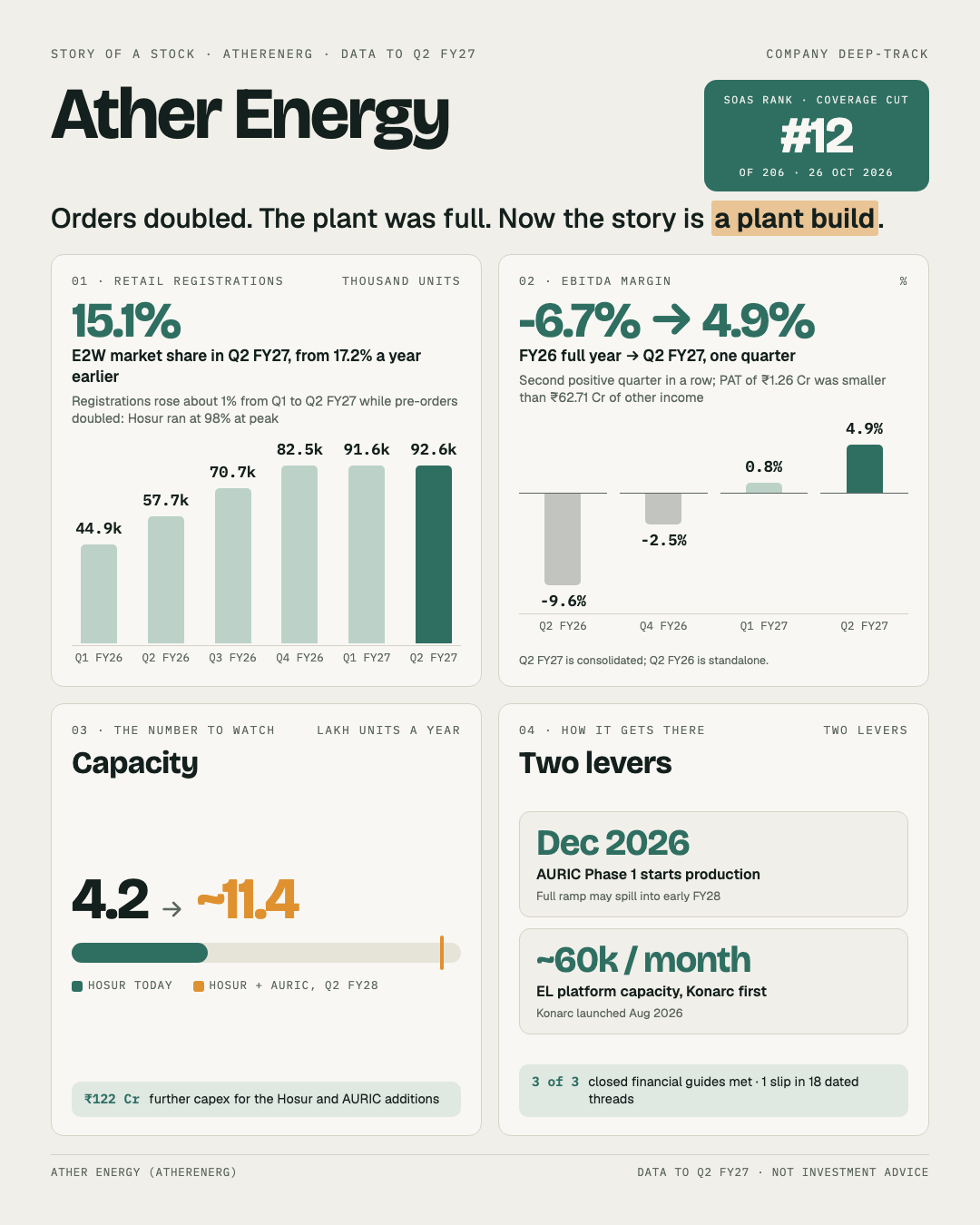
That's the Ather Energy story on one page. Below is the same story in words, built from six quarters of calls and decks, the FY26 annual report and the Q2 FY27 results filings.
Picture a restaurant with a queue out the door. The menu is priced above the street's average, diners keep coming back, and most of them order the extras. But the kitchen is already cooking as fast as it can, so part of the queue gives up and walks to the place next door.
That is Ather in October 2026. Paid pre-orders more than doubled to 1.80 lakh in Q2 FY27, while its only plant, at Hosur, ran at 98% at peak. Registrations barely moved, and its share of India's electric scooter market slipped to 15.1% from 17.2% a year earlier. The rivals next door took the diners Ather could not serve.
So the owner is building a second kitchen, and a bigger first one. And the restaurant has only just started covering its costs: in Q2 FY27 the business earned less after tax than its other income.
Where this lives on the portal: the Ather Energy company page.
1. What Ather Energy makes
Scooters, and the extras sold with them
Ather designs and builds electric scooters: the 450 series, the Rizta, and since August 2026 the Konarc, the first model on its new EL platform. It sells them through 700 dealer-run experience centres in India, Nepal and Sri Lanka. It builds its own battery packs and electronics at Hosur, runs a fast-charging network of over 6,000 points, and had filed 643 patents by March 2026.
The extras are the faster-growing part
Vehicle sales were 87% of FY26 revenue. The rest is non-vehicle revenue: the AtherStack Pro software pack, charging, accessories, spares and service. That share has climbed every year, from 10% in FY24 to 13% in FY26 and 15% in Q2 FY27, when 94% of buyers took AtherStack Pro. Ather does not disclose a margin for either line; its adjusted gross margin was 24% in FY26 and again in Q2 FY27.
A crowded street
Ather sells into a market where TVS Motor, Bajaj Auto, Hero's Vida and Ola Electric all offer scooters in its price bands. The moat review found no source of protection: no cost lead, no switching cost a rider faces, and a charging grid opened to other makers. The call is no moat.
2. How it got here
Twelve years from Bengaluru to a listing
Ather was incorporated in Bengaluru in 2013. It listed on 6 May 2025 after an IPO with a fresh issue of ₹2,626 Cr, unveiled the cheaper EL platform at its Community Day in 2025, and rolled out its 5,00,000th scooter from Hosur in October 2025.
The restaurant opened new rooms in new towns
The store count doubled through FY26, from 351 to 700, and the expansion leaned away from the South. Of the 700, 295 are in South India, 236 in Middle India and 169 in the rest of the country. Middle India market share rose from 9.5% in Q4 FY25 to 17.3% in Q4 FY26.
3. How the numbers have moved
Sales grew ninefold, and losses grew with them at first
Revenue went from ₹408 Cr in FY22 to ₹1,781 Cr in FY23, ₹2,255 Cr in FY25 and ₹3,672 Cr in FY26. FY26 volumes were 2,62,942 scooters, up 69%, though revenue per scooter fell 5% to ₹1,21,386. The company lost money every year on record: ₹1,060 Cr in FY24, ₹812 Cr in FY25 and ₹517 Cr in FY26.
Losses narrowed as volume outgrew fixed costs
The EBITDA margin moved from -36.3% in FY24 to -23% in FY25 and -6.7% in FY26, as volume outgrew fixed costs. The net loss shrank by more than that, because interest on IPO money parked in fixed deposits lifted other income to ₹146 Cr, which sits below the EBITDA line.
Returns are still negative, and the base is bigger
Return on capital was -20% in FY26 against -66% in FY25. A bigger equity base after the IPO did some of that work, as a denominator rather than a profit. Operating cash turned slightly positive, ₹32 Cr in FY26, from tighter working capital rather than from earnings: dealers and suppliers fund the business, with working capital at -36 days in Q2 FY27. The FY26 audit opinion was unmodified.
4. The last few quarters
The kitchen turned a profit, just
EBITDA turned positive in Q1 FY27 at 0.8% and reached ₹74.2 Cr, a 4.9% margin, in Q2 FY27, against -9.6% a year earlier. Revenue from operations was ₹1,464 Cr, up 63% on a year-ago figure that was standalone. Volumes were 93,211 units, up 42%. Profit after tax was ₹1.26 Cr, well short of the quarter's ₹62.71 Cr of other income.
The queue doubled, the plates did not
Enquiries averaged 3.34 lakh a month in Q2 FY27 against 1.60 lakh a year earlier, and pre-orders 60,000 a month against 30,000. Production averaged 33,000 a month. Registrations rose about 1% from Q1 to Q2 FY27, from 91,635 to 92,589, while the industry posted a record quarter. Ather's own deck charts an unrealised retail gap of 18,000 to 20,000 scooters a month.
Price held even as costs rose
Revenue per scooter rose to ₹1,33,507 from ₹1,20,183 a year earlier, on price rises and a richer mix. That kept the adjusted gross margin at 24% while aluminium, copper and plastics costs climbed.
5. Where growth comes from next
A second kitchen, and a bigger first one
Hosur goes from 4.2 lakh to 4.95 lakh units a year by December 2026. A new plant at AURIC, near Chhatrapati Sambhajinagar, starts production in phases from December 2026, with Phase 1 enlarged to 6.5 lakh units. Combined capacity reaches about 11.4 lakh units a year by Q2 FY28, for about ₹122 Cr of further capex.
A cheaper dish on the menu
The EL platform is a common chassis, powertrain and electronics base built for lower cost, which management calls a step change in cost structure. It sized EL capacity at about 60,000 units a month across both plants. No EL volume or margin has been disclosed yet, and a cheaper scooter may pull revenue per vehicle down.
What it costs to build
Ather raised ₹1,300 Cr through a QIP and ₹200 Cr through preferential shares in Q2 FY27, and issued ₹1,000 Cr of warrants, of which ₹250 Cr has been received. The ₹122 Cr of capex is to come from debt and internal accruals; the larger cost of growth so far has been new shares.
The cases
Ather gives no revenue guide, so the cases are our estimate from H1 FY27 revenue of ₹2,681 Cr and the capacity path. Revenue grows 44-59% a year over two years in the base case, 59-72% in the bull case and 29-44% in the bear case, at flat margins. The one number that decides it is AURIC's ramp.
6. What management promised, and what it delivered
Financial delivery is too young to score: 3 of 3 closed financial guides were met or beaten, below the four we need. The clearest was FY26's exit margin, guided better than -9%; Q4 FY26 came in at -2.5%. Timing has been reliable, with 1 slip across 18 dated commitments.
The slip is the one that matters. In May 2026 the CEO said AURIC's full 42,000 units a month "should be operationalized before end of this FY for sure." In August it became "could spill over into the first few months of FY 2028," which moves the finish from March 2027 into the first months of FY28.
What has held so far: the December 2026 start, the Hosur addition and the EL launch, which arrived in August. Margins carry direction only. Management calls FY27 transformational and gives no number.
7. What the price already assumes
At ₹1,575 on 26 October, a market value of ₹62,309 Cr, Ather trades at 13.0 times sales. That is about 35% above the 9.6 times median of its range since listing, which runs from 6.4 to 15.5 times.
With no full year of profit, there is no earnings growth for the price to imply, so we do not grade it. What the multiple sits beside is the revenue record and the cases: 68% revenue growth over the last twelve months, 27% over three years, and our base case of 44-59% a year. The market is paying more per rupee of sales than it has for most of the stock's listed life, for a kitchen that has not been built yet.
What would make me wrong
- The queue is the moat. If pre-orders hold near 1.80 lakh once capacity arrives, demand is stronger than a no-moat call allows.
- AURIC ramps on the first date. A full ramp by March 2027 would put the bull case in play.
- The extras keep compounding. Non-vehicle revenue at 15% and rising may carry margins further than the scooters do.
The opposite error would be to read a long queue as loyalty. Rivals offer scooters in the same price bands, and the diners who walked next door this year may not walk back.
The full read is on the Ather Energy company page.
The queue is out the door and the second kitchen is half built. Whether the diners are still waiting when it opens is the question the next three quarters answer.
This is a summary of what Ather Energy's filings, earnings calls and annual report say. It is not investment advice or research.